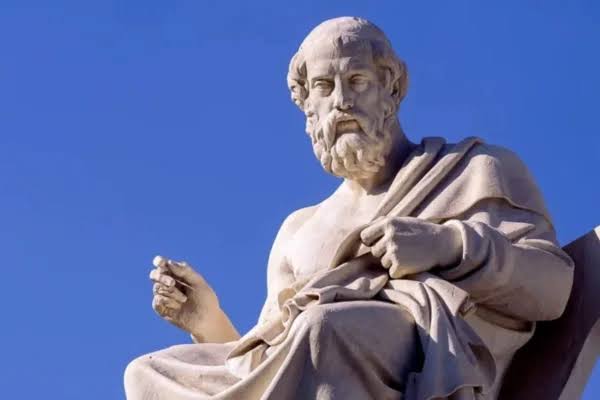
The Third Man Argument challenges Plato’s theory of Forms by questioning how one universal Form relates to the many individual objects that resemble it. If several objects share a Form, the argument suggests that another Form may be necessary to explain their common character. Robert Roecklein examines this criticism and questions whether it accurately represents Plato’s theory.
What Is the Third Man Argument?
The Third Man Argument appears in the first part of Plato’s Parmenides. It examines a fundamental problem concerning the relationship between universal Forms and individual things.
Plato’s theory proposes that many particular objects can share a common characteristic. For example, several people may possess courage, even though they differ in appearance, character, and experience.
The theory of Forms explains this common characteristic through the Form of Courage.
However, Parmenides introduces a difficulty. If individual courageous people resemble the Form of Courage, they share a characteristic that seems to require another explanation.
This reasoning can continue indefinitely. Each new collection of similar things appears to require another universal Form.
Consequently, the argument raises the possibility of an infinite regress.
How Does the Argument Challenge the Theory of Forms?
Consider three brave individuals and the Form of Courage.
The original theory explains their shared characteristic through one universal Form. Yet Parmenides asks whether the Form itself also belongs to the same group of things that possess courage.
If it does, the philosopher may need another Form to explain what the original Form and the individual objects share.
The process can repeat without reaching a final explanation.
This problem becomes known as the Third Man Argument because traditional examples often use the Form of Man.
The central difficulty concerns the relationship between a universal pattern and the particular things that participate in it.
Why Does Roecklein Question the Traditional Interpretation?
Roecklein argues that the criticism depends on an insufficient distinction between two different ways of discussing Forms.
The first concerns Forms as recognizable patterns within ordinary objects. The second concerns Forms as isolated objects of intellectual investigation.
These two approaches have a relationship, but they do not perform the same function.
For example, people recognize courage in particular individuals before they develop a philosophical definition of Courage itself.
The isolated Form requires further intellectual investigation. Nevertheless, the original recognition remains essential.
Roecklein argues that Parmenides’ criticism becomes problematic when it treats these different objects as though they belonged to one undifferentiated category.
What Is the Difference Between a Form as an Image and a Form as an Intellectual Object?
Roecklein makes an important distinction between recognition and definition.
An individual may recognize beautiful things without understanding the philosophical meaning of Beauty.
Similarly, someone may identify just actions without possessing a complete definition of Justice.
The philosopher begins with these familiar examples and gradually examines their common characteristics.
The process involves two stages:
- Recognition: People identify recurring patterns in ordinary objects and actions.
- Definition: Philosophical investigation isolates the relevant Form and examines its essential character.
The second stage requires more rigorous thinking. However, it does not invalidate the first.
In Roecklein’s interpretation, Plato’s theory depends on the connection between ordinary recognition and intellectual definition.
Does the Third Man Argument Disprove Plato’s Theory of Forms?
Roecklein does not accept the idea that the Third Man Argument automatically destroys Plato’s theory.
He argues that the criticism requires a more careful understanding of how Plato distinguishes individual objects, recognizable patterns, and isolated Forms.
The dialogue also investigates whether Parmenides can maintain his own philosophical position without accepting some of the principles he challenges.
This reversal matters because Plato does not simply present Socrates as a defeated philosopher.
Instead, Roecklein reads the dialogue as an examination of Parmenides’ assumptions.
The argument therefore becomes part of a larger investigation into the possibility of coming-into-being and the relationship between unity and multiplicity.
The structure of Plato’s later dialogues is examined in Plato’s Statesman as a philosophical journey. For a scholarly discussion of the Third Man Argument, see the Stanford Encyclopedia of Philosophy entry on Plato’s Parmenides.
Key Takeaways
- The Third Man Argument appears in Plato’s Parmenides.
- It challenges the relationship between universal Forms and individual objects.
- The argument raises the problem of infinite regress.
- Roecklein distinguishes Forms as recognizable patterns from Forms as objects of intellectual investigation.
- He questions whether Parmenides’ criticism adequately represents Plato’s theory.
Source: Robert Roecklein, Plato versus Parmenides: The Debate over Coming-into-Being (2011), Chapter 5, “The Parmenides: Plato’s Proof of Coming to Be,” section “The Third Man.”
Further reading: Plato’s Theaetetus: Knowledge, Perception, and the Unity of Objects
About the Author