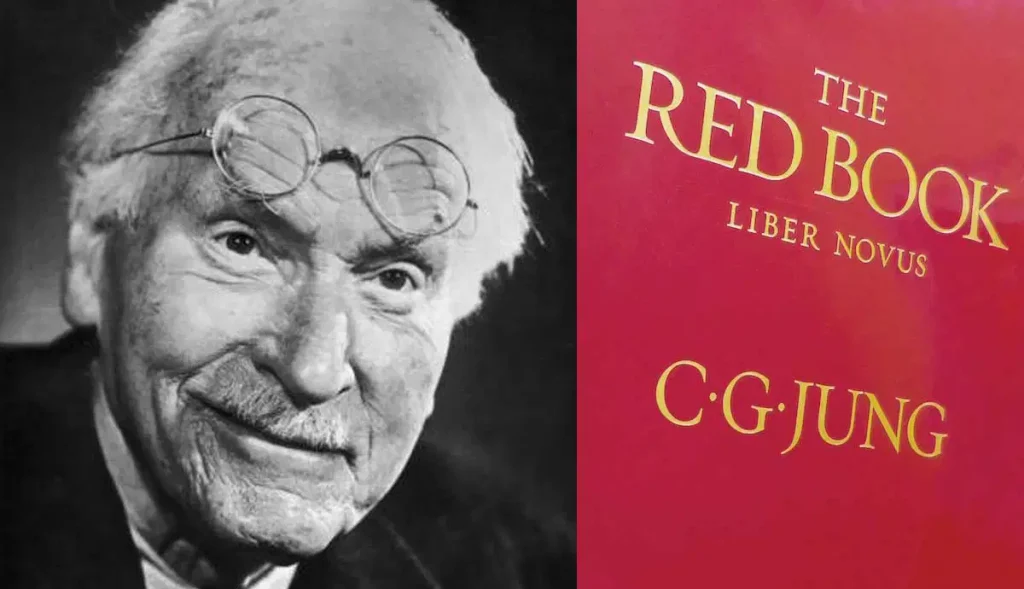
Carl Jung’s Red Book is one of the most extraordinary—and for many years, one of the most closely guarded—works in the history of psychology. The Swiss psychiatrist recorded his intense inner explorations of the unconscious through both words and images, creating a work that occupies an unusual place at the crossroads of psychology, literature, art, mythology, and religious history.
Beginning around 1913, Jung recorded the fantasies and images that emerged from his inner world in notebooks known as the Black Books. He later developed this material into a much more elaborate work entitled Liber Novus, or The New Book. Today, it is widely known as The Red Book. The Philemon Foundation preserves and publishes important material relating to the work and its origins.
Yet The Red Book is far more than a private diary. As Jung explored the depths of his own unconscious, he was also laying the foundations for ideas that would eventually become central to his analytical psychology.
Jung’s Encounter with the Unconscious
Around 1913, Jung began a systematic exploration of the contents of the unconscious. Rather than observing these phenomena solely in his patients, he deliberately turned his attention inward, concentrating on his own fantasies, visions, and inner images.
Jung would later refer to this method as “active imagination.” The Philemon Foundation describes the period from 1912 to 1918 as Jung’s “confrontation with the unconscious.”
This marked an important turning point in his intellectual development. Jung was no longer concerned exclusively with observing unconscious processes in others; he had begun to observe, record, and interpret his own.
Seen in this light, The Red Book can also be read as the record of a prolonged experiment in which a psychiatrist turned the instruments of psychological inquiry upon his own inner world.
How The Red Book Came into Being
Jung first recorded his experiences in notebooks known as the Black Books. These were not conventional diaries. Rather than chronicling the ordinary events of everyday life, they documented the mental states, fantasies, and inner experiences that emerged during his practice of active imagination. The Philemon Foundation makes this distinction particularly clear.
Jung subsequently reworked this material. He prepared handwritten drafts, expanded the texts, and eventually transferred them into a large volume bound in red leather.
According to the Library of Congress, Jung designed the manuscript in a style reminiscent of medieval illuminated manuscripts. He embellished the text with elaborate initial letters, decorative borders, and paintings.
This is what makes The Red Book so distinctive. It is not simply a psychological text. It is also a visual and literary artefact that draws together painting, symbolism, the history of religion, and the traditions of the illuminated manuscript.
What Is “Active Imagination”?
Active imagination is one of the key methods associated with Jungian psychology. Jung sought to establish a conscious relationship between the individual and the images emerging from the unconscious.
Rather than suppressing or dismissing these images, the individual attempts to observe them, engage with them, and explore their possible meanings. Jung regarded this dialogue with the unconscious as an important part of the process.
The Red Book remains one of the most extensive historical records of this approach. The Library of Congress explicitly identifies the work as a product of Jung’s practice of active imagination.
At the same time, active imagination should not simply be equated with a standardized diagnostic or therapeutic technique in contemporary clinical psychology. It is best understood within the particular intellectual framework of Jung’s analytical psychology.
The Red Book Was Not a Diary
One of the most common misconceptions about The Red Book is to describe it simply as a “psychological diary.”
The Black Books are particularly important in correcting this assumption. The Philemon Foundation emphasizes that they contain records of Jung’s personal encounters with the unconscious rather than a conventional account of daily events.
Nor is The Red Book simply a transcription of the Black Books. Jung rewrote, interpreted, reorganized, and substantially expanded the original material.
According to the Philemon Foundation, approximately half of the text of The Red Book derives directly from material recorded in the *Black Books between 1913 and 1916.
Why Did It Remain Hidden for So Long?
After Jung’s death, The Red Book was not immediately made available to the public.
The manuscript remained in the care of Jung’s family and heirs for decades. The Library of Congress reports that after Jung’s death, the manuscript was kept in a bank vault and that its contents remained known only to a limited circle of people close to him.
This long period of secrecy contributed greatly to the aura of mystery surrounding the work.
During Jung’s lifetime, The Red Book never reached a broad academic readership. As a result, a manuscript considered important for understanding the development of analytical psychology remained inaccessible to researchers for many years.
When Was The Red Book Published?
The Red Book was finally published in 2009.
W. W. Norton released the facsimile edition on 7 October 2009. The Library of Congress likewise records the publication of the 205-page illustrated manuscript in 2009.
The publication represented a significant development in Jung scholarship. For the first time, researchers could examine Jung’s own handwriting, his paintings, and the visual record of his encounters with the unconscious in their original form.
- Library of Congress — The Red Book of Carl G. Jung
- Philemon Foundation — C. G. Jung’s Red Book: Liber Novus
The Relationship Between The Red Book and Analytical Psychology
The Red Book is an important source for understanding the development of Jung’s later psychological ideas.
Three concepts are particularly significant:
- Archetypes
- The collective unconscious
- Individuation
The Philemon Foundation notes that Jung’s confrontation with the unconscious played an important role in the development of these fundamental psychological ideas.
Jung eventually came to understand human psychology as something that could not be explained solely through conscious thought. Myths, dreams, symbols, religious traditions, and cultural images also assumed a central place in his intellectual framework.
For this reason, The Red Book can be regarded as an important primary source for understanding the intellectual background of Jung’s theoretical system.
Religion, Mythology, and Symbolism
The Red Book reaches far beyond the boundaries of psychology.
Throughout the work, Jung reflects on religion, mythology, the idea of God, and the nature of symbolism. The Library of Congress notes that the manuscript contains Jung’s reflections on subjects including the relationship between religion and science, representations of God in different periods and cultures, and the workings of human imagination.
In this respect, The Red Book creates a bridge between psychology and cultural history.
Mythological symbols in Jung’s thought are not merely relics left behind by ancient societies. He approaches them as images connected to deeper structures of the human psyche.
The Visual World of The Red Book
One of the most remarkable features of The Red Book is its visual dimension.
Jung did not merely write the text. He created the book as a visual object, filling it with paintings, ornamental details, elaborate lettering, and symbolic imagery. The Library of Congress notes its resemblance to the tradition of medieval illuminated manuscripts.
The work consequently brings together three distinct but interconnected realms:
Psychology + Literature + Visual Art
This convergence allows The Red Book to be understood not simply as an academic or psychological document, but also as a deeply personal and artistic creation.
Its pages occupy an unusual space between manuscript and artwork, between private revelation and intellectual investigation.
“The Holy Grail of the Unconscious”
In popular publications, The Red Book is sometimes described as “the Holy Grail of the unconscious.”
The phrase, however, is not a scientific or academic concept. It is a metaphorical expression intended to emphasize the extraordinary significance attributed to the work within Jungian studies.
The distinction matters. The Red Book can be studied as an important primary source in the history of psychology, but “the Holy Grail of the unconscious” should not be treated as a formal scholarly classification.
Why Does The Red Book Matter?
The significance of The Red Book lies in more than the fact that it remained hidden for decades.
The manuscript offers an unusual opportunity to examine the relationship between Jung’s own encounters with the unconscious and the psychological theories he developed later. The Library of Congress describes The Red Book as a record of Jung’s “confrontation” with the unconscious and as raw material for his subsequent theories.
The work also reveals that Jung’s ideas did not emerge solely as abstract theoretical propositions. His psychological concepts developed through a sustained process of recording, interpreting, and reflecting upon his own experiences, images, and symbols.
For researchers, The Red Book therefore provides an important window onto Jung’s intellectual development.
Frequently Asked Questions
What is Carl Jung’s Red Book?
Also known as Liber Novus, The Red Book records Carl Jung’s intense inner explorations of the unconscious through writing and visual imagery. The Philemon Foundation provides extensive historical information about the manuscript and its origins.
When did Jung write The Red Book?
The process began after 1913. The Library of Congress dates the associated manuscript to the period between 1914 and 1930.
Why was The Red Book unpublished for so many years?
After Jung’s death, his heirs preserved the manuscript, and it remained inaccessible to the wider public for decades. W. W. Norton eventually published the facsimile edition in 2009.
What is active imagination?
Active imagination is a method developed by Jung for consciously engaging with images and fantasies arising from the unconscious. The Red Book is one of the most important historical documents associated with this practice.
Which of Jung’s ideas are associated with The Red Book?
The work is particularly important for understanding the development of concepts such as archetypes, the collective unconscious, and individuation.
Sources and Further Reading
- Library of Congress — The Red Book of Carl G. Jung: Its Origins and Influence
- Library of Congress — Creation and Publication of The Red Book
- Library of Congress — Before The Red Book
- Philemon Foundation — C. G. Jung’s Red Book: Liber Novus
- Philemon Foundation — The Black Books 1913–1932
About the Author