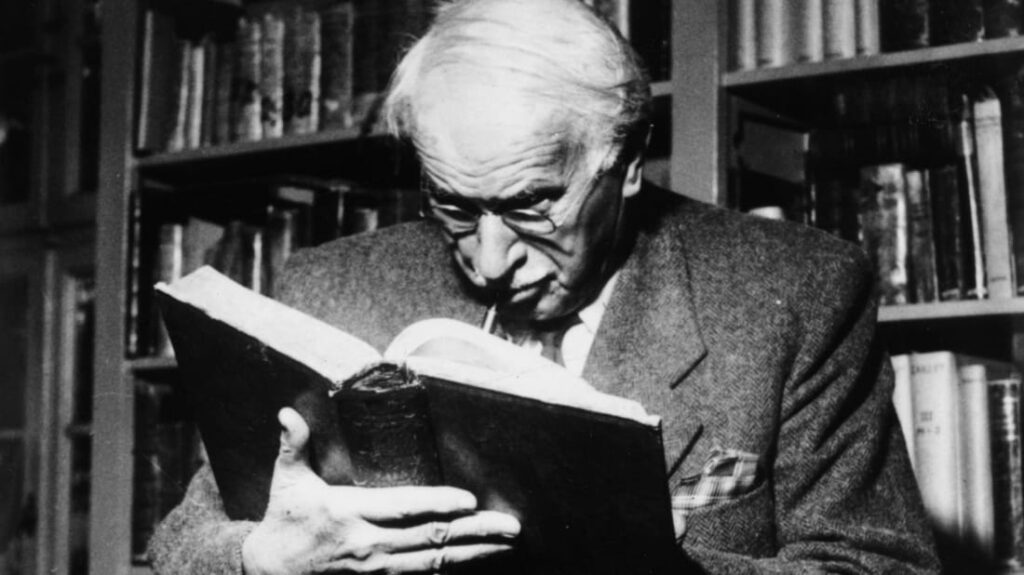
Jung’s discussion of ritual participation examines how people experience transformation through ceremonies that symbolize changes in life, death, renewal, or spiritual identity. A participant does not necessarily undergo a personal transformation in the same way as the symbolic figure in the ritual. Instead, participation can connect the individual to a larger narrative of continuity, meaning, and renewal.
Why does Jung consider ritual participation psychologically significant?
In Four Archetypes, Jung examines rituals as symbolic actions through which people encounter ideas that exceed ordinary individual experience. A ritual may portray a god or sacred hero undergoing death and renewal. Participants then witness, share in, or identify with this symbolic drama.
Jung distinguishes the transformation represented by the ritual from the participant’s immediate psychological state. Someone may take part in a ceremony without experiencing intense emotion. Nevertheless, the ceremony can still place that person within a shared symbolic framework.
Therefore, Jung’s account does not reduce ritual to a private feeling. It considers the relationship between an individual and a symbolic process that a religious community treats as meaningful.
How does a ritual connect individual experience with a larger symbolic story?
Jung discusses ceremonies in which a sacred figure undergoes a symbolic death and returns to life. The participant may observe the event, take part in its enactment, or identify with the sacred figure through the ritual.
He explains that the transformation represented in such ceremonies can occur outside the individual, even when the individual participates in it. In his discussion, the participant’s involvement may produce a sense of blessing, connection, or hope.
For example, Jung considers the Eleusinian Mysteries of ancient Greece. These rites connected religious participation with hopes concerning immortality. He also discusses Christian communion as a ritual that represents death, transformation, and renewed life.
However, these examples belong to different religious traditions. Their symbols and theological meanings are not identical. Jung’s psychological comparison concerns the way ritual can connect personal experience with a larger narrative of transformation.
Does ritual participation automatically transform a person?
No. Jung’s discussion does not require every participant to experience the same emotional or psychological effect.
A person may participate mechanically, while another may experience the ceremony as profoundly meaningful. These different responses show why outward participation and inward experience should not be treated as identical.
Moreover, the significance of a ritual depends on its symbolic framework and the participant’s relationship to it. A ceremony can provide a structure for interpreting experience, but its presence alone does not prove that every participant has undergone a lasting psychological change.
This distinction matters when reading Jung today. His account offers a way to examine the psychological dimensions of ritual; it does not establish the supernatural claims of any particular religion as scientific facts.
Why is Jung’s view of ritual participation relevant beyond religious ceremonies?
Rituals can organize transitions and give them a recognizable social form. Graduation ceremonies, commemorations, funerals, and other public events may help people understand an individual experience through a shared symbolic language.
These modern examples are extensions of Jung’s general argument, not examples that he specifically analyzes in this passage. Nevertheless, they illustrate how a ceremony can connect private experience with collective meaning.
Jung invites readers to consider both what a ritual represents and how people relate to that representation.
For a wider view of how Jung explored symbols and inner transformation, you can also read our article on Carl Jung’s Red Book. In addition, Encyclopaedia Britannica’s biography of Carl Jung offers a reliable overview of his life and work.
Key Points
- Jung examines ritual as a symbolic form of transformation.
- Participants may witness, enact, or identify with a sacred drama.
- Participation does not guarantee a uniform psychological response.
- Ritual can connect individual experience with collective religious meaning.
- Psychological interpretation should remain distinct from claims about supernatural reality.
Frequently Asked Questions
What is ritual participation in Jungian psychology?
It is involvement in a ceremony whose symbolic actions connect participants with a larger narrative of transformation or renewal.
Does Jung claim that rituals always change people?
No. His discussion allows for different levels of emotional engagement and distinguishes participation from personal transformation.
Which examples does Jung discuss?
He refers to the Eleusinian Mysteries and Christian communion when examining ritual participation and symbolic transformation.
References
Jung, Carl Gustav. Dört Arketip. Translated into Turkish by Zehra Aksu Yılmazer. Foreword by M. Bilgin Saydam. Istanbul: Metis Yayınları, 2001/2005 edition consulted, especially “Yeniden Doğuş Üzerine,” pp. 149–151.
Further reading: Why Do Animals Appear as Guides in Fairy Tales? Jung’s Interpretation of Animal Symbolism · Jung’s Father Complex: How Can Inner Authority Shape Belief and Obedience? · Can an Inner Guide Be Both Helpful and Dangerous? Jung on the Ambivalence of Spirit Figures
About the Author