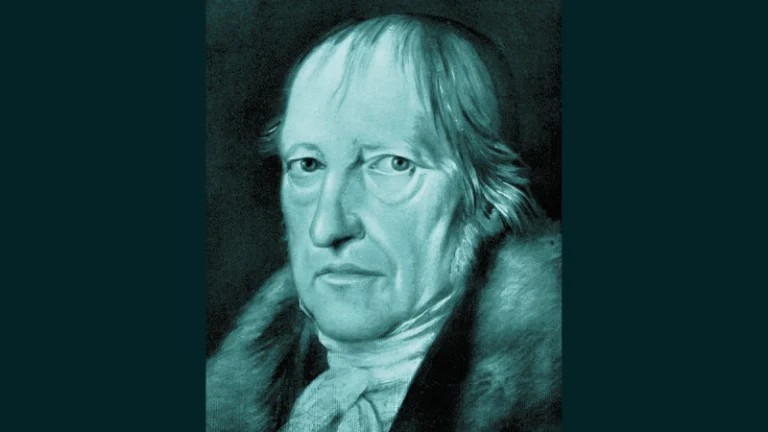
Georg Wilhelm Friedrich Hegel’s Phenomenology of Spirit (Phänomenologie des Geistes, 1807) contains one of the most influential analyses of the relationship between self-consciousness, recognition, domination, and labor. The section commonly known as the “Lordship and Bondage” or “Master-Slave Dialectic” examines how individuals seek recognition from one another and how unequal social relations undermine that recognition. (Stanford Felsefe Ansiklopedisi)
Hegel does not present the relationship simply as a political struggle between two social classes. Instead, he uses it to investigate a deeper philosophical problem: How can a person achieve genuine self-consciousness through another self-conscious being?
Hegel and the Problem of Recognition
For Hegel, self-consciousness does not develop in complete isolation. A person needs another self-conscious being who can recognize them as an independent subject. Therefore, recognition becomes a fundamental condition of self-consciousness. (Stanford Felsefe Ansiklopedisi)
At first, two self-conscious individuals encounter one another as independent beings. Each person wants confirmation of their own independence, but neither initially accepts the other as an equal source of recognition. Consequently, their encounter develops into a struggle for recognition.
Moreover, Hegel connects this struggle with the desire for independence. Each individual wants to establish that nothing external determines their essential identity. Thus, the encounter with another self-consciousness creates a profound tension: each person needs the other for recognition, yet each initially wants to subordinate the other.
The Struggle That Begins the Master-Slave Dialectic
Hegel describes this encounter as a life-and-death struggle. The phrase does not simply describe a literal historical battle. Rather, it dramatizes the extreme demand that each self-consciousness makes for recognition and independence. (Cambridge)
However, the struggle cannot end with the complete destruction of one participant. If one self-consciousness dies, the surviving individual loses the very subject who could provide recognition.
Therefore, the struggle produces an unequal relationship instead of complete destruction. One individual becomes the lord, while the other becomes the bondsman.
This relationship creates an apparent hierarchy. Nevertheless, Hegel soon reveals a paradox: the lord depends on the bondsman more than the lord initially realizes.
Why the Lord Cannot Obtain Genuine Recognition
At first, the lord appears independent. The bondsman serves the lord, satisfies the lord’s desires, and works on objects for the lord.
Yet this arrangement creates a philosophical problem. The lord wants recognition from another self-conscious being, but the lord simultaneously reduces the bondsman to a subordinate position. Consequently, the lord cannot receive the fully reciprocal recognition that genuine self-consciousness requires. (Cambridge)
In other words, the lord receives recognition from someone whom the lord does not recognize as an equal.
Thus, the apparent victor experiences an unexpected form of dependence.
The lord depends on the bondsman for labor, material satisfaction, and recognition. Therefore, the lord’s apparent independence contains an internal contradiction.
The Bondsman and the Experience of Fear
The bondsman occupies the subordinate position, but this position also produces an important transformation.
Fear enters his experience because the original struggle confronts him with the possibility of death. Furthermore, he must obey another person’s commands and restrain his immediate desires. Hegel connects this discipline with the development of self-consciousness. (Cambridge)
Nevertheless, fear alone does not transform the bondsman.
Labor becomes the decisive element.
Through labor, the bondsman encounters the external world in a sustained and transformative way. He does not merely consume an object. Instead, he shapes, modifies, and gives form to it.
Consequently, the bondsman begins to recognize his own activity in the world that he creates.
Why Labor Matters for Hegel
Hegel gives labor a remarkably important philosophical role. The bondsman transforms external objects through disciplined activity, and this transformation allows him to encounter his own capacities in material form.
For example, a person who shapes wood into a table does more than produce a useful object. The person also encounters an external expression of their own skill, intention, discipline, and creativity.
Therefore, labor creates a relationship between self-consciousness and the objective world.
The Cambridge scholarship on Hegel emphasizes this point: the bondsman’s practical engagement with objects contributes to a developing awareness of independence, while the lord’s immediate enjoyment does not provide the same experience. (Cambridge)
The Paradox at the Heart of the Master-Slave Dialectic
Here Hegel introduces the central reversal of the dialectic.
The lord initially appears independent, whereas the bondsman appears dependent. However, their actual relationship becomes more complicated.
The lord depends on the bondsman’s labor. The bondsman, meanwhile, develops an increasing awareness of his own productive capacity through labor.
Thus, the relationship gradually reverses its original appearance.
The apparent master discovers dependence, while the apparent subordinate discovers a path toward independence.
However, Hegel does not simply argue that every form of labor automatically produces freedom. His analysis concerns the development of self-consciousness through disciplined activity, transformation of objects, and recognition. Contemporary scholarship also warns against reducing the entire dialectic to a simple historical story in which the “slave” inevitably defeats the “master.” (Cambridge)
Labor Transforms Both the Worker and the World
One of the most important ideas in Hegel’s analysis concerns the relationship between human labor and the external world.
The bondsman changes the object through work. At the same time, the process changes the bondsman’s own consciousness.
Therefore, labor operates in two directions:
- The worker transforms the external object.
- The transformed object reveals the worker’s own capacities.
For this reason, labor becomes more than an economic activity. It becomes a process through which consciousness encounters itself outside itself.
In fact, Hegel’s analysis of labor later attracted considerable attention from Karl Marx. Marx recognized the importance of Hegel’s treatment of labor while criticizing Hegel’s idealist framework and developing a materialist account of human activity and alienation. (Marxist Arşiv)
Recognition Requires Reciprocity in the Master-Slave Dialectic
Hegel’s analysis ultimately raises a broader question: Can genuine recognition exist when one person dominates another?
The answer within the dialectic points toward a problem of reciprocity. If one person recognizes another only as a subordinate, that recognition cannot fully satisfy the demand for independent self-consciousness.
Therefore, genuine recognition requires more than simply receiving praise, obedience, or submission.
It requires a relationship in which each self-consciousness recognizes the other as an independent subject. Consequently, Hegel’s analysis moves beyond a simple opposition between master and slave and toward a broader account of mutual recognition. (Cambridge)
Why the Master-Slave Dialectic Remains Important
Hegel’s analysis continues to influence philosophy because it connects several problems that philosophers often treat separately: identity, recognition, freedom, labor, dependence, domination, and social relations.
Moreover, later thinkers developed very different interpretations of the passage. Marx connected Hegel’s analysis with labor and alienation, while twentieth-century philosophers, social theorists, and psychoanalysts such as Jacques Lacan used the concept of recognition to investigate interpersonal and social relations. (Marxist Arşiv)
Nevertheless, readers should avoid treating the passage as a simple political allegory. Hegel’s argument operates simultaneously at philosophical, social, and psychological levels, and scholars continue to debate the relative importance of these dimensions. (Cambridge)
Conclusion: From Domination to Self-Consciousness
Hegel’s master-slave dialectic presents a profound paradox. The person who appears to possess absolute independence eventually depends on the person whom that individual dominates. Conversely, the subordinate person develops an important form of self-awareness through fear, discipline, and labor.
Thus, Hegel’s central insight does not concern domination alone. It concerns the conditions under which human beings can recognize themselves and one another as self-conscious subjects.
Furthermore, labor plays a crucial role because it allows the bondsman to transform the external world while simultaneously discovering his own capacities within that transformation.
Ultimately, Hegel’s analysis suggests that genuine independence cannot rest securely on domination. Self-consciousness develops through relationships with others, and meaningful recognition requires reciprocity rather than one-sided dependence.
References
- Hegel, G. W. F. Phenomenology of Spirit. 1807, especially Chapter IV, “Self-Consciousness,” §§178–196. (Marxist Arşiv)
- Pinkard, Terry. “Georg Wilhelm Friedrich Hegel.” Stanford Encyclopedia of Philosophy. (Stanford Felsefe Ansiklopedisi)
- Brandom, Robert B. “Independence and Dependence of Self-Consciousness: The Dialectic of Lord and Bondsman in Hegel’s Phenomenology of Spirit.” In The Cambridge Companion to Hegel and Nineteenth-Century Philosophy, pp. 94–110. (Cambridge)
- Duquette, David. “The Political Significance of Hegel’s Concept of Recognition in the Phenomenology.” Hegel Bulletin, 2015. (Cambridge)
- Siep, Ludwig. “Hegel on the Master-Slave Relation.” Cambridge University Press, Fifteen Eighty Four. (cambridgeblog.org)
- Marx, Karl. Critique of Hegel’s Philosophy in General. 1844. (Marxist Arşiv)
.
About the Author