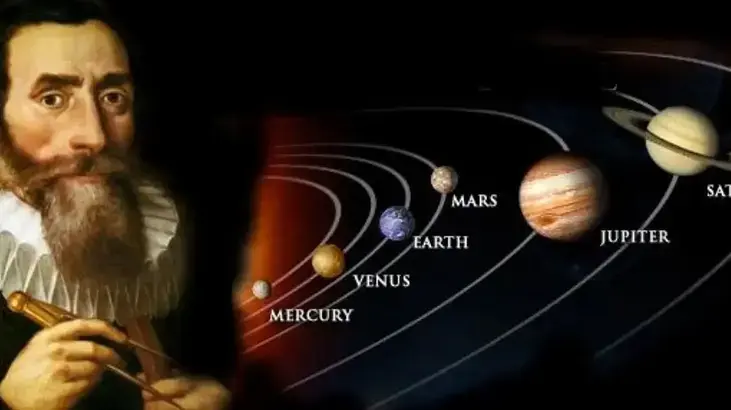
When Johannes Kepler set out to explain the motions of the planets, he found himself confronting an astronomical tradition nearly two thousand years old. Since ancient Greece, it had been widely assumed that celestial bodies moved regularly along perfect circles. Even Kepler himself initially embraced this idea. To his mind, the divine order of the universe ought to reveal itself through geometrically perfect forms.
Then came the observations of Mars made by Tycho Brahe.
They seriously challenged this aesthetic and philosophical expectation. Kepler tried to explain Mars’s motion using circular models, but his calculations repeatedly failed to match the observations. Worse still, the discrepancies were too large to be dismissed given the observational precision available at the time.
Kepler eventually made a crucial choice: he accepted the model that agreed with observation rather than the one that looked mathematically beautiful.
In Astronomia Nova (New Astronomy), published in 1609, he described the orbit of Mars as an ellipse. In doing so, he helped overturn the long-standing assumption that planets moved in circular orbits and opened the way toward modern celestial mechanics. NASA Science
But this was more than the adoption of a new geometric shape. Kepler demonstrated something fundamental about scientific inquiry: when observations contradict our assumptions about nature, it is the assumptions that must be reconsidered.
1. Why Did Kepler Regard Circles as Perfect?
To understand why Kepler eventually accepted ellipses, we first need to understand why circles had acquired such extraordinary importance.
Ancient Greek astronomers regarded the heavens as fundamentally different from the earthly world. In Aristotelian cosmology, celestial bodies belonged to a realm of perfection and permanence. The circle, one of geometry’s most symmetrical forms, seemed to embody that cosmic perfection.
The Ptolemaic system likewise relied upon combinations of circular motions to account for planetary movements. Copernicus placed the Earth among the planets orbiting the Sun, but he retained the assumption of circular planetary orbits.
Kepler’s problem, therefore, was not merely astronomical. The circle was also a cosmological and philosophical ideal.
Kepler himself was deeply influenced by this tradition. As NASA’s historical account notes, like many thinkers of his age, he regarded the circle as the “perfect” form of the universe and consequently expected planetary orbits to be circular as well. NASA Science
Yet this is precisely where scientific discovery took an unexpected turn: Kepler was eventually forced to question his own assumptions in the face of his own data.
2. Why Were Tycho Brahe’s Observations of Mars So Important?
The most important source that led Kepler toward the ellipses was the vast body of observational data collected over many years by the Danish astronomer Tycho Brahe.
Brahe worked before telescopes became commonplace in astronomy. Even so, he employed large and remarkably precise instruments to record the positions of the planets with extraordinary care. His observations of Mars were particularly valuable because the planet’s orbit presented serious difficulties for the geometrical models of the period.
In 1600, Kepler travelled to Prague to work with Brahe. Brahe assigned him a particularly troublesome problem: Mars.
It was no easy task.
Kepler had to explain the positions of Mars in the sky through mathematical models. He tried various circular arrangements, but every new calculation seemed to produce another difficulty.
And Brahe’s observations were so precise that Kepler could not simply ignore small discrepancies.
3. Kepler’s Great Problem: Mars
Mars became the planet that changed the course of Kepler’s life—and the history of astronomy.
Kepler initially attempted to explain its orbit using circular models. But discrepancies emerged between the positions predicted by his calculations and those recorded by Brahe.
One figure became crucial: eight arcminutes.
A degree consists of sixty arcminutes, so eight arcminutes amounts to only about 0.133 degrees. From a modern perspective, that may seem like a negligible difference.
For Kepler, however, it was anything but negligible.
Brahe’s observations were extraordinarily accurate. Kepler therefore refused to dismiss the discrepancy as an ordinary measurement error. The Stanford Encyclopedia of Philosophy emphasises that the eight-arcminute discrepancy in Kepler’s calculations of Mars could not simply be ignored given the precision of Brahe’s observations.
Kepler’s approach in Astronomia Nova is striking from the perspective of the history of science. For him, such a small discrepancy was enough to force a fundamental reconsideration of astronomy.
Historians of mathematics have likewise regarded those eight arcminutes as a crucial step on the road to the reshaping of astronomy. MacTutor History of Mathematics
4. Why Did “Eight Arcminutes” Change the History of Science?
This is where Kepler’s scientific attitude deserves particular attention.
When a scientist encounters a discrepancy between theory and observation, there are essentially two possible responses.
The first is to assume that the observation is wrong.
The second is to question the theory.
Kepler chose the second path.
His decision illustrates one of the defining principles of modern scientific inquiry: when a model fails to describe nature adequately, the model must be changed.
Kepler had an easier option. He could have treated the eight-arcminute discrepancy as an observational error and preserved his circular model.
But he did not.
MacTutor History of Mathematics shows how Kepler addressed this discrepancy in his 1609 Astronomia Nova and refused to disregard the eight arcminutes because of the precision of Tycho Brahe’s observations.
That is why the statement “Kepler discovered the ellipse” is, by itself, not quite enough.
A more accurate way of putting it would be this:
Kepler accepted the ellipse because the observations refused to conform to the circle.
5. Why Did Kepler Choose the Ellipse?
The ellipse was not a new mathematical shape.
Ancient Greek mathematicians already knew the ellipse, parabola, and hyperbola as conic sections. Kepler therefore did not invent a new form of geometry.
His revolutionary step was to recognise the ellipse as the actual geometric form of a planetary orbit.
An ellipse can be thought of, rather simply, as a flattened circle. Technically, however, it has two foci. According to Kepler’s First Law, a planet moves along an elliptical orbit with the Sun located at one of its two foci. NASA Science
This conclusion overturned one of the fundamental assumptions of ancient astronomy.
Celestial motion no longer had to be explained exclusively through perfect circles.
Nature could be more complicated than the geometrical ideal.
6. Why Did Mars Lead Kepler to the Ellipse?
Mars was particularly revealing.
Brahe’s extensive observations of the planet brought the deviations in its orbit into sharp focus. NASA notes that Mars had one of the most pronounced elliptical orbits among the planets for which Brahe possessed extensive observational records. NASA Science
Mars therefore exposed the limitations of the old circular models.
Kepler tested different geometrical possibilities, but eventually the ellipse proved to correspond far more closely with the observations.
There was another crucial discovery. Kepler did not merely conclude that “Mars travels along a slightly flattened circle.” He also realised that the planet’s orbital speed was not constant.
Mars moved faster when it approached the Sun and more slowly as it moved away.
This became the basis of Kepler’s Second Law:
A line connecting a planet to the Sun sweeps out equal areas in equal intervals of time. NASA Science
Kepler’s discovery of the ellipse, therefore, did not stand alone. He established a physical relationship between the shape of an orbit and the speed at which a planet travels along it.
7. Kepler’s Real Revolution: From the Circle to Reality
It would be too narrow to regard Kepler’s achievement simply as a geometrical discovery.
His deeper revolution lay in reconsidering the relationship between the ideal mathematical form and physical reality.
Earlier astronomers had sought to explain celestial motion through predetermined geometrical models. Kepler instead investigated how planets actually moved.
This approach gradually transformed astronomy into a physical science.
Bruce Stephenson’s Kepler’s Physical Astronomy emphasises the importance of Kepler’s attempt to move astronomy beyond the construction of geometrical models toward an investigation of physical causes. Google Books
Kepler’s 1609 work was therefore much more than an astronomy book.
Astronomia Nova became one of the landmark texts in the history of astronomy’s transition toward the investigation of physical causes.
8. What Changed Once Kepler Accepted the Ellipse?
Kepler’s elliptical model offered a far simpler way of describing planetary motion.
Circular models required numerous additional geometrical devices to account for irregularities in planetary movements. The ellipse, by contrast, described the planet’s orbit through a single fundamental curve. The Library of Congress notes the significance of Kepler’s elliptical model in replacing much of the elaborate geometrical machinery inherited from earlier astronomical systems.
The change had a profound consequence for scientific thought:
Simplicity was no longer synonymous with perfection.
The circle looked more symmetrical and aesthetically satisfying. The ellipse appeared, by comparison, “imperfect.” But if nature followed an ellipse, the scientist had to accept the ellipse.
Kepler thus arrived at a profound principle:
The mathematical beauty of nature does not necessarily correspond to the beauty we have decided in advance that nature ought to possess.
9. Did Kepler Really Abandon Circles Completely?
There is an important misconception to correct here.
Kepler did not reject the circle as a mathematical form. The circle remained a perfect and important geometrical figure. What he demonstrated was that the circle was insufficient for describing planetary orbits.
Nor was Kepler’s thinking based entirely on what we would today call “abstract mathematics.” He believed that physical causes lay behind planetary motion.
In working on New Astronomy, Kepler sought to explain planetary movements through physical forces. The High Altitude Observatory of UCAR likewise emphasises Kepler’s effort to investigate physical causes alongside his first two laws of planetary motion.
This approach would later acquire a far more powerful physical framework through the work of Isaac Newton.
10. The Road from Kepler to Newton
Kepler’s acceptance of elliptical orbits was not, in itself, Newton’s theory of gravity.
But it provided an important mathematical foundation for the theory Newton would later develop.
Kepler established how the planets move:
- Planets travel in elliptical orbits.
- The line joining a planet to the Sun sweeps out equal areas in equal times.
- There is a mathematical relationship between a planet’s orbital period and its average distance from the Sun.
Newton later developed his laws of motion and universal gravitation to explain why those motions occur. NASA likewise notes that Kepler’s laws paved the way for Newton’s physical laws describing planetary motion. NASA Science
A major transformation had therefore taken place in astronomy:
Kepler: How do the planets move?
Newton: Why do they move that way?
Together, these two stages laid the foundations of modern celestial mechanics.
11. What Does the “Imperfect” Ellipse Really Represent?
The expression “imperfect ellipse” should, of course, be understood metaphorically.
An ellipse is not an imperfect mathematical figure. It possesses an extraordinarily precise and orderly set of mathematical properties.
What was “imperfect” was the aesthetic meaning that ancient cosmology had attached to the circle.
Kepler’s revolution lies precisely here.
People had wanted to see perfect forms in the heavens. Kepler sought instead to uncover the geometry that nature itself actually followed.
His scientific attitude might therefore be summarised in a single sentence:
Not theory first and observation second, but theory continually tested against observation.
This approach is striking even from the perspective of modern philosophy of science.
Kepler did not alter the observations in order to protect his theory. Instead, he allowed the observations to alter his theory.
12. The Legacy of Kepler’s “Eight Arcminutes”
Kepler’s Mars problem matters today for more than the history of astronomy.
It is also a powerful illustration of how scientific method works.
Eight arcminutes was a small number. Yet for Kepler, that small discrepancy became the starting point for a profound theoretical transformation. The Stanford Encyclopedia of Philosophy notes the importance of Kepler’s refusal to dismiss the discrepancy and its role in the reconstruction of astronomy.
The history of science therefore offers a recurring lesson:
Great revolutions are sometimes set in motion not by enormous numbers, but by small discrepancies that refuse to be explained away.
Kepler’s story is one of the clearest examples.
References
- Johannes Kepler, Astronomia Nova. Prague, 1609. A digital copy of the work is available through Smithsonian Libraries.
- Bruce Stephenson, Kepler’s Physical Astronomy. Princeton University Press, 1994. Google Books
- NASA Science — “Orbits and Kepler’s Laws”
- NASA Science — “Planetary Motion: The History of an Idea That Launched the Scientific Revolution”
- Stanford Encyclopedia of Philosophy — “Johannes Kepler”
- MacTutor History of Mathematics — “Kepler’s Laws”
- Library of Congress — “Whose Revolution? Copernicus, Brahe and Kepler”
- High Altitude Observatory, UCAR — “Johannes Kepler (1571–1630)”
- OpenStax — Astronomy 2e, “The Laws of Planetary Motion”
About the Author