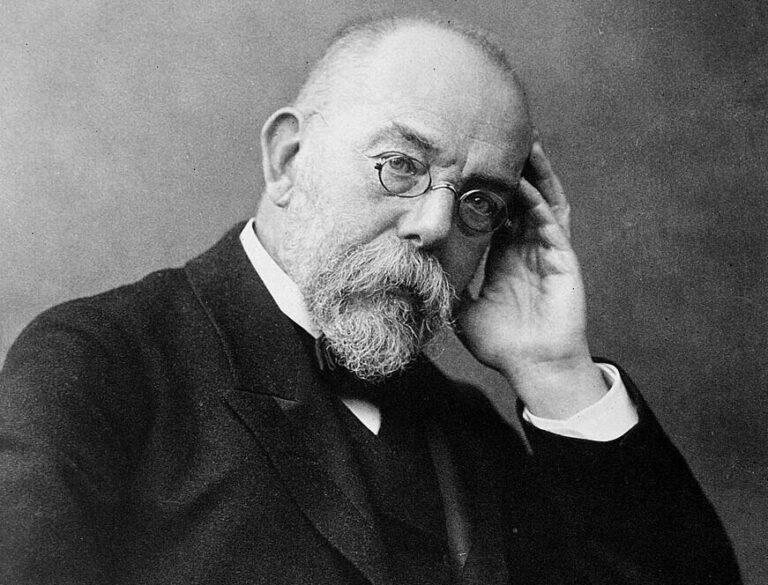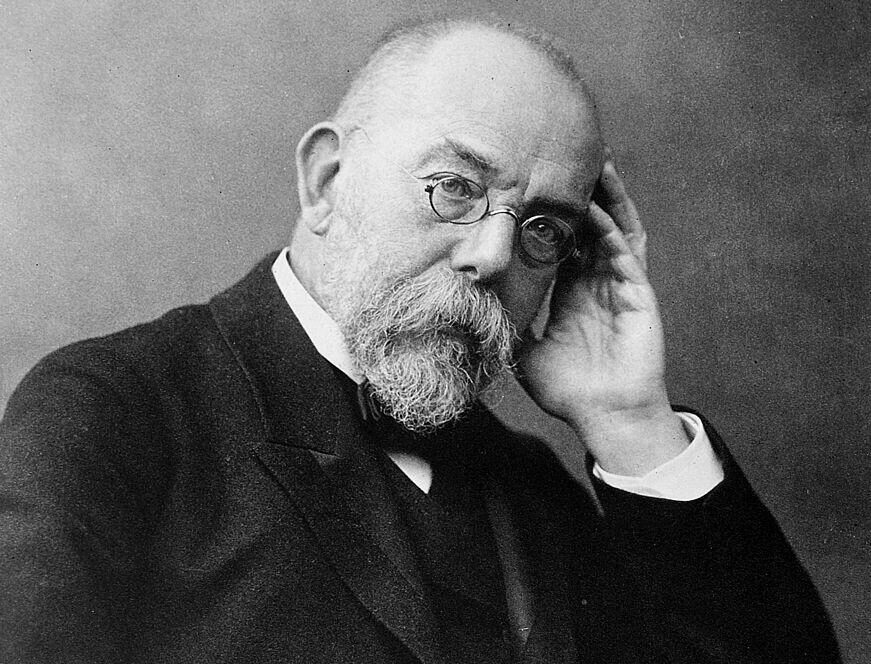
A potato in a scientist’s laboratory may seem an unlikely sight today. Yet in the late nineteenth century, the humble potato became an unlikely instrument in one of the most important transformations in the history of microbiology.
Robert Koch used slices of potato as an early solid medium for cultivating bacteria, helping researchers separate microorganisms and obtain what came to be known as pure cultures. The significance of the potato, however, lay not in the vegetable itself, but in the experimental problem it helped Koch solve: how could one isolate a particular bacterium from a mixture of microorganisms and study it on its own?
Koch therefore began exploring solid surfaces alongside liquid culture media. Sterilized potato slices provided one of the earliest practical surfaces on which bacteria could grow in distinct colonies. Instead of remaining mixed together in a liquid, microorganisms could be observed as separate areas of growth.
It was a modest technical innovation with profound consequences.
The potato was not a perfect solution. Many bacteria failed to grow adequately on it, and its nutritional composition could not satisfy the requirements of every microorganism. Koch consequently turned to other solidifying agents, first gelatin and eventually agar.
The potato in Koch’s laboratory was therefore far more than an improvised piece of food. It represented one of the earliest steps in the long quest to separate bacteria, isolate them, and study them as individual organisms.
What Was Robert Koch’s Real Problem?
By the nineteenth century, the microscope had made it possible for scientists to see bacteria. But seeing a microorganism was not enough to demonstrate that it caused a particular disease.
The crucial problem was isolation.
A sample taken from diseased tissue could contain several different microorganisms. If they remained mixed together, it was extremely difficult to determine which organism was responsible for the disease—or even to study the characteristics of a single species with confidence.
Koch confronted this problem particularly clearly during his work on anthrax.
Liquid culture media presented an obvious obstacle. Bacteria could multiply throughout the fluid, becoming intermixed and making the separation of individual organisms difficult. Koch therefore began looking for a solid surface that could physically separate growing microorganisms.
This was where the potato entered the story.
Why Did the Potato Work?
The potato offered something that a liquid culture could not: a solid surface.
Koch could cut potatoes into slices under sterile conditions and introduce bacteria onto their surfaces. As the microorganisms multiplied, they could produce distinct areas of growth—colonies that could be observed separately.
The importance of this seemingly simple arrangement was considerable.
Instead of merely observing bacteria under a microscope, researchers could now begin to isolate them.
That change in perspective was fundamental to the emergence of modern bacteriology. Koch’s work helped establish the experimental importance of obtaining microorganisms in pure culture, free from other organisms.
The laboratory was no longer simply a place where bacteria could be seen.
It became a place where they could be separated, cultivated, compared, and identified.
What Did Koch See on the Potato?
One of the crucial observations was that bacteria growing on a solid surface could form distinct colonies.
A single bacterial cell, under suitable conditions, can reproduce again and again until its descendants form a visible mass. When separate colonies arise from separate organisms, a researcher can select them individually and transfer them into new cultures.
This was an essential step toward the concept of the pure culture.
Koch’s objective was not simply to make bacteria multiply. His goal was to obtain a particular microorganism separately from all others and then study its morphology, growth, and relationship to disease.
The distinction may sound technical today, but it represented a profound methodological advance.
To understand a microorganism, one first had to separate it from the microbial world surrounding it.
Why Wasn’t the Potato Enough?
The potato was ingenious precisely because it was simple. But simplicity came with limitations.
Not every bacterium grew well on potato. Its nutrients were not standardized, and its physical and chemical properties varied from one slice to another. A medium that supported one organism might be unsuitable for another.
Koch therefore experimented with other substances. Among them were coagulated egg albumin and starch paste, before he moved toward more effective solid culture media.
The search was no longer merely for something on which bacteria would grow.
The challenge was to create a reliable, controllable environment in which individual colonies could be isolated and studied.
That search led to gelatin.
From Potato to Gelatin
Gelatin offered an important advantage.
Koch discovered that adding gelatin to a nutrient broth could transform the liquid medium into a transparent solid surface. When the medium was spread across a flat glass plate, bacteria could grow into separate colonies that were much easier to observe and isolate.
For microbiology, this was a major conceptual and practical advance.
Yet gelatin had an inconvenient weakness.
It melted at relatively low temperatures—above roughly 25°C—and some bacteria could also break it down enzymatically. This became particularly problematic because many pathogenic bacteria grow well at temperatures close to that of the human body, around 37°C.
A medium that melted when it reached the ideal temperature for bacterial growth was hardly an ideal laboratory tool.
Koch and his colleagues needed something better.
The Woman Who Introduced Agar
The next breakthrough came from an unexpected direction.
Fanny Hesse, the wife of Koch’s laboratory assistant Walther Hesse, suggested using agar as a solidifying agent. She was familiar with the material from its use in preparing jellies and puddings at home and understood its remarkable ability to remain solid at temperatures at which gelatin would melt.
Agar, derived from seaweed, proved to be far better suited to bacteriological work.
It could remain firm at incubation temperatures and was not readily broken down by many bacteria. This made it possible to create stable, transparent culture media on which individual colonies could develop and be observed.
A seemingly domestic piece of knowledge thus entered the history of modern science.
The transition from potato to gelatin and then to agar was not a single dramatic invention. It was a gradual process of experimentation, failure, adaptation, and refinement.
That is often how science actually advances.
From Potatoes to Agar: A Revolution in the Laboratory
The history of Koch’s culture media reveals an important truth about scientific progress.
Revolutions do not always begin with sophisticated instruments or expensive technology. Sometimes they begin with whatever happens to be at hand.
A potato was available.
It offered a solid surface.
It was not perfect, but it suggested a solution to a fundamental problem.
Gelatin improved upon it. Agar improved upon gelatin.
Each step addressed the same underlying question:
How can microorganisms that grow together be separated from one another?
Agar provided a much more effective answer. Nutrients could be incorporated into a transparent, solid medium, allowing bacterial colonies to develop in a stable environment and making individual colonies easier to observe and transfer.
The consequences reached far beyond Koch’s laboratory.
Pure cultures became essential to the systematic study of bacterial morphology, growth, and pathogenicity—and to the identification of microorganisms responsible for specific diseases.
And Where Does the Petri Dish Come In?
The familiar Petri dish belongs to the same story.
In 1887, Julius Richard Petri, working in Koch’s laboratory, replaced the earlier flat glass plates with a shallow circular vessel consisting of a dish and a matching lid. The design helped protect cultures from contamination while making bacterial colonies easier to observe.
The modern Petri dish was therefore not an isolated invention.
It was the next stage in an evolving laboratory tradition.
Potato → gelatin → agar → Petri dish.
Seen in this sequence, the history of bacterial culture becomes a story of increasingly precise ways to control, separate, and observe the microscopic world.
What looks today like an ordinary piece of laboratory equipment was built upon generations of experimentation.
Why Does Koch’s Potato Matter in the History of Science?
The historical importance of Koch’s potato experiment lies less in the potato than in the experimental logic behind it.
Koch recognized that bacteria growing together in liquid culture could not easily be separated. He therefore looked for a solid surface on which individual organisms could establish distinct colonies.
The solution was simple enough to seem obvious in retrospect.
But scientific ideas often acquire that appearance only after someone has discovered them.
The crucial principle was this:
Before a microorganism could be studied as the cause of a disease, it had to be isolated from the other organisms with which it shared its environment.
This principle became central to bacteriology.
Koch’s methods for obtaining pure cultures provided an experimental foundation for identifying pathogenic bacteria and connecting specific microorganisms with specific diseases. His work also contributed to the broader methodological framework that became associated with what are now known as Koch’s postulates.
The potato was only one step in that larger transformation.
But it was an important one.
Koch’s Potato: A Lesson in Scientific Creativity
There is something almost poetic about the image of Robert Koch working with slices of potato in a laboratory.
Today, microbiology is associated with sophisticated incubators, molecular sequencing, automated instruments, and highly controlled media. Yet some of its foundational techniques emerged from remarkably modest materials.
Koch did not begin with a perfect medium.
He began with a problem.
How could one bacterium be separated from another?
The potato offered a partial answer. Gelatin offered a better one. Agar offered a better answer still. The Petri dish then provided a more convenient vessel in which these methods could be used.
The history is therefore not really a story about a potato.
It is a story about learning how to isolate the invisible.
A potato slice became a laboratory surface. A laboratory surface became a method. The method became a foundation of modern bacteriology.
And when we look today at a bacterial colony growing quietly inside a Petri dish, we are looking at the distant descendant of an experiment that began with one of the most ordinary objects imaginable.
A potato.
References
- Koch, R. (1881). Zur Untersuchung von pathogenen Organismen. Berlin.
- Brock, T. D. (1999). Robert Koch: A Life in Medicine and Bacteriology. American Society for Microbiology.
- Gradmann, C. (2009). “Robert Koch and the Pressure of Scientific Research.” Medical History.
- Nobel Prize. “Robert Koch – Biographical.” Nobel Prize – Robert Koch
- Lechevalier, H. A., & Solotorovsky, M. (1965). Three Centuries of Microbiology. McGraw-Hill.
- Prescott, L. M., Harley, J. P., & Klein, D. A. Microbiology. McGraw-Hill.
- Atlas, R. M. (2010). Handbook of Microbiological Media. CRC Press.
- “Bacterial culture through selective and non-selective conditions: the evolution of culture media in clinical microbiology.” New Microbes and New Infections.
About the Author