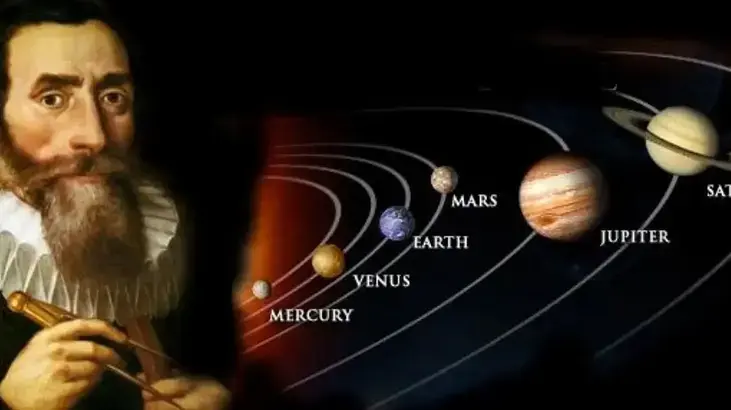
Johannes Kepler’s Somnium (The Dream) is an extraordinary early narrative that combines the idea of a journey to the Moon with the astronomical knowledge of its age. Kepler was not simply imagining a fantastical voyage through space; he was using literature to explore the revolutionary astronomy of the seventeenth century. For this reason, Somnium is regarded as one of the pioneering texts in the history of science fiction.
Kepler began developing the text in the early seventeenth century. Its earliest form dates to around 1608–1609, and he continued to expand it throughout his lifetime, adding increasingly detailed astronomical explanations. Somnium, however, was not published until 1634, four years after Kepler’s death.
At the heart of the work lies an imaginary journey to the Moon. Kepler does not conceive of the Moon merely as a distant celestial body. Instead, he imagines it as another world, with its own physical conditions, living creatures, and geographical features. More remarkably, he connects these imagined landscapes and forms of life with the astronomical knowledge of his own time.
In this respect, Somnium creates a remarkable bridge between the fantastic and the scientific imagination.
What Is Somnium?
Somnium is Latin for “dream.” The work’s full title is Somnium, seu opus posthumum de astronomia lunari, meaning The Dream, or a Posthumous Work on Lunar Astronomy. The first edition appeared in 1634.
Kepler frames the narrative around the story of Duracotus, a young Icelander. Through his mother, Fiolxhilde, and a supernatural being, Duracotus reaches the Moon. Kepler uses this fantastical framework as a vehicle for presenting his astronomical ideas.
The result is a work built upon two distinct yet inseparable layers: an imaginary journey and a sustained scientific explanation.
Why Did Kepler Send His Traveller to the Moon?
Kepler’s purpose was not simply to tell an adventure story set in space. He wanted his readers to imagine the implications of the Copernican, Sun-centred model of the universe.
Instead of looking up at the heavens from Earth, the reader is invited to imagine looking back at Earth from the Moon. This becomes a powerful intellectual experiment. Earth is stripped of its privileged position at the centre of the universe and viewed instead as one celestial body among many.
The idea is closely connected with Kepler’s astronomical thinking. He argued that the planets move around the Sun and sought to explain the motions of celestial bodies through mathematical laws. In Somnium, this new cosmology becomes visible through the imaginative possibilities of literature.
How Does the Moon Become a World in Kepler’s Somnium?
One of the most striking features of Somnium is the extraordinary detail with which Kepler imagines the Moon.
He gives the lunar world the name Levania and considers the possibility that it might possess distinctive climates, forms of life, and geographical characteristics. He also imagines that the two sides of the Moon—the side facing Earth and the side turned away from it—might experience radically different conditions.
At this point, Kepler is asking more than the simple question, “Is there life on the Moon?”
He is asking a more profound question:
If life exists on another celestial body, what would the conditions of that life be?
This approach comes remarkably close to one of the defining characteristics of modern science fiction: constructing an alternative world on the basis of a scientific premise.
How Does Kepler Bring Science and Imagination Together?
Here lies the feature that distinguishes Kepler’s work from many of the fantastical travel narratives of his time.
Stories of imaginary journeys to the Moon had existed since antiquity. Lucian of Samosata’s True History, for example, features a journey to the Moon as part of a comic and fantastical adventure. Kepler, however, takes a different approach. He connects the lunar journey with the new astronomical knowledge of his age.
He also appended extensive explanatory notes to the narrative. These notes contain detailed reflections on the Moon’s astronomical properties, the appearance of the heavens, and the physical conditions that might exist there. In this way, the fictional story begins to resemble a scientific thought experiment.
Why Is Somnium Considered a Forerunner of Science Fiction?
Scholars of science fiction do not agree entirely on what should be regarded as the “first science-fiction work.” Establishing a precise starting point for the genre depends largely on how its boundaries are defined.
Nevertheless, Somnium occupies an important place in this debate. It brings together elements that would later become central to science fiction: scientific knowledge, astronomical speculation, another world, and questions about humanity’s place in the universe.
The Cambridge History of Science Fiction likewise places Kepler’s Somnium within the early tradition of science fiction and lunar-journey narratives.
At the same time, calling it definitively “the first science-fiction work” would be too strong a historical claim. Earlier fantastical journeys through space, including Lucian’s True History, are part of the same broader discussion. The crucial distinction is that Somnium systematically combines a fantastical voyage with the serious astronomical debates of its time.
What Did Kepler Anticipate Before Modern Science Fiction?
Perhaps Kepler’s most important achievement was to reposition the Moon within the human imagination.
In his age, the Moon was increasingly being considered not merely as a distant object in the night sky, but as another possible world. Kepler carried this idea into literature. He also introduced the powerful imaginative device of viewing Earth from outside itself.
This perspective helped establish an intellectual foundation for later literature about journeys to the Moon. Francis Godwin’s The Man in the Moone appeared in 1638, while Cyrano de Bergerac’s work about a journey to the Moon emerged in the middle of the seventeenth century. Centuries later, writers such as Jules Verne and H. G. Wells would place space travel and scientific and technological speculation at the heart of modern literature.
Why Does Kepler’s Somnium Still Matter Today?
Somnium reminds us that the scientist is not simply a figure who measures, calculates, and records. Kepler was also a thinker who tested scientific ideas through the power of imagination.
The work also demonstrates that the dialogue between science and literature began long before the modern age. Kepler took an astronomical problem and explored it through fiction, inviting his readers to step beyond the boundaries of Earth.
For this reason, Somnium is more than an early work of science fiction. It is also a literary reflection of the Copernican Revolution and an important historical document demonstrating how scientific thought can intersect with the imaginative power of literature.
References
- Johannes Kepler (1634), Somnium, seu opus posthumum de astronomia lunari — Utrecht University DSpace
- Edward Rosen (trans.), Kepler’s Somnium: The Dream, or Posthumous Work on Lunar Astronomy (1967) — Scribd
- University of California Press (2022), Kepler’s Dream: With the Full Text and Notes of Somnium, Sive Astronomia Lunaris — University of California Press
- Cambridge University Press, The Cambridge History of Science Fiction — PagePlace
- Luca Lovisetti (2024), The Dream of Kepler: A Retrospective Work on the Human Side of the Scientist — University of Milan – AIR Unimi
About the Author