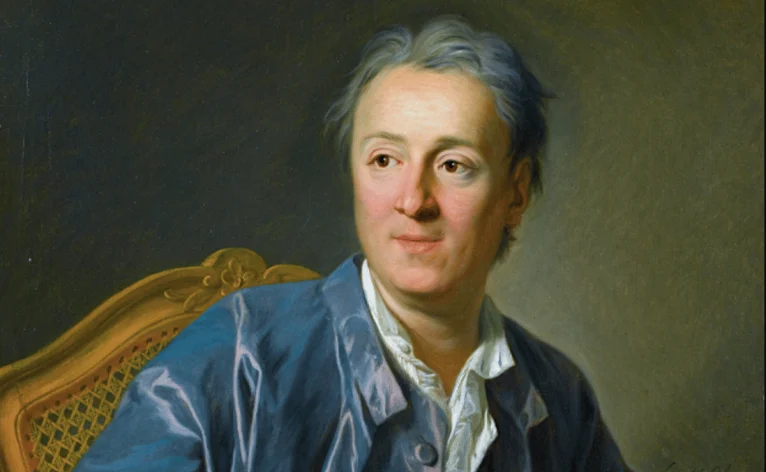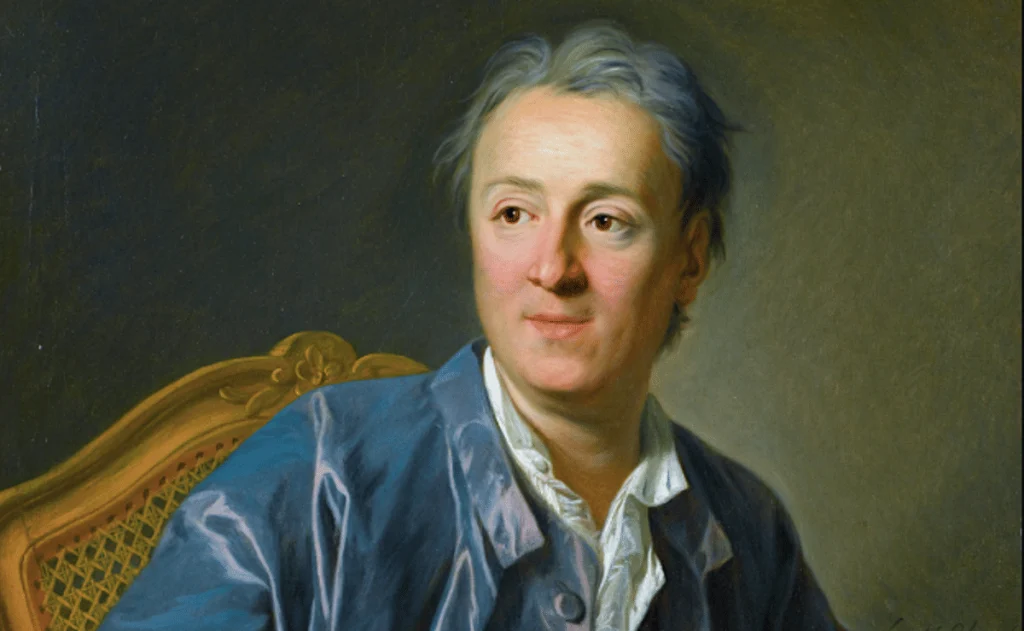
Denis Diderot (1713–1784) stands out in Enlightenment thought not only for his role in the Encyclopédie project, but also for his radical views on nature, matter, and life. In seeking to explain living beings, Diderot turned his attention away from supernatural design and towards the properties of matter and the ways in which it becomes organised. This approach moved beyond the mechanical conception of nature dominant in the eighteenth century, opening the way towards a more dynamic understanding of matter. (Stanford Encyclopedia of Philosophy)
His Letter on the Blind (Lettre sur les aveugles) of 1749 and D’Alembert’s Dream (Le Rêve de D’Alembert), written around 1769, are particularly important for tracing the development of his ideas about the relationship between life and matter. The first contains speculative reflections on the adaptation of species to their environments and the conditions under which living beings survive. The second develops these questions within a much broader philosophical framework, exploring the relationship between matter, movement, sensibility, and organisation. (Stanford Encyclopedia of Philosophy)
Diderot should not, however, be presented as a direct precursor of modern biology. His ideas do not constitute an experimental theory of evolution. What makes them historically significant is his attempt to understand life not as the product of an immutable and transcendent order, but through the transformation and organisation of matter.
Matter in Diderot’s Philosophy of Nature
Diderot’s materialism differs from the classical mechanical conception of matter. For him, matter is not merely a passive and inert substance. It may possess properties connected with movement, sensibility, and organisation. For this reason, Diderot’s approach has been described by scholars as “vital materialism.” (Taylor & Francis Online)
In this conception, nature is not a static structure. Matter is constantly transformed, combined, and separated. Diderot drew particularly upon chemistry in attempting to explain transformation in nature, suggesting that the boundaries between physics, chemistry, and life might not be as absolute as they were commonly assumed to be. (Stanford Encyclopedia of Philosophy)
For Diderot, therefore, there is no absolute ontological gulf between the living and the non-living. The difference is better understood in terms of the level of organisation and mode of operation of matter.
Can Life Emerge Without God?
One of Diderot’s most striking questions concerns the origins of life. He does not answer this question by proposing a modern theory of biological evolution. Instead, he considers the possibility that matter might, under suitable conditions, reach increasingly complex forms of organisation.
D’Alembert’s Dream is particularly important in this respect. Through the example of an egg, the work explores the transition between matter and life. Diderot considers development not as the result of a metaphysical principle imposed from outside, but in terms of heat, movement, and the organisation of matter. (Stanford Encyclopedia of Philosophy)
This approach offered a powerful alternative to the creation-centred conception of nature prevalent in his time. Diderot’s aim was not simply to declare that “God does not exist.” More fundamentally, he questioned whether a divine principle of design was necessarily required to explain life.
From the perspective of modern science, an important distinction must be made here. Diderot did not provide an experimental explanation of the origins of life and did not develop a modern theory of abiogenesis. His contribution lies rather in creating a philosophical space in which life could be considered through the processes of nature itself.
Adaptation and Early Evolutionary Thought
Diderot’s Letter on the Blind contains striking reflections on the relationship between the structures of living beings and environmental conditions. Through the character of Saunderson, Diderot questions the relationship between the characteristics of living organisms and the conditions found in nature.
Some scholars have described this aspect of his thought as “proto-Darwinian.” Rather than assuming that all characteristics of living beings had emerged according to a predetermined plan, Diderot considered the possibility that organisms possessing suitable forms of organisation might be capable of maintaining their existence. (CiteSeerX)
An important qualification is necessary, however. Diderot did not formulate Darwin’s mechanism of natural selection. He did not explain the systematic relationship between heredity, variation, and natural selection. For this reason, presenting him as a direct precursor of Darwin would be historically excessive.
Nevertheless, his attempt to explain the relationship between living organisms, their environment, and the conditions of survival through natural rather than supernatural processes remains remarkable.
The Idea of the Survival of the “Fittest Structure”
In Diderot’s thought, the harmony among the parts of a living organism occupies an important place. An organism’s ability to survive depends upon its constituent parts functioning together as an integrated whole. The diversity of life in nature, therefore, need not necessarily depend upon a predetermined plan.
When this idea is compared with modern evolutionary theory, a certain resemblance becomes apparent. Modern biology explains how environmental conditions exert selective pressures on organisms and how particular characteristics may spread through successive generations. Diderot, however, had not yet formulated this mechanism. At a more general level, he was exploring the relationship between organisation, adaptation, and the continuity of life.
For this reason, Diderot’s thought is better understood not as Darwinism, but as an approach that explored some of the philosophical premises of evolutionary thought.
Diderot and the Question of the Cell
The claim that Diderot possessed “intuitions concerning cellular structure” should be treated with caution. Although the concept of the cell had emerged by the eighteenth century, modern cell theory did not yet exist.
Diderot was particularly interested in the possibility that organisms might be composed of smaller units, in the relationships among these units, and in the way an integrated living whole might emerge from them. In D’Alembert’s Dream, he uses concepts such as “point,” “part,” “combination,” and “organisation” when discussing the formation of living organisms. (Utpictura18)
It would therefore be more scientifically precise to say that Diderot attempted to explain the organism through the relationships and organisation of its constituent parts, rather than claiming that he anticipated cell theory itself.
Modern cell theory became a systematic biological theory during the nineteenth century through the work of researchers such as Matthias Schleiden and Theodor Schwann. Diderot’s thought did not directly produce this theory; nevertheless, his attempt to understand the integrity of an organism through the relationships among its smaller structures represents an intriguing philosophical parallel with later developments in biology.
D’Alembert’s Dream: Nature as Continuity
One of the most concentrated expressions of Diderot’s philosophy of nature appears in D’Alembert’s Dream. The work discusses questions of matter, movement, sensibility, life, and consciousness within a complex philosophical fiction consisting of three dialogues. (Stanford Encyclopedia of Philosophy)
At its centre lies the idea of continuity in nature. Diderot rejects the notion that there must be a sharp and impassable boundary between matter and living beings. Different forms of existence need not constitute completely separate categories.
Rather than imagining nature as a ladder divided into fixed levels, he conceives it as a whole in continual transformation. Matter can assume different forms of organisation, and these forms of organisation can give rise to different degrees of sensibility and vitality. (Stanford Encyclopedia of Philosophy)
Matter, Movement, and Sensibility
One of the most original aspects of Diderot’s materialism is the importance he gives to the concept of sensibility (sensibilité). Diderot questions whether sensibility is a quality belonging exclusively to the human mind. More broadly, he searches for a continuity between matter and sensibility. (Stanford Encyclopedia of Philosophy)
This idea does not correspond directly to contemporary science. Modern neuroscience relates sensibility to the functioning of particular biological systems, whereas Diderot was constructing a much more speculative ontology.
Yet the fundamental question he posed remains strikingly relevant:
How do consciousness and sensibility emerge from matter?
Diderot does not provide a definitive scientific answer. What he does, however, is remove the question from metaphysical dualism and place it within the study of nature and matter.
How Far Ahead of Darwin Was Diderot?
Diderot’s biological reflections appeared roughly a century before Darwin’s On the Origin of Species. Yet chronological precedence should not be confused with theoretical equivalence.
Darwin developed a comprehensive theory of evolution based on natural selection in 1859. Diderot, by contrast, was working within the scientific possibilities of the eighteenth century and pursuing a far more speculative philosophy of nature.
The fundamental difference lies in their explanatory mechanisms. Diderot focused on transformation, organisation, and adaptation to the environment, whereas Darwin systematically combined hereditary variation with natural selection.
It is therefore more accurate to describe Diderot not as “the philosopher who discovered Darwin before Darwin,” but as an Enlightenment thinker who explored some of the philosophical premises that would later contribute to evolutionary thought.
Diderot’s Importance in the History of Science
Diderot’s importance in the history of science does not lie in having anticipated all the concepts of modern biology. His deeper significance lies in his tendency to explain nature through processes taking place within nature itself.
In his philosophy, nature is not a passive structure dependent upon continual intervention from outside. Matter moves, changes, and assumes different levels of organisation. Life, too, does not constitute a separate metaphysical realm beyond these natural processes. (Stanford Encyclopedia of Philosophy)
This approach reflects one of the important transformations taking place in Enlightenment philosophy of nature. Drawing particularly upon fields such as chemistry, physiology, and natural history, Diderot reshaped philosophical materialism and gave it a more dynamic character.
His thought was not the direct starting point of modern biology. Yet his attempt to understand life through the concepts of matter, movement, organisation, and transformation remains a remarkable episode in the history of scientific thought.
References
- Diderot, D. (1749). Lettre sur les aveugles à l’usage de ceux qui voient [Letter on the Blind].
- Diderot, D. (1769). Le Rêve de D’Alembert [D’Alembert’s Dream].
- Diderot, D. Éléments de physiologie.
- Gaukroger, S. (2010). The Emergence of a Modern Natural Philosophy. Oxford University Press.
- Wolfe, C. (2024). “Diderot’s Vital Materialism.” Ambix, 71(3), 342–359. (Taylor & Francis Online)
- Suzuki, M. (1987). “Chaîne des idées et chaîne des êtres dans Le Rêve de d’Alembert.” Dix-Huitième Siècle, 19, 327–338. (Persée)
- Stanford Encyclopedia of Philosophy — “Denis Diderot”
- Nicoglou & Wolfe — studies on Diderot, epigenesis and Spinozism
About the Author