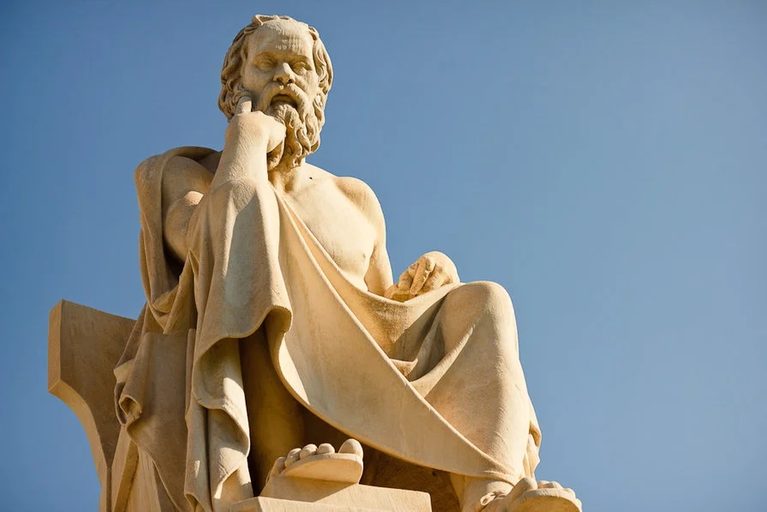
Philosophy Beyond the Classroom
When we imagine ancient philosophy, we often picture quiet schools, formal lectures, and students gathered around a learned teacher. Socrates in the streets of Athens, however, offers a strikingly different model of philosophical education. Rather than establishing a formal school or charging students for instruction, he developed philosophy through conversation in the public spaces of Athens.
The Agora, gymnasia, wrestling schools, streets, and other gathering places provided the social environment for these encounters. Moreover, ancient sources portray Socrates as someone who deliberately sought conversation with a wide range of people rather than limiting philosophical discussion to a specialized intellectual circle. (Stanford Felsefe Ansiklopedisi)
Therefore, Socratic philosophy can be understood not simply as a collection of doctrines but as a public practice of questioning, dialogue, and intellectual examination.
The Agora: A Philosophical Space in the Heart of Athens
The Agora occupied a central position in Athenian civic life. It functioned as a marketplace, meeting place, and important setting for social and political interaction. For Socrates in the streets and squares of the city, such an environment offered something essential: access to people with different occupations, experiences, and opinions.
According to accounts discussed in modern scholarship, Socrates was frequently found in the marketplace and other public areas, where he engaged people in question-and-answer conversations. (Plato)
Consequently, philosophy did not remain separated from everyday life. Instead, philosophical questions could emerge from ordinary encounters. What is justice? What makes a person wise? What does it mean to live well? These questions could be examined through conversation rather than through a formal lecture.
Gymnasia and Wrestling Schools as Intellectual Meeting Places
Socrates also appeared in gymnasia and palaestrae, spaces traditionally associated with physical education and the training of young Athenian men. However, these locations also supported intellectual and social interaction.
Plato’s dialogues repeatedly place Socratic conversations in or around gymnasia. For example, Lysis presents Socrates encountering people while traveling between the Academy and the Lyceum, whereas Euthydemus situates a philosophical discussion in a gymnasium connected with the Lyceum. (Felsefe Ansiklopedisi)
Thus, the gymnasium could function as more than a place for athletic development. Physical training and intellectual examination occupied the same social world. As a result, Socrates could transform an ordinary encounter into an investigation of ethical or philosophical questions.
Socrates Did Not Teach Like a Conventional Sophist
Another important distinction concerns the Sophists, professional intellectuals who often offered instruction for payment. Socrates, by contrast, did not charge a fee or present a fixed philosophical curriculum in the manner associated with professional teachers. (Felsefe Ansiklopedisi)
Instead, he relied heavily on dialogue. First, he asked questions. Then, he examined the answers. Finally, he exposed assumptions that his interlocutors might not have considered carefully.
This approach became closely associated with the Socratic method, although modern scholars emphasize that the historical Socrates remains difficult to reconstruct with certainty. Socrates himself left no writings, and our knowledge of him depends principally on later representations by authors such as Plato, Xenophon, and Aristophanes. (Stanford Felsefe Ansiklopedisi)
Socrates in the Streets: Philosophy as a Public Activity
The location of Socratic philosophy mattered because the setting shaped the character of the discussion. A private school could create a relatively controlled intellectual environment. Socrates in the streets, by contrast, placed philosophical questioning directly within ordinary social life.
Furthermore, Socrates did not restrict his conversations to a single intellectual profession. Ancient accounts portray him engaging with people from different social and occupational backgrounds. (Plato)
As a result, philosophy became an activity that could challenge everyday assumptions. Rather than asking people merely to memorize philosophical doctrines, Socrates encouraged them to examine what they believed and why they believed it.
Why Socrates in the Streets Had No Formal School
It would be misleading, however, to describe Socrates simply as an educator who rejected every form of organized intellectual community. He had people who regularly associated with him for philosophical discussion. Nevertheless, his activity differed substantially from the institutional schools that emerged in later periods. (Felsefe Ansiklopedisi)
In particular, the Academy associated with Plato represents a later stage in the institutional development of Greek philosophy. Plato established an enduring philosophical community, whereas Socrates is remembered primarily through conversations that took place across the social landscape of Athens.
Therefore, the contrast between Socrates and later philosophical schools helps explain why the image of “philosophy in the streets” has remained so powerful.
The Socratic Method and the Culture of Dialogue
The physical setting also complemented Socrates’ distinctive intellectual practice. His conversations generally moved through questions and answers rather than through a one-directional lecture.
First, he invited an interlocutor to state an opinion. Next, he asked questions that tested the implications of that opinion. Moreover, the conversation could reveal contradictions or uncertainties. Consequently, the participant might recognize that an apparently simple concept required deeper examination.
This process did not necessarily produce a final answer. Instead, it could produce awareness of one’s own intellectual limitations. That feature became one of the defining characteristics of the Socratic tradition.
From Socrates in the Streets to the History of Philosophy
Socrates’ public approach had an enormous influence on the later history of philosophy. Although the historical evidence remains complex, Plato’s dialogues transformed Socratic conversations into literary and philosophical works that continued to shape Western thought. Centuries later, Raphael celebrated this legacy in The School of Athens. (Stanford Felsefe Ansiklopedisi)
More importantly, the dialogues preserve an image of philosophy as an activity rather than merely a body of knowledge. Philosophy could begin with a question, continue through disagreement, and develop through sustained conversation.
In this sense, the image of Socrates in the streets reminds us that the Agora and the gymnasium were not merely backgrounds to Socrates’ philosophy. They formed part of the social conditions that made his distinctive style of philosophizing possible.
References and Active Sources
- Stanford Encyclopedia of Philosophy — “Socrates”
Stanford Encyclopedia of Philosophy: Socrates - Internet Encyclopedia of Philosophy — “Socrates”
Internet Encyclopedia of Philosophy: Socrates - Stanford Encyclopedia of Philosophy — “Plato”
Stanford Encyclopedia of Philosophy: Plato - Plato, Apology — discussion of Socrates’ philosophical mission and public activity.
Perseus Digital Library — Plato, Apology - Xenophon, Memorabilia — an important ancient source for Socrates’ conversations and daily activities.
Perseus Digital Library — Xenophon, Memorabilia
About the Author