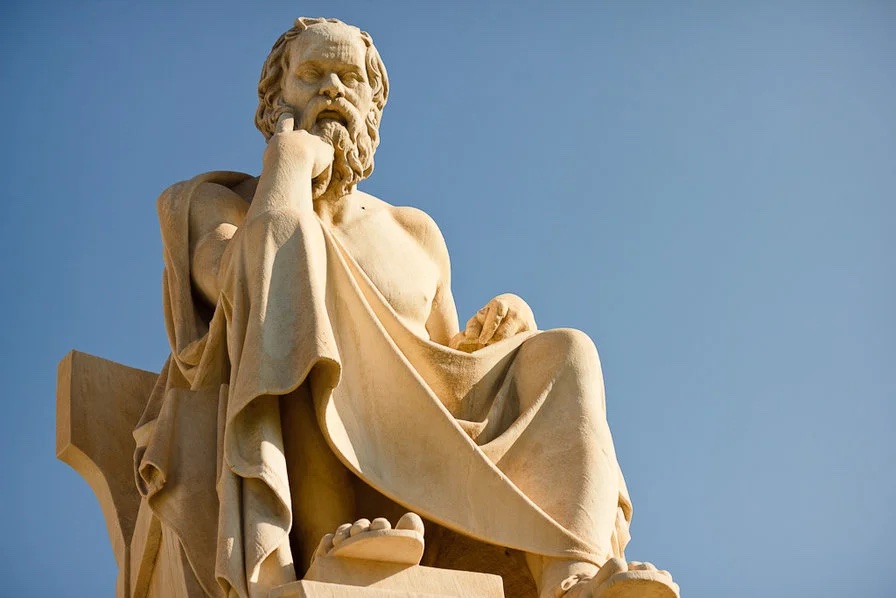
Socratic irony represents one of the most distinctive features of Socrates’ philosophical method. Rather than presenting himself as an unquestionable authority, Socrates often approached his interlocutors as someone who wanted to investigate a question with them.
He asked apparently simple questions and encouraged people to explain what they believed they already understood. In this way, a confident statement could become the starting point for a much deeper philosophical examination.
According to the Stanford Encyclopedia of Philosophy’s entry on Socrates, Socrates developed a reputation for irony because he frequently claimed that he lacked important knowledge while continuing to guide the discussion through questioning. (Stanford Felsefe Ansiklopedisi)
What Is Socratic Irony?
Socratic irony does not simply mean sarcasm or mockery. Instead, it describes a particular philosophical strategy associated with Socrates’ way of conducting conversations.
Socrates could present himself as someone who did not possess the knowledge that his interlocutor claimed to possess. Consequently, the other person had to explain and defend their position.
Moreover, Socrates could use the answers he received as the basis for additional questions. The discussion therefore moved from an apparently simple definition toward increasingly complex problems.
The exact interpretation of Socratic irony remains debated among scholars. Nevertheless, ancient and modern discussions consistently connect the concept with Socrates’ characteristic practice of questioning people who claimed to possess knowledge. (Stanford Felsefe Ansiklopedisi)
Socrates and the Illusion of Knowledge
One of the central concerns of Socratic philosophy involves the difference between possessing knowledge and believing that one possesses knowledge.
Plato presents an important example in the Apology. Socrates explains how he questioned people who enjoyed reputations for wisdom. In one passage, he concludes that his limited form of wisdom consists in recognizing that he does not know what he does not know. The Perseus Digital Library text of Plato’s Apology, 21d preserves this famous discussion. (Perseus)
Therefore, Socratic questioning does not merely challenge another person’s opinion. It also examines the confidence behind that opinion.
For example, someone might confidently define justice, courage, or virtue. Socrates could then ask further questions to determine whether that definition remained consistent in different circumstances.
How Socratic Questioning Works
The Socratic method generally begins with a claim made by the interlocutor. Socrates then examines that claim through a sequence of questions.
First, he asks the person to clarify the original statement. Next, he introduces additional questions that test its implications. Then, he compares the answers with the assumptions that support the original claim.
The Stanford Encyclopedia of Philosophy’s discussion of Plato’s shorter ethical works describes the elenchus as a form of examination in which Socrates begins with his interlocutor’s own beliefs and uses further questions to test their consistency. (Stanford Felsefe Ansiklopedisi)
As a result, the person may discover that two of their beliefs conflict with one another.
The Meaning of Elenchus
The Greek term elenchus plays an important role in discussions of Socratic philosophy. Scholars commonly use the term to describe Socrates’ method of testing a person’s claims through questioning and argument.
Furthermore, the method does not necessarily require Socrates to provide a ready-made answer. Instead, the interlocutor must examine the consequences of their own statements.
The Stanford Encyclopedia of Philosophy explains that Socrates often begins with a person’s claim to knowledge and then examines whether the person can consistently defend that claim. (Stanford Felsefe Ansiklopedisi)
Thus, the method turns philosophical dialogue into a form of intellectual self-examination.
Why Did Socrates Claim Ignorance?
Socrates’ repeated references to his own ignorance form an important part of his philosophical persona. However, his claim did not simply mean that he had no intellectual knowledge whatsoever.
In Plato’s Apology, Socrates describes his investigation of people regarded as wise. He discovers that some individuals believe they understand matters that they cannot adequately explain.
The Perseus Digital Library version of Apology 21a–21e presents Socrates’ account of this investigation. (Perseus)
In contrast, Socrates recognizes the limits of his own knowledge. Therefore, his philosophical position creates an unusual relationship between knowledge and ignorance.
Socratic Irony and Intellectual Humility
Socratic irony encourages intellectual humility. A person who recognizes the limits of their knowledge becomes more capable of examining assumptions and considering alternative explanations.
In addition, Socrates’ method shifts attention from simply possessing an answer to understanding the reasons behind that answer.
Plato’s Apology contains another important formulation of this idea. Socrates argues that thinking one knows something that one does not know represents a serious form of ignorance. Readers can consult the Perseus Digital Library translation of Apology 29a–29b for this passage. (Perseus)
Consequently, Socratic philosophy treats awareness of ignorance as a potential beginning of philosophical inquiry rather than as an intellectual failure.
From Certainty to Aporia
Socratic questioning can lead to aporia, a state of puzzlement or intellectual impasse. The interlocutor may begin the conversation with confidence but eventually discover that their definition cannot answer every question.
Nevertheless, reaching aporia does not necessarily mean that the philosophical investigation has failed.
On the contrary, uncertainty can reveal weaknesses in an argument that previously appeared convincing. The person can then reconsider the original assumption and continue the investigation.
The Stanford Encyclopedia of Philosophy connects Socratic elenchus with dialogues that move toward aporia when an interlocutor cannot sustain the original position. (Stanford Felsefe Ansiklopedisi)
Socratic Irony Is Not Simply Sarcasm
Modern readers sometimes associate irony with sarcasm. However, Socratic irony has a more specific philosophical function.
Socrates’ apparent lack of knowledge creates an opportunity for dialogue. Meanwhile, his questions encourage the other person to articulate assumptions that might otherwise remain unexamined.
For this reason, Socratic irony works as an investigative technique rather than merely a rhetorical joke.
The Stanford Encyclopedia of Philosophy’s discussion of Socrates emphasizes the connection between Socrates’ reputation for irony and his characteristic practice of claiming ignorance while directing philosophical conversations through questions. (Stanford Felsefe Ansiklopedisi)
Socrates and the Examination of Life
Socratic questioning extends beyond abstract definitions. Socrates also examined how people lived and whether their beliefs could withstand rational examination.
Plato famously associates Socrates with the principle that an unexamined life lacks genuine value. The Stanford Encyclopedia of Philosophy discusses this aspect of Socrates’ philosophical mission and his continuing examination of himself and others. (Stanford Felsefe Ansiklopedisi)
Accordingly, Socratic philosophy connects knowledge with self-examination. A person should not simply accept inherited assumptions but should ask whether those assumptions withstand careful questioning.
The Continuing Importance of Socratic Questioning
The influence of Socratic questioning extends far beyond ancient Greek philosophy. Modern discussions of critical thinking, philosophical education, ethics, and intellectual inquiry frequently draw on the idea that carefully structured questions can expose assumptions and contradictions.
Moreover, the method remains relevant because it does not require immediate agreement. Instead, it encourages participants to examine the reasoning behind their positions.
Ultimately, Socratic irony transforms apparent ignorance into a method of investigation. Socrates does not simply tell people what to think. He asks questions that encourage them to investigate what they think they know.
References
- Stanford Encyclopedia of Philosophy — Socrates (Stanford Felsefe Ansiklopedisi)
- Stanford Encyclopedia of Philosophy — Plato’s Shorter Ethical Works (Stanford Felsefe Ansiklopedisi)
- Perseus Digital Library — Plato, Apology, 21d (Perseus)
- Perseus Digital Library — Plato, Apology, 21a–21e (Perseus)
- Perseus Digital Library — Plato, Apology, 23a–23c (Perseus)
- Perseus Digital Library — Plato, Apology, 29a–29b (Perseus)
About the Author