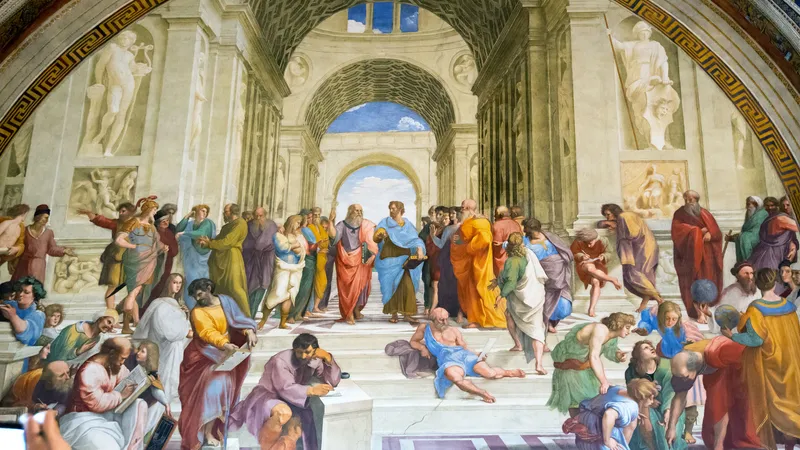
The School of Athens by Raphael ranks among the most celebrated masterpieces of the Italian Renaissance. The fresco does more than portray a gathering of ancient philosophers. Instead, it constructs a visual world in which philosophy, mathematics, science, and art interact within a monumental architectural setting.
Raphael painted the fresco around 1509–1511 for the Stanza della Segnatura in the Vatican Palace. The Vatican Museums describe the room’s decorative program as a representation of major dimensions of human intellectual life, with The School of Athens representing rational truth and philosophy. (Vila Vaticano)
Moreover, the fresco contains an intriguing connection between antiquity and Raphael’s own Renaissance world: several ancient figures appear to carry the features of contemporary artists. Most famously, many scholars and art historians have associated the face of Plato with Leonardo da Vinci. (scholarship.claremont.edu)
Raphael and the School of Athens as a Visual History of Philosophy
At first glance, The School of Athens appears to depict an imaginary meeting of ancient intellectuals. Raphael, however, brings together thinkers who lived in different centuries.
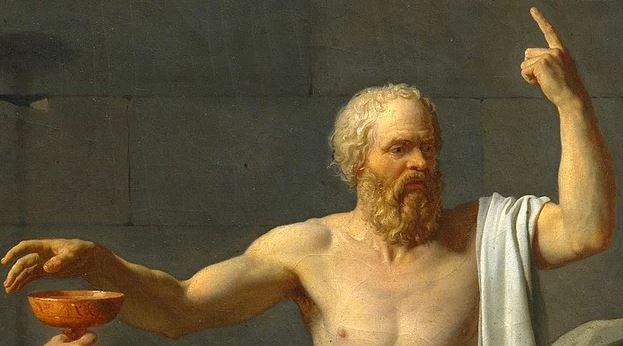
Plato and Aristotle stand at the center of the composition. Around them, Raphael presents figures traditionally identified with philosophers, mathematicians, and scholars such as Socrates, Pythagoras, Diogenes, Euclid, Zoroaster, and Ptolemy. (Vila Vaticano)
Consequently, Raphael does not present a literal historical event. Rather, he creates an ideal intellectual community in which different traditions of knowledge can meet.
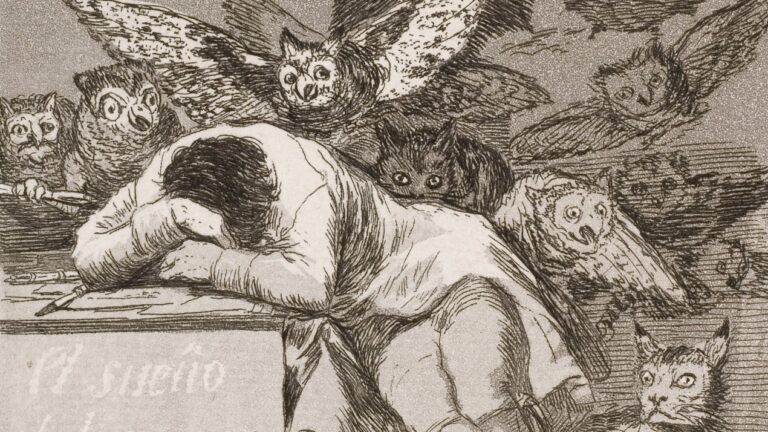
This approach reflects the intellectual climate of Renaissance humanism. Renaissance scholars increasingly studied Greek philosophy, mathematics, literature, and science, while artists sought to integrate classical knowledge into contemporary culture. Thus, the School of Athens by Raphael becomes a visual history of thought, an idea that Hegel would later explore through the image of the Owl of Minerva.
Plato and Aristotle at the Center of Raphael’s School of Athens
The central position of Plato and Aristotle carries particular significance.
Plato stands on the left and holds his Timaeus. He raises one hand toward the heavens. Aristotle, meanwhile, holds his Nicomachean Ethics and extends his hand toward the world below. (Vila Vaticano)
These gestures provide a visual contrast between two philosophical orientations.
Plato’s upward gesture traditionally suggests his emphasis on transcendent Forms and a higher level of reality. Aristotle’s downward gesture, by contrast, suggests his greater attention to the observable and empirical world.
However, Raphael does not portray the two philosophers as enemies. Instead, he places them side by side within the same architectural and intellectual framework.
In this sense, the composition suggests that different approaches to knowledge can participate in a broader search for truth.
Why Does Raphael Place Philosophy in Such a Grand Building?
The architecture contributes significantly to the meaning of the fresco.
The monumental building recalls classical architecture and also reflects contemporary Renaissance architectural ideals. The Vatican Museums note that Raphael based the architecture on Bramante’s project for the renewal of the early Christian Basilica of St. Peter. (Vila Vaticano)
Therefore, the architectural space does not merely provide a background.
It gives philosophy a monumental setting.
Furthermore, Raphael uses linear perspective to organize the large number of figures. The architectural lines guide the viewer toward the central figures of Plato and Aristotle.
As a result, perspective becomes an intellectual device as well as a visual one. The composition directs the eye toward the philosophical center of the fresco.
Who Are the Other Philosophers?
Raphael surrounds Plato and Aristotle with numerous thinkers.
On the left side, the fresco traditionally identifies Pythagoras among the figures. He appears to study mathematical and musical relationships. Diogenes lies casually on the steps, creating a striking contrast with the formal activity around him. (Vila Vaticano)
On the right, Euclid demonstrates geometry to students. Nearby, Raphael includes Zoroaster with a celestial globe and Ptolemy with an earthly globe. (Vila Vaticano)
Thus, the fresco extends beyond philosophy in the narrow sense.
It incorporates mathematics, astronomy, geometry, music, and natural knowledge into the same intellectual universe.
For this reason, the School of Athens can function as a visual representation of Renaissance ideas about the interconnectedness of knowledge.
The Surprising Face of Leonardo da Vinci
One of the most intriguing details appears at the very center of the fresco.
The face of Plato strongly resembles known images of Leonardo da Vinci. Art historians have long discussed this resemblance, although scholars cannot establish the identification with absolute certainty. (scholarship.claremont.edu)
A 2021 article by Frode Sirnes Larsen in the Journal of Humanistic Mathematics argues that Raphael intentionally gave Plato the features of Leonardo. Larsen connects this visual choice with Leonardo’s ideas about painting, mathematics, and the status of painting as a liberal art. (scholarship.claremont.edu)
This interpretation makes the image even more fascinating.
If Raphael deliberately used Leonardo’s likeness, then Plato does not simply represent an ancient philosopher. He also connects ancient philosophy with Renaissance intellectual culture.
Why Would Raphael Use Leonardo’s Face?
Raphael and Leonardo belonged to the same extraordinary artistic generation.
Leonardo represented an ideal of the Renaissance polymath: a painter who also investigated mathematics, anatomy, engineering, nature, and optics.
Therefore, placing Leonardo’s likeness on Plato could create a symbolic connection between ancient philosophical knowledge and Renaissance intellectual achievement.
Larsen proposes an even more specific connection. He argues that Raphael’s treatment of Plato and the Timaeus may allude to Luca Pacioli’s De Divina Proportione, a mathematical work that included Leonardo’s contributions. (scholarship.claremont.edu)
Nevertheless, this interpretation remains a scholarly argument rather than an established historical fact.
That distinction matters because Renaissance artworks often contain identifications that scholars continue to debate.
Raphael Also Included Michelangelo
The references to contemporary artists do not end with Leonardo.
The Vatican Museums identify the figure leaning against a block of marble as Heraclitus, while noting that Raphael gave the figure the features of Michelangelo. Michelangelo worked on the nearby Sistine Chapel during the same period. (Vila Vaticano)
This detail creates another remarkable connection between antiquity and Renaissance Rome.
Raphael effectively places his own artistic world inside the world of ancient philosophy.
Moreover, the Vatican Museums identify the figure wearing a black cap at the far right as Raphael’s self-portrait. (Vila Vaticano)
Consequently, the fresco contains a subtle dialogue between Plato, Leonardo, Michelangelo, Raphael, and the intellectual culture of classical antiquity.
Renaissance Artists Enter the Ancient World
This strategy gives the fresco an important conceptual dimension.
Raphael does not simply reconstruct ancient Athens. Instead, he imagines antiquity through the intellectual concerns of his own period.
In other words, the School of Athens presents ancient thinkers while simultaneously celebrating the Renaissance belief that contemporary artists and scholars could enter into dialogue with the ancient world.
This approach explains why the fresco feels both historical and contemporary.
The philosophers belong to antiquity, yet their faces and artistic environment connect them to sixteenth-century Rome.
The Fresco as a Meeting Point of Art and Philosophy
The School of Athens also challenges the modern distinction between the humanities and the sciences.
Pythagoras represents mathematical thought. Euclid represents geometry. Ptolemy represents astronomy and geography. Plato and Aristotle represent philosophical inquiry.
Meanwhile, Raphael himself demonstrates that artistic creation can interact with mathematics, geometry, perspective, and philosophical ideas.
Indeed, the fresco turns the organization of knowledge itself into an artistic subject.
Why the School of Athens by Raphael Still Matters
The importance of the School of Athens by Raphael extends beyond its visual beauty.
First, it presents philosophy as a collective intellectual activity. The figures discuss, teach, calculate, read, and debate.
Second, it presents different forms of knowledge within one coherent space.
Third, it connects classical antiquity with Renaissance culture.
Finally, the possible image of Leonardo as Plato creates a fascinating bridge between two intellectual worlds.
For this reason, the School of Athens remains more than a famous Renaissance painting. It functions as a visual argument about knowledge, dialogue, philosophy, mathematics, and the relationship between antiquity and modernity.
Conclusion: Raphael Turned the School of Athens into a Visual World of Philosophy
Raphael transformed the School of Athens into a monumental image of intellectual dialogue. Plato and Aristotle occupy the center, while numerous philosophers, mathematicians, and scholars surround them.
More importantly, Raphael connects the ancient world with his own era. The possible likeness of Leonardo in the figure of Plato and the recognizable features of Michelangelo in Heraclitus demonstrate how Renaissance Rome could enter the imagined world of ancient Athens. (Vila Vaticano)
Ultimately, the fresco suggests that knowledge does not belong to a single period or discipline. Instead, different thinkers can encounter one another across centuries.
That idea explains much of the enduring power of Raphael’s masterpiece.
Bibliography
- Vatican Museums. The School of Athens. Vatican Museums. (Vila Vaticano)
- Vatican Museums. Room of the Segnatura. Vatican Museums. (Vila Vaticano)
- Khan Academy. Raphael, School of Athens. (Khan Academy)
- Larsen, Frode Sirnes. “Leonardo da Vinci in Raphael’s School of Athens.” Journal of Humanistic Mathematics, vol. 11, no. 2, 2021, pp. 196–243. (scholarship.claremont.edu)
- Margolis, Oren. “Raphael, School of Athens.” Oxford University Cabinet. (Oxford University Cabinet)
About the Author