How Can a Novel Describe an Entire Historical Period?
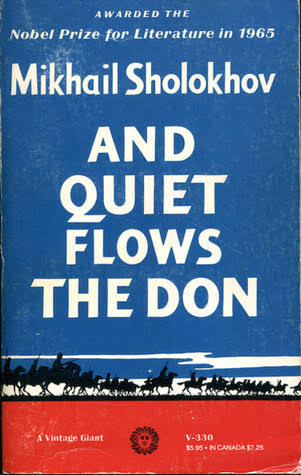
Mikhail Aleksandrovich Sholokhov’s And Quiet Flows the Don (Tikhiy Don) is one of the most comprehensive historical narratives in twentieth-century Russian literature. In this four-volume novel, Sholokhov describes the profound transformation experienced by the Don Cossacks during the First World War, the 1917 Revolution, and the Russian Civil War. The novel examines the effects of war, revolution, and social conflict on the individual, particularly through the life of Grigory Melekhov. This epic is also the main reason behind the Sholokhov Nobel Prize of 1965.
When Sholokhov received the 1965 Nobel Prize in Literature, the Swedish Academy emphasized the “artistic power and integrity” of his Don epic and his ability to portray a historical period in the life of the Russian people. Therefore, the Nobel Committee did not base its decision solely on the success of one novel. Nevertheless, And Quiet Flows the Don stood at the center of Sholokhov’s literary reputation leading to the Nobel Prize.
The novel’s importance derives partly from the fact that it does not portray revolutionary history only through political leaders and military conflicts. Instead, Sholokhov combines major historical events with everyday experiences such as family, love, land, labor, war, and death. As a result, history becomes tangible through the lives of ordinary people.
The Sholokhov Nobel Prize and And Quiet Flows the Don
First, an important distinction must be made. In fact, the Nobel Prize in Literature was not awarded for a single novel. The Swedish Academy awarded the prize to Sholokhov in 1965 and particularly emphasized the artistic power of his Don epic. Moreover, the Nobel Foundation identifies And Quiet Flows the Don as one of Sholokhov’s major works.
The novel represents the culmination of Sholokhov’s literature based on the Don region. In other words, the author does not use the geography of the Don merely as a background. The river, villages, fields, houses, and steppe shape the social world of the novel.
For this reason, the expression “Don epic” in the Nobel citation is particularly significant. While Sholokhov tells the story of a particular family, he also tells the history of an entire community.
What Historical Period Does And Quiet Flows the Don Describe?
The novel covers an exceptionally broad historical period. Sholokhov examines the turbulent years between approximately 1912 and 1920 through the lives of the Don Cossacks. The First World War, the 1917 Revolution, and the Russian Civil War form the novel’s central historical background.
This period represented an extraordinary transformation for Russia. The tsarist regime collapsed, revolution followed, and civil war subsequently broke out between competing political forces.
However, Sholokhov does not simply arrange these events chronologically. Instead, he shows how history can disrupt and fragment an individual’s life.
A person may simultaneously feel attached to family, land, traditions, and political beliefs. Yet war can place these loyalties in direct conflict.
The tragic power of the novel emerges precisely from this tension.
Why Are the Don Cossacks at the Center of the Novel?
The Don Cossacks constituted a distinctive community within the historical and social structure of the Russian Empire. Sholokhov explores their way of life, traditions, family relationships, and military culture in considerable detail.
However, the novel does not transform the Cossacks into a romanticized heroic community.
Instead, Sholokhov also reveals their internal contradictions and divisions. On one side stand traditional life, land, and local identity. On the other stand revolutionary ideas and a new political order. Therefore, the conflict experienced by the Cossacks also becomes a conflict between the old society and the emerging new society.
Sholokhov’s achievement lies in the fact that he does not reduce this historical transformation to abstract ideological concepts. The reader sees the transformation through people’s everyday lives.
Grigory Melekhov: A Man Trapped in the Middle of History
Grigory Melekhov, the central character of the novel, is essential for understanding Sholokhov’s approach to history.
He does not behave like a conventional literary hero who follows a fixed ideological position. Throughout the war, revolution, and Civil War, he encounters different sides and repeatedly faces difficult choices.
Consequently, his story raises a more complex question than simply asking, “Which side was right?”
How can an individual preserve a moral direction while living through a major historical conflict?
Grigory’s conflicts strengthen the human-centered structure of the novel. Academic studies also emphasize the novel’s treatment of human behavior, moral choices, and the preservation of humanity under the conditions of war and civil conflict. KCI – academic research on Sholokhov
Thus, for Sholokhov, history is not merely the history of states or armies. History is also a process experienced within the individual conscience.
Why Is the Novel More Than a “War Novel”?
And Quiet Flows the Don contains exceptionally powerful descriptions of warfare. However, placing the novel exclusively within the category of war literature would narrow its scope.
Alongside war, Sholokhov describes family relationships, love, sexuality, agricultural production, traditions, religious beliefs, and social hierarchy.
Consequently, war enters every one of these areas.
For example, the conflicts in Grigory’s private life do not develop independently of political conflicts. Romantic relationships, family bonds, and political choices influence one another.
This structure gives the novel a broad social panorama.
The Indiana University Press study of Russian realism also notes that, with its approximately 1,500 pages, the novel presents Cossack life in considerably greater detail and realism than earlier literary examples. Indiana University Press – Introduction to Russian Realism: Sholokhov
Sholokhov’s Concept of Realism
Sholokhov does not use realism merely to provide detailed descriptions. For him, realism means portraying the complex ways in which human beings respond to historical circumstances.
Therefore, the characters in the novel are not one-dimensional.
Characters may behave courageously in one situation and fearfully in another. They may act generously at one moment and selfishly at another. The same individual can make different decisions under different circumstances.
This approach removes human behavior during wartime from a simplistic “good versus evil” framework.
Indeed, academic studies emphasize that Sholokhov examines the experience of revolution and civil war through human life, violence, and moral choices. Philology. Theory & Practice – Sholokhov study
The Don River Is More Than a Setting
The Don River, which appears in the title, also occupies an important position within the novel’s symbolic structure.
Still, the river continues to flow. In contrast, human lives become fragmented by wars, revolutions, and deaths.
This contrast reinforces one of the novel’s central ideas:
History changes, people die, and societies transform; however, nature continues to flow according to its own rhythm.
For this reason, the Don River functions throughout the novel both as a real geographical element and as a symbol of historical continuity.
Academic research also identifies the contrast between the “quiet” and “troubled” Don as an important metaphor in the novel’s understanding of history. Philology. Theory & Practice – “Good and Evil in the Novel by M. A. Sholokhov”
Where Does the Revolution Stand in the Novel?
Although Sholokhov’s novel emerged during the Soviet period, it does not present the Revolution solely as a narrative of triumph.
For some people, the Revolution creates hope for a new future. However, for others, the same process means destroyed homes, broken families, and death.
Therefore, the novel makes visible the tension between revolution and human life.
Grigory’s uncertainty, in particular, demonstrates a human psychology that cannot easily fit into a single ideological framework. This characteristic distinguishes the novel from simpler political narratives of its period.
The Novel’s Most Powerful Theme: Humanity and History
One of the central concepts for explaining the significance of And Quiet Flows the Don in relation to the Nobel Prize is the relationship between humanity and history.
Sholokhov brings major historical events down to the level of individual lives. War, revolution, and civil war do not appear merely as historical subjects in textbooks. They enter people’s homes, meals, loves, and families.
This approach increases the novel’s universality.
The reader does not see only twentieth-century Russia. Beyond that, readers also encounter the broader question of how war can transform human life in any society.
The Nobel Committee’s emphasis on Sholokhov’s ability to portray “a historical period in the life of the Russian people” points directly to this aspect of the novel. The Nobel Prize – Mikhail Sholokhov
Why Is the Novel Compared with Tolstoy’s War and Peace?
Because of its scale and historical approach, And Quiet Flows the Don is frequently compared with Leo Tolstoy’s War and Peace. (For a closer look at Tolstoy’s characters, see our article on jealousy in Tolstoy’s novels.)
Both works combine war and everyday life within the same narrative. Moreover, both novels make major historical events visible through the lives of different families and individuals.
However, there is an important difference.
While Tolstoy presents a broad panorama of Russian aristocratic society during the Napoleonic Wars, Sholokhov focuses on the world of the Don Cossacks.
Therefore, Sholokhov’s novel is more explicitly rooted in a particular regional culture. Nevertheless, the human problems it describes acquire universal significance. Indiana University Press – Sholokhov and Russian Realism
Fourteen Years of Literary Work
Sholokhov worked on And Quiet Flows the Don for approximately 14 years. The novel began appearing in installments in 1928, and the final volume appeared in 1940.
This lengthy period of work directly relates to the novel’s enormous scope.
Sholokhov did not merely construct a plot. He brought together the social structure of the Don region, Cossack culture, the experience of war, and the political conflicts of the revolutionary period within a single monumental narrative.
As a result, the novel became an enormous historical panorama of approximately 1,500 pages.
The Controversy Over the Novel’s Authorship
Even after Sholokhov received the Nobel Prize, one of the most important controversies surrounding And Quiet Flows the Don remained unresolved: Did Sholokhov really write the entire novel?
Some researchers have argued that the work was based on an earlier text written by the Cossack writer Fyodor Kryukov. This claim generated a long-running debate and became an important controversy concerning Sholokhov’s literary legacy. Oxford Academic – Sholokhov and the authorship debate
However, this controversy should not be confused with the reasoning behind the Nobel Prize. In 1965, the Nobel Committee awarded Sholokhov the prize for the artistic power of his Don epic and his ability to portray the historical experience of the Russian people.
Consequently, the academic debate over authorship constitutes a separate issue, while the novel’s influence on twentieth-century Russian literature represents a much broader field of evaluation.
Why Was And Quiet Flows the Don So Important for the Sholokhov Nobel Prize?
The novel’s significance in relation to the Nobel Prize can be summarized through several fundamental points:
1. Its historical scope is exceptionally broad.
Sholokhov describes a major transformation extending from the First World War to the Russian Civil War.
2. It places the individual at the center.
The novel makes historical events tangible through the lives of characters such as Grigory Melekhov.
3. It presents the world of the Don Cossacks in considerable detail.
In this way, it brings the culture of a particular community into world literature.
4. It demonstrates the impact of war on human beings.
Violence, death, fear, and moral choices constitute some of the novel’s central concerns.
5. It establishes a powerful relationship between literature and history.
Rather than simply listing events like a history textbook, the novel presents historical transformation through human experience.
6. It combines realism with epic narrative.
Sholokhov integrates a broad social panorama with detailed character analysis.
The Swedish Academy’s Nobel citation brings many of these characteristics together in a single formulation: Sholokhov expressed a historical period in the life of the Russian people through the Don epic with “artistic power and integrity.” The Nobel Prize – The 1965 Nobel Prize in Literature
References
- Nobel Prize Outreach. “Mikhail Sholokhov – Facts.” NobelPrize.org. Nobel Prize – Mikhail Sholokhov
- Nobel Prize Outreach. “The Nobel Prize in Literature 1965.” NobelPrize.org. 1965 Nobel Prize in Literature
- Nobel Prize Outreach. “Facts on the Nobel Prize in Literature.” NobelPrize.org. Facts on the Nobel Prize in Literature
- Ostrowski, Donald. “Did Mikhail Sholokhov Write The Quiet Don?” Cornell University Press, 2020. Oxford Academic – Sholokhov authorship debate
- Iosifyan, Marina. “And Quiet Flows the Don: The Sholokhov-Kryukov Authorship Debate.” Digital Scholarship in the Humanities, 2020. Oxford Academic – Authorship debate
- Kandemir, Hüseyin. “An Epic Novel ‘And Quiet Flows the Don’ and the Traces of a Destruction: Revolution, War, Death.” Ankara University Journal of the Faculty of Languages and History-Geography, 48(2), 2008, pp. 95–110. Ankara University Journal / DergiPark
- Indiana University Press. “Introduction to Russian Realism: Sholokhov.” Indiana University Press – Sholokhov
- Grechushkina, N. V. “Good and Evil in the Novel by M. A. Sholokhov ‘Quietly Flows the Don’: Axiological Aspects of Historical Images.” Philology. Theory & Practice, 2017. Philology. Theory & Practice
About the Author