Francisco de Goya’s Los Caprichos occupies a crucial position in the history of European printmaking. Published in 1799, the series combined satire, imagination, social observation, and criticism of irrational behavior. More importantly, Goya used the relatively accessible medium of printmaking to examine problems that affected Spanish society at the end of the eighteenth century.
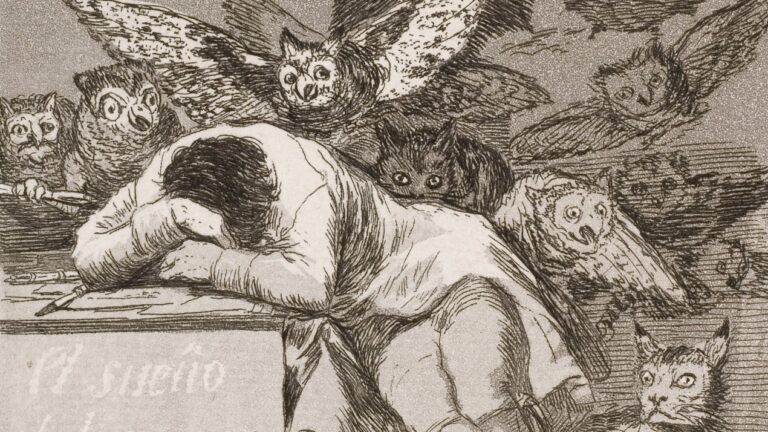
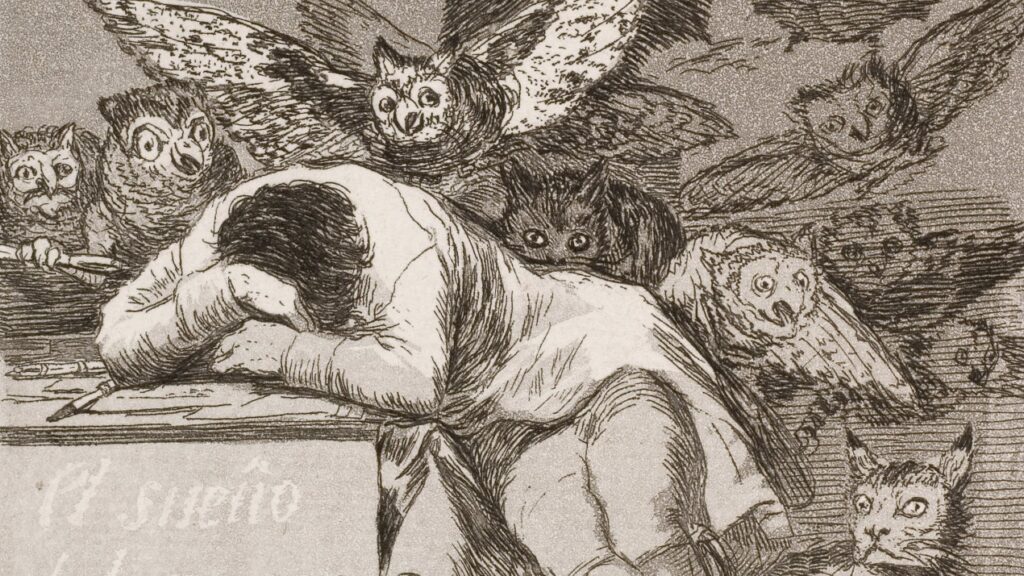
The series contains 80 prints, and The Sleep of Reason Produces Monsters (El sueño de la razón produce monstruos) became its most famous image. The Metropolitan Museum of Art describes the work as the best-known image from the series and notes that scholars generally understand Los Caprichos as a critique of the society in which Goya lived. (The Metropolitan Museum of Art)
Goya and the Culture of the Enlightenment
Goya created Los Caprichos during a period when Enlightenment thinkers increasingly emphasized reason, education, and critical inquiry.
However, Spanish society still contained widespread superstition, ignorance, and deeply rooted social inequalities. Goya observed these contradictions and transformed them into visual satire.
The Prado Museum connects the series with Enlightenment concerns about poor education, ignorance, superstition, and abuses of power. Furthermore, the museum identifies several recurring subjects, including social vices, criticism of the clergy, and the abuse of institutional authority. (Prado Müzesi)
Therefore, Los Caprichos does not simply illustrate strange or imaginary scenes. Instead, Goya uses strange images to expose recognizable human behavior.
What Are Los Caprichos?
Goya worked on the series mainly between approximately 1796 and 1798, and the Caprichos appeared publicly in 1799.
The series contains 80 etchings and aquatints. Goya combined these techniques to create strong contrasts between light and darkness, while aquatint allowed him to produce broad tonal areas and atmospheric effects. (The Metropolitan Museum of Art)
Moreover, Goya prepared drawings before transferring his ideas into prints. The Prado notes that many of the preliminary drawings survive and that the earlier Dreams drawings provided the starting point for the Caprichos. (Prado Müzesi)
Thus, the series emerged from a sustained process of experimentation rather than from spontaneous invention.
The Social Criticism of Los Caprichos
Goya addresses several interconnected forms of social dysfunction throughout the series.
First, he attacks ignorance and inadequate education. Second, he examines superstition and witchcraft. Third, he exposes vanity, greed, laziness, and other social vices. Finally, he criticizes abuses of power and institutional injustice.
The Prado identifies these themes as major components of the series. It also notes that contemporary viewers interpreted some prints as criticism directed at particular institutions and individuals, including political figures and the monarchy. (Prado Müzesi)
Nevertheless, we should distinguish documented historical interpretation from speculation about Goya’s intentions. The prints allow several readings, and scholars have continued to debate their precise meanings.
The Sleep of Reason Produces Monsters
Among the 80 prints, Plate 43, The Sleep of Reason Produces Monsters has achieved exceptional fame.
The image shows a sleeping figure surrounded by nocturnal creatures. Owls, bats, and other animals emerge from the darkness, while a lynx remains alert nearby.
At first glance, the scene appears to represent a nightmare. However, Goya creates a more complex relationship between sleep, imagination, and reason.
The Metropolitan Museum explains that the image eventually came to symbolize the broader meaning of Los Caprichos: the dangers that emerge when reason loses control. (The Metropolitan Museum of Art)
Why Does Reason Produce Monsters?
The title presents a paradox.
If reason falls asleep, irrational forces gain greater freedom. Consequently, superstition, fear, prejudice, and fantasy can dominate human thought.
Yet Goya does not present reason as an uncomplicated source of absolute truth. The Prado specifically notes that Goya does not simply transform reason into unquestionable truth in this image. (Prado Müzesi)
This distinction makes the print particularly important.
Goya does not merely say that humans should abandon imagination. Instead, he explores what can happen when critical judgment disappears and irrational forces dominate consciousness.
The Animals in the Darkness
The animals contribute significantly to the print’s meaning.
Bats and owls surround the sleeping figure and create an atmosphere of uncertainty. Their presence connects darkness with forces that remain hidden during rational daylight.
Meanwhile, the lynx introduces a contrasting element. The animal appears alert and observant, which creates a visual opposition between vigilance and unconsciousness.
Therefore, Goya constructs meaning through the contrast between sleep and awareness, darkness and light, reason and irrationality.
Superstition and Ignorance
Superstition represents one of the most important subjects in Los Caprichos.
Goya repeatedly associates irrational beliefs with inadequate education and ignorance. The Prado’s research on the series specifically identifies witchcraft and superstition as expressions of ignorance and insufficient education. (Prado Müzesi)
Furthermore, Goya does not restrict his criticism to individual believers. He examines the social mechanisms that allow irrational beliefs to survive.
For this reason, his satire operates on both an individual and institutional level.
Education as a Defense Against Irrationality
Education occupies an important place in Goya’s visual criticism.
Goya lived during an era when Enlightenment thinkers increasingly emphasized education as a means of improving society. Consequently, ignorance represented more than a lack of information; it could also create conditions in which superstition and manipulation flourished.
The Prado identifies incorrect education and ignorance as one of the four major thematic groups within Los Caprichos. (Prado Müzesi)
In this sense, Goya’s satire contains an implicit educational dimension. He encourages viewers to examine familiar behaviors rather than accept them without question.
Goya and the Criticism of Social Vices
Goya also examines human weaknesses such as vanity, greed, laziness, gluttony, and sexual exploitation.
However, he rarely presents these subjects through straightforward moral instruction. Instead, he exaggerates physical appearances and creates grotesque situations.
As a result, the viewer encounters an uncomfortable mixture of humor and criticism.
Indeed, this combination distinguishes Goya from a conventional moralist. He makes the viewer confront human absurdity while simultaneously creating images that remain visually fascinating.
Criticism of Power and Institutions
Los Caprichos also addresses abuses of power.
The Prado identifies criticism of the Inquisition, ruling elites, exploitation, and injustice within the legal system among the series’ major concerns. (Prado Müzesi)
Therefore, Goya’s criticism extends beyond personal morality. He also examines the relationship between individuals and institutions.
In some prints, authority appears absurd or grotesque. In others, vulnerable people encounter systems that they cannot easily challenge.
Consequently, Los Caprichos can function as both a psychological and social critique.
Why Did Goya Use Satire?
Direct criticism could create considerable risks for an artist working within a hierarchical society.
Goya therefore used ambiguity, metaphor, exaggeration, and fantasy. These devices allowed him to criticize recognizable problems without reducing every print to a single explicit political statement.
Moreover, ambiguity increased the intellectual participation of the viewer. Instead of receiving a simple message, viewers had to interpret the scene.
Thus, satire became a method of visual inquiry.
The Importance of Ambiguity
One of the most remarkable characteristics of Los Caprichos lies in its resistance to a single interpretation.
The Prado notes that viewers have offered varied interpretations of the series from Goya’s own time to the present. (Prado Müzesi)
This ambiguity helps explain the continuing relevance of the prints.
For example, The Sleep of Reason Produces Monsters can evoke debates about superstition, imagination, education, irrationality, and the limits of reason. Each perspective highlights a different dimension of the image.
From Enlightenment Criticism to Modern Art
Goya’s Los Caprichos occupies an important position between Enlightenment satire and modern visual culture.
His distorted figures, psychological darkness, grotesque animals, and ambiguous symbolism anticipate concerns that later became prominent in Romanticism and modern art.
Furthermore, his willingness to depict irrationality without completely explaining it gives the series an unusually modern character.
In fact, Goya’s images often raise questions rather than provide definitive answers.
Why The Sleep of Reason Produces Monsters Remains Relevant
The enduring power of the print comes from its ability to connect an eighteenth-century debate with a much broader human problem.
When critical judgment weakens, fear and irrationality can influence individual and collective behavior. However, Goya also reminds us that imagination itself does not simply represent an enemy of reason.
Instead, the image creates tension between the two.
Ultimately, this tension gives The Sleep of Reason Produces Monsters its intellectual strength. The print asks viewers to consider what happens when human beings stop questioning the forces that shape their beliefs.
Bibliography
- Museo Nacional del Prado. “The Sleep of Reason Produces Monsters.” Collection of Francisco de Goya. Museo del Prado — The Sleep of Reason Produces Monsters
- Museo Nacional del Prado. “Goya: Drawings. Only My Strength of Will Remains.” Exhibition materials on the Dreams drawings and Los Caprichos. Museo del Prado — Goya Drawings
- Metropolitan Museum of Art. “Goya: Plate 43 from Los Caprichos: The Sleep of Reason Produces Monsters.” The Metropolitan Museum of Art — Goya, Plate 43
- Museo Nacional del Prado. “El sueño de la razón produce monstruos.” Collection catalogue and scholarly notes. Museo del Prado — Spanish Collection Record
- Museo Nacional del Prado. Matilla, J. M. “Caprichos.” Goya en tiempos de guerra, Madrid, Museo Nacional del Prado, 2008, pp. 170–171. (Prado Müzesi)
About the Author