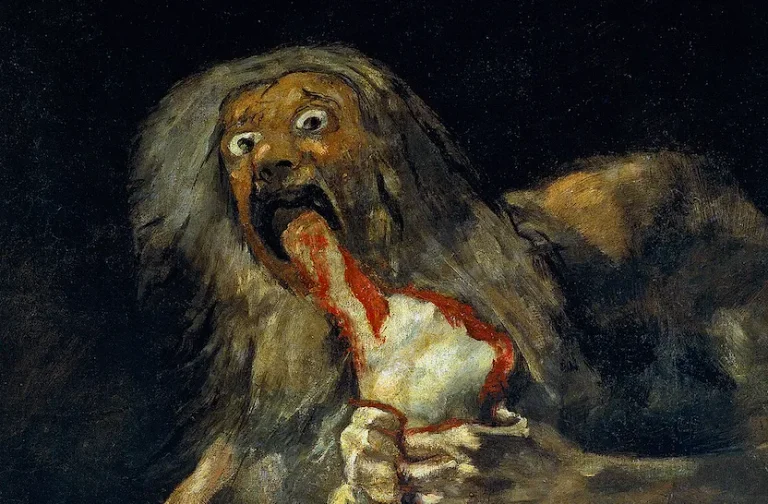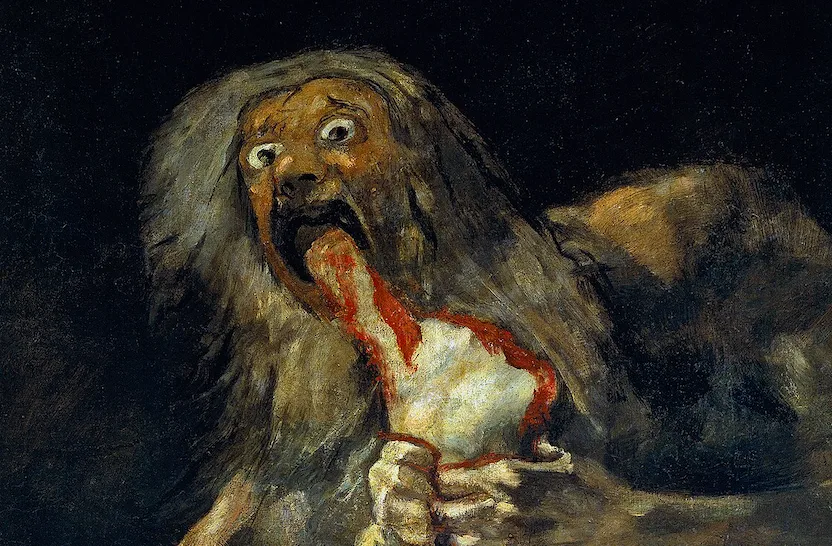
Francisco Goya’s Saturn Devouring His Son stands among the most disturbing images in European art. The painting depicts the mythological Saturn as he violently consumes one of his children. However, the work becomes even more intriguing when we consider its original setting: Goya painted it directly onto the wall of his private home, the Quinta del Sordo, rather than for a church, palace, or public museum. (Prado Müzesi)
This context raises an important question: Why would Goya place such a horrifying image inside his own living environment? Art historians have proposed several interpretations, but no surviving document records Goya’s precise intention. Therefore, any explanation must distinguish historical evidence from later interpretation.
The Painting Behind the Museum Canvas
Today, visitors encounter Saturn at the Prado Museum in Madrid. Yet the present canvas does not represent the work’s original physical form.
Goya painted the image directly onto a dry plaster wall at the Quinta del Sordo around 1820–1823. Later, conservators transferred the mural from the wall onto canvas. The Prado identifies the work as a mixed-technique mural transferred to canvas. (Prado Müzesi)
Consequently, the museum painting preserves the image but not its original architectural environment.
What Was the Quinta del Sordo?
Goya purchased the Quinta del Sordo in 1819, a country house on the outskirts of Madrid near the Manzanares River. He later decorated two large rooms with the works that modern scholars call the Black Paintings. (Prado Müzesi)
The house offered Goya a private environment away from the formal demands of court painting. Indeed, the Prado emphasizes the intimate character of the house and connects that privacy with the artistic freedom Goya exercised in these murals. (Prado Müzesi)
Thus, the Black Paintings represent a striking contrast with the elegant portraits and decorative commissions that Goya produced earlier in his career.
Was Saturn Really in the Dining Room?
The answer requires some qualification.
Researchers have reconstructed the original arrangement of the Black Paintings from inventories, historical descriptions, photographs, architectural evidence, and later research. The Prado places Saturn on the ground floor of the Quinta del Sordo. (Prado Müzesi)
Research by Carlos Foradada and other scholars connects the ground-floor room with the house’s dining area. Historical documentation describes a large dining table and numerous chairs in this part of the house. (AACA Digital)
However, scholars have debated the precise arrangement of some murals. For example, the Fundación Goya en Aragón notes competing reconstructions concerning the original position of Saturn. (Fundación Goya en Aragón)
Therefore, it makes sense to describe Saturn as a mural from the ground-floor dining area of the Quinta del Sordo, while avoiding an overly precise claim about its exact original position.
The Black Paintings Were Private Works
The private character of the Quinta del Sordo provides an essential clue to the Black Paintings.
Goya did not create these murals for a public exhibition. Instead, he painted them directly onto the walls of his own house. Moreover, he covered two rooms with fourteen compositions that explored disturbing subjects, including death, violence, superstition, old age, and human cruelty. (Prado Müzesi)
Consequently, Saturn belongs to a highly personal artistic environment rather than to the conventional tradition of commissioned public painting.
Why Did Goya Choose Saturn?
The mythological story comes from the Roman tradition surrounding Saturn, whom Goya presents through the violent act of consuming his child.
According to the myth, Saturn feared that one of his children would eventually overthrow him. For this reason, he swallowed his offspring in an attempt to preserve his power. Jupiter eventually escaped this fate and later defeated his father. (Prado Müzesi)
Goya therefore selected a myth centered on fear, power, succession, and destruction.
However, the painting does not present the story as an elegant classical narrative. Instead, Goya reduces the myth to an intensely physical and horrifying image.
Saturn as a Symbol of Fear and Power
The Prado proposes an important interpretation: Saturn may personify the human fear of losing power. (Prado Müzesi)
This interpretation fits the mythology particularly well. Saturn possesses enormous power, yet he cannot escape the possibility of losing it. Therefore, his attempt to preserve power becomes an act of extreme violence.
In this sense, the painting presents a paradox: Saturn destroys what he wants to preserve.
Moreover, the image turns political anxiety into a psychological nightmare. Rather than portraying power as stable and secure, Goya presents it as something that generates fear and ultimately produces destruction.
The Father Who Destroys His Own Future
The myth contains another disturbing paradox.
Saturn consumes his children because he fears the future. Yet his violence cannot eliminate that future. Jupiter survives, challenges him, and eventually takes his place.
Thus, Saturn’s violence fails on its own terms.
Goya’s image consequently allows viewers to interpret the myth as a meditation on the destructive consequences of absolute fear. The more Saturn tries to control the future, the more horrifying his present becomes.
Why Did Goya Paint It at Home?
No surviving document gives us a definitive answer.
Nevertheless, the private location allows several historically grounded interpretations.
First, Goya may have used the walls of his house as a space for unusually personal artistic experimentation. The Prado describes the Black Paintings as works through which Goya expressed himself with considerable freedom. (Prado Müzesi)
Second, the murals may reflect Goya’s engagement with themes of mortality, violence, aging, and human irrationality.
Third, the paintings may have created an environment that reflected his increasingly dark artistic imagination.
However, we should not automatically equate the paintings with Goya’s private psychological state. Such a conclusion would move beyond the surviving evidence.
Saturn and the Theme of Human Cruelty
Goya’s treatment of Saturn differs significantly from traditional academic history painting.
A conventional mythological painting might emphasize beauty, narrative clarity, or heroic composition. Goya instead focuses on terror.
Furthermore, Saturn’s enormous eyes, open mouth, and violent gesture dominate the composition. The viewer encounters the act almost directly, without the distance that a conventional mythological treatment might provide.
As a result, the ancient myth becomes an image of human brutality rather than divine grandeur.
The Black Paintings and Modern Art
The importance of Saturn extends beyond Goya’s own period.
The Prado connects the Black Paintings with later artistic movements, particularly German Expressionism and Surrealism. (Prado Müzesi)
Indeed, the paintings anticipate several concerns that modern artists later explored: distorted bodies, psychological anxiety, irrationality, violent imagery, and the rejection of conventional beauty.
Therefore, Saturn occupies an unusual position between traditional European mythology and modern psychological art.
From Wall Painting to Museum Masterpiece
The work’s journey from private house to museum also tells an important story.
In 1873, Baron Émile d’Erlanger acquired the Quinta del Sordo. He subsequently commissioned the transfer of the murals from the walls to canvas. The process caused significant damage and loss of paint. Later, he donated the paintings to the Spanish state, and the Prado eventually received them. The museum has displayed the works since 1889. (Prado Müzesi)
Consequently, today’s viewers encounter Saturn in a completely different context from the one Goya created.
The original wall has disappeared from the viewing experience, while the museum canvas has transformed a private architectural image into an autonomous work of art.
The Mystery of Goya’s Intention
Perhaps the most fascinating aspect of Saturn Devouring His Son remains its ambiguity.
We know where Goya painted it. We know approximately when he painted it. We know the mythological subject and the later history of the mural. Nevertheless, we do not possess a definitive statement from Goya explaining why he created the image.
For this reason, interpretations must remain cautious.
The painting may evoke the fear of losing power. It may address mortality, violence, old age, political anxiety, or destructive human impulses. Alternatively, several of these themes may operate simultaneously.
In fact, the absence of a definitive explanation contributes to the painting’s continuing power.
Bibliography
- Museo Nacional del Prado. “Saturn.” Collection catalogue. Prado Museum — Saturn (Prado Müzesi)
- Museo Nacional del Prado. Valeriano Bozal, “Pinturas negras [Goya].” Prado Encyclopedia. Prado Encyclopedia — Black Paintings (Prado Müzesi)
- Fundación Goya en Aragón. “Saturn Devouring One of His Children.” Fundación Goya en Aragón — Saturn(Fundación Goya en Aragón)
- Foradada Baldellou, Carlos. “El interior de la Quinta del Sordo: Las Pinturas negras de Goya y la maqueta de León Gil de Palacio.” AACA Digital, 2019. AACA Digital — The Interior of the Quinta del Sordo (Dialnet)
- Teixidor Cadenas, Carlos, and Francisco Javier Laguna Rodríguez. “Las Pinturas negras en la Quinta de Goya: Reconstrucción de la planta baja.” Instituto del Patrimonio Cultural de España. (IfC)
About the Author