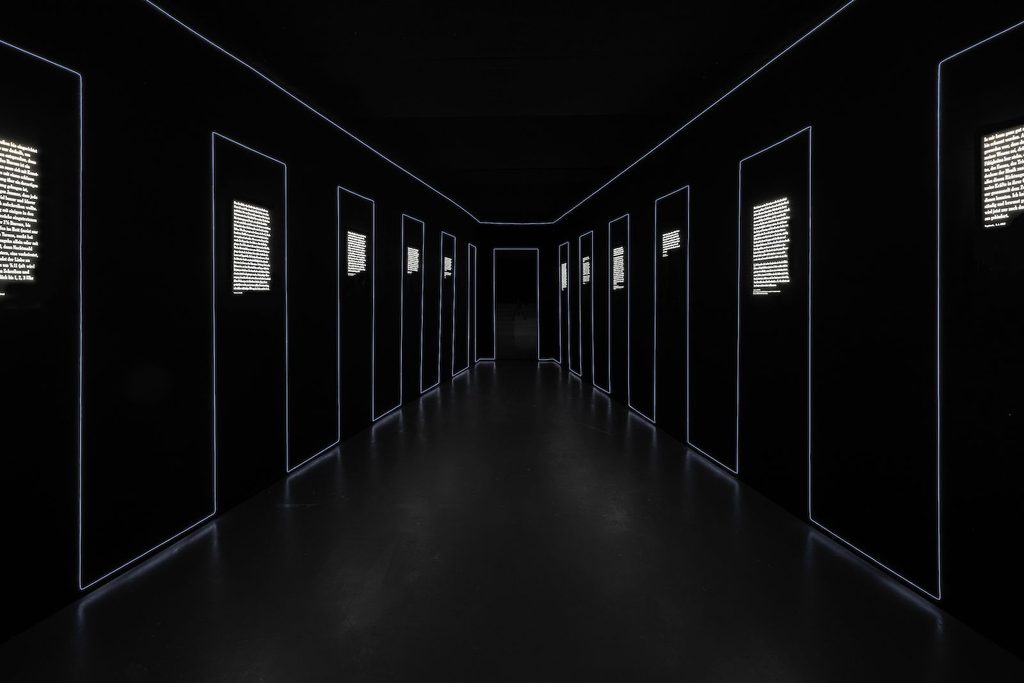
Franz Kafka’s fiction repeatedly places his characters in spaces that resist ordinary interpretation. Doors, corridors, rooms, courts, castles, offices, and bureaucratic institutions do not merely provide backgrounds for the narrative. Instead, they shape how characters experience authority, exclusion, uncertainty, and social isolation. In this sense, Kafka bureaucracy is as much a matter of architecture as of rules and officials.
This spatial dimension becomes particularly important in The Trial (Der Prozess) and The Castle (Das Schloss). In both novels, the protagonist seeks access to an elusive institutional center. However, the closer he comes to that center, the more complicated access becomes. Recent scholarship likewise emphasizes the labyrinthine spatial structures of both novels and their relationship to the characters’ movements and social positions. (CEEOL)
Kafka, Bureaucracy, and the Meaning of Space
In conventional fiction, a room, street, office, or building often establishes the setting for an event. Kafka uses space differently.
His architectural environments frequently influence the characters’ actions and expectations. Consequently, physical movement becomes closely connected with psychological and social experience.
A corridor may suggest a route toward a destination. Nevertheless, Kafka’s corridors often create further uncertainty rather than provide a clear path. A door may promise access, yet it can also establish a boundary.
Therefore, Kafka transforms ordinary architecture into a system of possibility and restriction.
Scholarly research on The Trial and The Castle identifies labyrinthine spatial organization as an important feature of both novels. Corridors, paths, and alternative routes frequently confuse rather than assist the protagonists. (CEEOL)
Doors as Boundaries
Doors occupy a particularly important position in Kafka’s fictional world.
A door separates one space from another. It therefore creates a basic distinction between inside and outside, access and exclusion, and authority and the individual.
However, Kafka rarely treats a door as a simple physical barrier. The door often represents an institutional or existential obstacle.
The short parable “Before the Law”, which Kafka incorporates into The Trial, provides the clearest example. A man seeks access to the Law but encounters a doorkeeper who prevents him from entering. The man waits for years, yet he never reaches the interior.
Thus, the door becomes more than an architectural object. It represents the individual’s uncertain relationship with an authority that remains inaccessible.
Corridors and the Architecture of Uncertainty
Kafka’s corridors often create the impression of movement without genuine progress.
A character walks forward, enters another room, encounters another official, and receives another instruction. Nevertheless, the destination remains distant.
This pattern produces a distinctive labyrinthine structure.
Recent literary research describes the spatial organization of The Trial and The Castle as labyrinthine, particularly because their corridors, paths, and routes repeatedly complicate rather than facilitate the protagonists’ goals. (CEEOL)
Consequently, Kafka turns movement itself into a source of uncertainty.
The character does not necessarily remain physically stationary. Instead, the character can move constantly while remaining socially and institutionally trapped.
The Trial: When the Court Has No Clear Location
The Trial provides one of Kafka’s most striking examples of unstable institutional space.
Josef K. discovers that a court has accused him, but the court does not occupy a clearly defined institutional building in the conventional sense. Court offices appear in unexpected locations, including ordinary residential spaces and attics.
Therefore, the distinction between private space and institutional space begins to collapse.
Legal authority enters everyday life without announcing a clear boundary between the two.
Legal scholarship on Kafka has emphasized precisely this spatial ambiguity. In The Trial, official and bureaucratic spaces frequently merge with ordinary domestic environments, producing uncertainty about where authority actually resides. (www5.austlii.edu.au)
The Attic and the Hidden Bureaucracy in Kafka
The attic occupies a particularly revealing position in The Trial.
An attic normally belongs to the margins of a building. Kafka, however, places court offices in such marginal spaces.
This arrangement produces an important paradox: the institution appears everywhere and nowhere at the same time.
Josef K. cannot simply locate the court, enter its central building, and confront its officials according to ordinary institutional procedures.
Instead, the court appears through scattered rooms, corridors, officials, documents, and conversations.
As a result, bureaucracy in Kafka loses the transparent structure that a conventional institution should possess.
The Castle as an Elusive Center
The Castle develops the spatial problem even further.
The protagonist, K., arrives in a village dominated by a castle. The castle represents the administrative center of the community, yet K. cannot establish a straightforward relationship with its authorities.
The geographical structure appears relatively simple: village below, castle above.
Nevertheless, the relationship between these two spaces becomes extraordinarily complicated.
K. wants to reach the castle and establish his position within its administrative system. Yet every attempt generates new obstacles, intermediaries, messages, and misunderstandings.
Cambridge research on Kafka’s writing describes this structure as a topographical framework organized around two major points: the village and the castle. K.’s movement toward the castle becomes the central trajectory of his experience. (Cambridge University Press)
The Castle: Kafka Bureaucracy at a Distance
The castle does not function simply as a physical building.
It also represents a remote administrative authority.
K. repeatedly attempts to establish direct contact with the institution, but intermediaries continually intervene. Messages pass between different levels of authority, while their meaning remains uncertain.
Therefore, communication itself becomes spatial.
Information travels through offices, letters, messengers, officials, and administrative channels. Yet communication rarely produces genuine clarity.
Research comparing Kafka and Max Weber’s theories of bureaucracy emphasizes this characteristic. Kafka’s The Castlepresents bureaucracy as a system in which opacity, excessive procedure, and institutional distance become fundamental features of everyday existence. (DOI)
The Geography of Kafka Bureaucracy
In Kafka, bureaucracy does not exist only through rules and officials. It also exists through space.
Offices occupy rooms. Officials occupy buildings. Documents travel between locations. Characters move through corridors while attempting to understand who possesses authority.
Consequently, bureaucracy acquires a physical geography.
The individual must navigate this geography without possessing a reliable map.
This lack of orientation becomes crucial. K. knows that the castle exists, but he cannot determine how to establish a stable relationship with it. Similarly, Josef K. knows that a court exists, yet he cannot identify its institutional center in a conventional sense.
Space, Authority, and Exclusion in Kafka Bureaucracy
In Kafka, bureaucracy and architecture work together to separate individuals from centers of authority.
The individual stands outside a door, while the official occupies an inaccessible room. Meanwhile, the court exists somewhere beyond the protagonist’s immediate reach. The castle remains visible but difficult to approach institutionally.
Thus, visibility does not guarantee accessibility.
K. can see the castle, but seeing it does not give him power over it. Josef K. encounters representatives of the court, but these encounters do not provide a complete understanding of the legal system.
This distinction between visibility and access constitutes one of the most important spatial tensions in Kafka’s fiction.
This logic of recognition and exclusion recalls, in a different register, Hegel’s master–slave dialectic, in which authority depends on who is recognized and who is kept at a distance.
The Paradox of Movement
Kafka’s protagonists frequently move.
They walk through streets, climb stairs, enter rooms, cross buildings, visit offices, and search for officials.
Yet movement does not necessarily produce liberation.
On the contrary, movement can produce further entanglement.
For this reason, Kafka creates a peculiar narrative paradox: physical movement can coexist with institutional immobility.
The character advances geographically while remaining uncertain about his social or legal position.
A recent study of Kafka’s spatial design similarly argues that the labyrinthine structures of The Trial and The Castleshape both character development and narrative relationships. (CEEOL)
The Labyrinth and the Modern Individual
The labyrinth offers a useful conceptual framework for understanding Kafka’s spaces.
A labyrinth contains paths, intersections, boundaries, and uncertain destinations. More importantly, the traveler does not possess complete knowledge of the system.
Kafka’s protagonists experience precisely this kind of uncertainty.
They possess partial information and encounter people who know more than they do. They receive contradictory explanations. Furthermore, they must continue moving despite the absence of a reliable map.
Consequently, Kafka’s labyrinth does not simply describe physical architecture. It represents a condition of limited knowledge.
The Individual Against an Invisible System
Kafka’s characters rarely confront a single, clearly identifiable enemy.
Instead, they encounter systems.
Officials represent the system, but no individual official completely controls it. Documents represent authority, yet documents often generate further questions. Rules exist, but their interpretation remains uncertain.
Therefore, power appears distributed rather than concentrated.
Research on Kafka and bureaucracy has emphasized this feature. Kafka presents bureaucratic power through institutional opacity and through individuals who experience the system from its margins rather than from its administrative center. (Københavns Universitets Forskningsportal)
Architecture and Alienation
Kafka’s spaces also contribute to a broader theme of alienation.
A person normally expects a home, workplace, institution, or public building to provide some degree of orientation.
Kafka reverses that expectation.
Rooms become confusing. Offices become inaccessible. Courts appear in unexpected places. The castle remains simultaneously present and unreachable.
As a result, the individual loses confidence in the ordinary relationship between place and meaning.
Architectural scholarship on The Castle similarly argues that Kafka’s spaces express psychological effects associated with alienation, insecurity, identity, belonging, and modern social conditions. (eurekaselect.com)
Why The Trial and The Castle Remain Important
Kafka’s spatial imagination continues to attract literary, philosophical, legal, and architectural scholarship.
In The Trial, space helps Kafka explore the individual’s relationship with an opaque legal system. In The Castle, spatial distance reinforces the protagonist’s uncertain relationship with administrative authority.
Moreover, the two novels demonstrate how institutions can influence individuals without appearing as clearly bounded physical structures.
Recent scholarship continues to examine The Trial and The Castle in relation to law, bureaucracy, authority, and institutional legitimacy. (Tandfonline)
Thus, the spatial logic of Kafka bureaucracy remains relevant because modern institutions also depend on offices, procedures, documents, access points, hierarchies, and communication networks.
Conclusion: When Space Becomes Power
Kafka’s doors, corridors, rooms, courts, castles, and bureaucratic offices perform more than a decorative function. They construct a world in which space becomes a form of power. Ultimately, Kafka bureaucracy is never only administrative; it is spatial.
A door can separate an individual from authority. A corridor can create movement without progress. An office can conceal rather than clarify institutional power. A castle can remain visible while its administrative center remains inaccessible.
Therefore, Kafka’s spatial world expresses a fundamental tension between the desire for access and the persistence of exclusion.
Ultimately, The Trial and The Castle show how physical movement can become a metaphor for the individual’s attempt to understand institutions that remain distant, fragmented, and difficult to interpret. Kafka transforms architecture into a language through which he explores authority, alienation, bureaucracy, uncertainty, and the modern individual’s search for belonging.
References
- Lăcan, Carmen. “Lost in the Labyrinth: Paths and Figure Constellations in Franz Kafka’s The Trial and The Castle.” Kronstädter Beiträge zur germanistischen Forschung, 2026, pp. 81–92. (CEEOL)
- Jørgensen, Torben Beck. “Weber and Kafka: The Rational and the Enigmatic Bureaucracy.” Public Administration, vol. 90, no. 1, 2012, pp. 194–210. (DOI)
- Buonamano, Roberto. “Kafka and Legal Critique.” Griffith Law Review, vol. 25, no. 4, 2016. (www5.austlii.edu.au)
- Lau, Wai-cheung. Law and Authority in Motion: Reading Kafka’s Novels. University of Hong Kong, 2015. (HKU Scholars Hub)
- Cantürk Akyıldız, Emel. “An Architectural Reading of Franz Kafka’s The Castle.” In Architecture in Fictional Literature: Essays on Selected Works, 2021. (eurekaselect.com)
- Löwy, Michael. “Paper Chains: Bureaucratic Despotism and Voluntary Servitude in Franz Kafka’s The Castle.” Diogenes, vol. 51, no. 4, 2004, pp. 49–58. (Cambridge University Press)
- Krivenko, Ekaterina Yahyaoui. “The Castle at 100 and The Trial at 101: A Century of Kafka and Legal Humanities.” Law and Humanities, vol. 20, no. 1, 2026. (Tandfonline)
About the Author