Sigmund Freud is best known as the founder of psychoanalysis. Yet his intellectual world extended far beyond medicine and psychology. Indeed, the Freud antiquities collection reveals a profound fascination with archaeology, ancient cultures, mythology, and material objects.
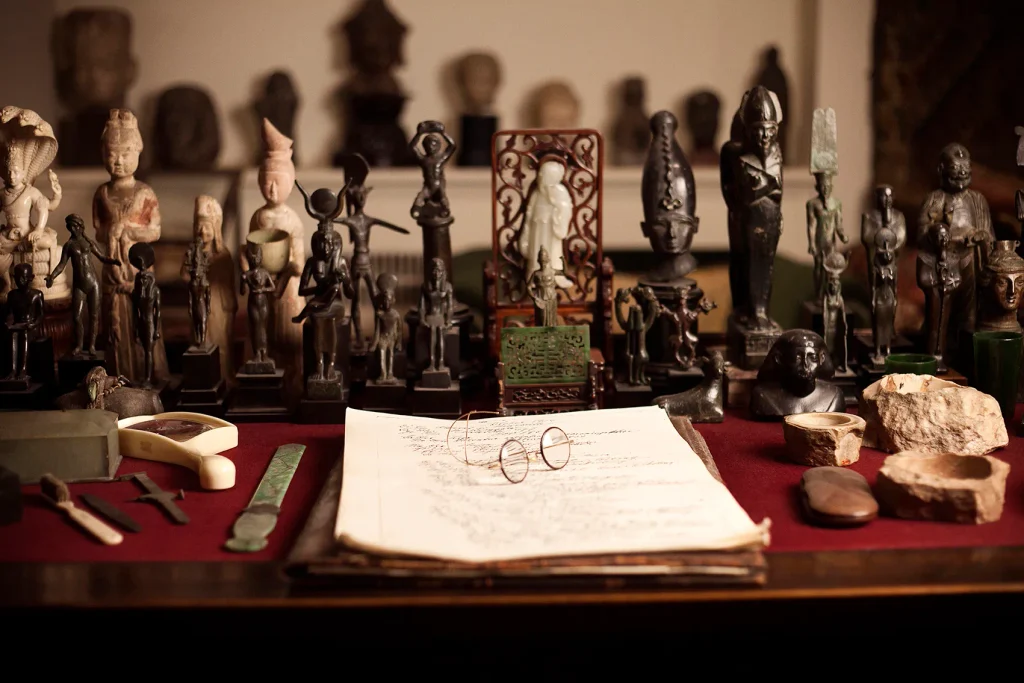
Freud’s consulting room contained thousands of small sculptures, figurines, vessels, amulets, and archaeological objects. His collection included antiquities from Ancient Egypt, Greece, Rome, China, Japan, and other cultures. Today, the Freud Museum London collection preserves around 2,500 objects from Freud’s personal collection.
Consequently, Freud’s consulting room looked less like a conventional medical office and more like an archaeologist’s study. Moreover, the objects did not simply decorate the room. They formed part of the intellectual environment in which Freud developed and articulated psychoanalytic ideas.
Building the Freud Antiquities Collection
Freud began collecting artworks and antiquities in the late nineteenth century. His interest gradually developed into a major personal passion. According to archaeologist Peter Ucko, Freud collected at least 2,500 antiquities during his lifetime.
The Freud Museum London currently displays and preserves approximately 2,500 antiquities from Freud’s collection. The objects range from Egyptian funerary figures and Greek vessels to Roman sculpture and objects from cultures far beyond the Mediterranean world.
Furthermore, the collection contains objects from very different historical periods. Some pieces date back thousands of years, while others come from the modern period.
Freud therefore created more than a collection of aesthetically attractive objects. He assembled a material archive of human culture.
Greek and Egyptian Antiquities in the Freud Collection
Ancient Egyptian objects occupy a particularly important place within Freud’s collection. The Freud Museum’s “Between Oedipus and the Sphinx: Freud and Egypt” archive notes that Egyptian artefacts form the largest part of his collection.
The museum’s digital archive documents numerous Egyptian objects associated with Freud, including figures of Bastet, Imhotep, Ptah, Isis, Osiris, Hathor, Thoth, and Amen-Re. The collection also contains shabti figures, mummy-related objects, amulets, and funerary artefacts.
Greek and Roman antiquities also occupied a prominent position. Freud owned representations of Athena, Artemis, Aphrodite, Venus, Eros, Zeus/Jupiter, and Hermes/Mercury, together with Greek pottery and other classical objects.
Thus, Freud’s study brought together an extraordinary range of ancient images.
Why Did Freud Build an Antiquities Collection?
Freud’s interest in antiquities had a strong intellectual dimension. He repeatedly turned to archaeology when he searched for ways to explain the human mind.
Archaeology investigates what lies beneath the visible surface. Psychoanalysis, in a different way, explores memories, desires, fantasies, and conflicts that remain outside conscious awareness.
Freud consequently developed an influential archaeological metaphor for the psyche. The Freud Museum’s research archive explains that Egyptian artefacts played an important role in this metaphor and in Freud’s attempts to explore the layers of the mind.
The comparison proved especially powerful because archaeological excavation and psychoanalysis share a conceptual structure: both search for traces of an earlier past.
Archaeology and the Unconscious
Freud often compared the psychoanalytic process with archaeological excavation.
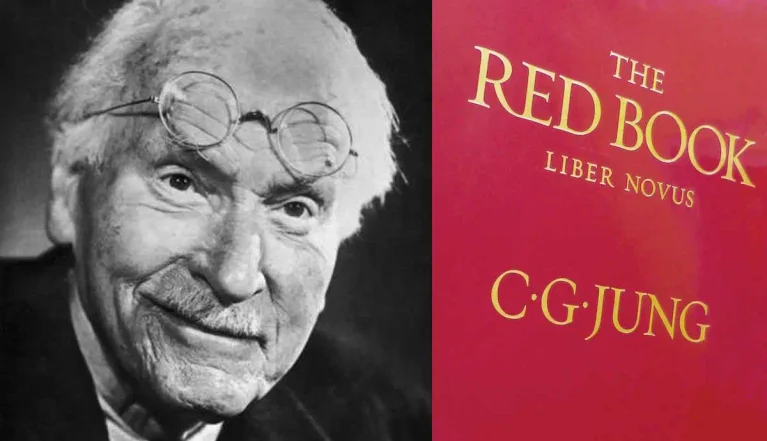
An archaeologist removes layers of soil to reveal structures and objects from earlier periods. Similarly, a psychoanalyst attempts to uncover memories and experiences that consciousness has buried or repressed. Freud’s younger colleague Carl Jung later explored buried layers of the psyche in a very different way, as seen in Carl Jung’s Red Book.
The comparison also appears in the way Freud discussed memory. The Freud Museum’s digital archive explains that Freud associated the preservation of unconscious memory with entombment and imagined the analyst’s work as bringing repressed memories back into psychological life.
Therefore, the antiquities surrounding Freud offered more than visual stimulation. They provided concrete images for abstract psychological processes.
Freud’s Consulting Room as an Archaeological Space
Freud’s consulting room at 19 Berggasse in Vienna became one of the most famous interiors in the history of psychoanalysis.
Photographs of the room show antiquities occupying tables, shelves, cabinets, and other surfaces. The objects stood alongside Freud’s books, furniture, artworks, and the famous psychoanalytic couch.
Later, when Freud moved to London, he recreated much of this environment at 20 Maresfield Gardens. The Freud Museum London now preserves the house and displays Freud’s study and collection.
The room therefore functioned as more than a workplace. It created a visual environment in which the ancient past constantly surrounded the analyst.
Egyptian Figures, Death, and Memory
Freud’s fascination with Egypt had another important dimension: death and the afterlife.
Many Egyptian objects in his collection relate to funerary practices. The museum’s archive identifies mummy masks, funerary figures, shabtis, and other objects associated with ancient Egyptian beliefs about death and the afterlife.
These objects offered Freud a rich vocabulary for thinking about memory and repression.
Ancient Egyptians sought to preserve the dead through elaborate funerary rituals. Freud, meanwhile, investigated memories that survived within the unconscious.
The parallel was not merely decorative. It provided a powerful intellectual image: something apparently buried could continue to exist beneath the surface.
The Oedipus Connection
Freud’s interest in classical antiquity also extended to Greek mythology.
The story of Oedipus and the Sphinx became particularly important in psychoanalytic history. Freud used the Oedipus myth as a central reference point in developing what later became known as the Oedipus complex.
The Freud Museum’s “Between Oedipus and the Sphinx” archive explores the relationship between Freud’s fascination with Egypt, Greek mythology, archaeology, and psychoanalysis.
Consequently, Freud’s classical antiquities formed part of a broader intellectual world in which mythology and archaeology could illuminate psychological questions.
The Freud Antiquities Collection and Psychoanalysis
The relationship between Freud’s antiquities and psychoanalysis has attracted considerable scholarly attention.
The Freud Museum’s “Freud’s Antiquity: Object, Idea, Desire” digital archive examines the relationship between Freud’s collection and the development of his concepts and methods. The project connects representative objects from the collection with important themes in Freudian theory.
However, scholars do not agree that every object in Freud’s collection carried a specific psychological meaning.
Peter Ucko, for example, cautions against interpreting every acquisition as a deliberate symbolic choice. His research suggests that Freud’s purchases may also have depended on his mood at a particular moment and on the objects available through the antiquities market.
This distinction matters. Freud certainly used archaeology as an intellectual metaphor, but researchers should not automatically assign a fixed symbolic meaning to every figurine on his desk.
A Museum Inside the Consulting Room
Freud’s study eventually became almost museum-like in its appearance.
His collection included hundreds of figurines, sculptures, amulets, vessels, and other objects. The Freud Museum’s antiquities archive provides photographs and catalogued descriptions of objects ranging from Egyptian shabtis and Greek pottery to Roman figures and Mesopotamian seals.
Moreover, Freud continued to live and work among these objects after moving to London.
At 20 Maresfield Gardens, his study retained the atmosphere created by his Viennese collection. The ancient world remained physically present around his desk.
This continuity suggests that collecting formed a lasting part of Freud’s intellectual and personal identity.
The Material Culture of Psychoanalysis
Freud’s antiquities also demonstrate how intellectual history can depend upon material culture.
Ideas do not exist only in books and manuscripts. Objects, rooms, libraries, and visual surroundings can shape the intellectual environment in which ideas develop.
Freud’s study offers a particularly striking example. Ancient Egyptian gods stood beside Greek figures, Roman sculptures, books, photographs, and modern furniture.
The result was an unusual visual dialogue between past and present.
The Freud Museum’s digital archive argues that Freud’s desire for antiquity helped animate aspects of his psychoanalytic thinking and that his archaeological language supported important theoretical developments.
The Freud Antiquities Collection Today
Freud died in London in 1939, but his antiquities survived as a material record of his intellectual life.
Today, visitors can explore many of these objects at the Freud Museum London. The museum preserves approximately 2,500 antiquities from Freud’s collection.
The museum’s online antiquities archive also allows researchers and readers to examine individual objects, including Egyptian, Greek, Roman, Mesopotamian, Chinese, and other artefacts.
Consequently, Freud’s collection remains accessible not only as a historical curiosity but also as a resource for studying the relationship between psychoanalysis and material culture.
References and Further Reading
1. Freud Museum London — Collections
Explore Freud’s personal collection of approximately 2,500 antiquities:
Freud Museum London — Collections
2. Freud Museum London — Antiquities Photo Library
A detailed visual archive of Greek, Roman, Egyptian, Mesopotamian, Chinese and other objects in the collection:
Freud Museum London — Antiquities
3. Freud Museum London — Freud’s Antiquity: Object, Idea, Desire
Digital archive examining the relationship between Freud’s antiquities and the development of psychoanalysis:
Freud’s Antiquity: Object, Idea, Desire
4. Freud Museum London — Between Oedipus and the Sphinx: Freud and Egypt
Research resource on Freud’s fascination with Egypt, archaeology, death and psychoanalysis:
Between Oedipus and the Sphinx: Freud and Egypt
5. Ucko, Peter. “Unprovenanced Material Culture and Freud’s Collection of Antiquities.” Journal of Material Culture, Vol. 6, No. 3, 2001, pp. 269–322.
SAGE Journals — Ucko, “Unprovenanced Material Culture and Freud’s Collection of Antiquities”
6. Freud Museum London — About the Museum
Information about Freud’s house, study and surviving collection:
Freud Museum London — About Us
About the Author