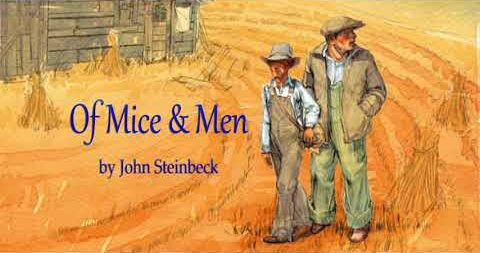
John Steinbeck’s 1937 novella Of Mice and Men portrays the lives of migrant agricultural workers seeking employment in California during the Great Depression. The novel does not merely construct an individual tragedy through the friendship between George Milton and Lennie Small. It also examines the connections among poverty, loneliness, social exclusion, and insecure labor relations. The Library of Congress places the work within the context of the Great Depression and describes it through the dream of two migrant workers who hope to own their own piece of land.
For this reason, the lack of worker solidarity can be considered one of the novel’s central social concerns. However, Steinbeck does not simply ask, “Why do workers fail to unite?” Instead, he addresses a deeper question: How do economic insecurity, racism, sexism, age discrimination, and competition alienate people from one another?
The workers on the ranch belong to the same broad economic class; nevertheless, they fail to develop a common social consciousness. George and Lennie’s relationship represents an important exception to this pattern. However, Steinbeck does not transform their friendship into lasting collective solidarity. Therefore, Of Mice and Men connects the absence of solidarity not simply with individual selfishness but with social conditions that produce loneliness.
The Great Depression and the Loneliness of Migrant Workers
The economic insecurity created by the Great Depression forms the social background of Of Mice and Men. George and Lennie constantly change jobs and move from one ranch to another. This mobility represents economic necessity rather than freedom.
Steinbeck’s interest in agricultural workers did not originate solely in literary imagination. While growing up around the Salinas Valley, he observed migrant agricultural workers closely. Moreover, during his youth, he worked at Spreckels Sugar Ranches and experienced working conditions firsthand. (Cambridge University Press)
Therefore, the ranch in the novel functions as more than a setting for the events. It also operates as a small-scale model of labor relations, hierarchy, and social exclusion.
A migrant worker remains in constant motion. Consequently, this mobility makes it difficult to establish lasting social relationships. A worker may leave for another ranch the following day. Thus, relationships with fellow workers often remain temporary.
At this point, Steinbeck’s narrative reveals an important contradiction: workers share similar economic conditions, but this commonality does not automatically produce solidarity.
Why Do Workers’ Common Interests Fail to Become Solidarity?
The workers in the novel live under similar economic conditions. However, their common economic position does not create a strong class consciousness. There are several important reasons for this.
First, the ranch operates within a continuous environment of competition. A worker sells his labor in order to survive and attempts to protect his own position. Second, differences involving age, race, physical strength, and social status divide relationships among the workers.
For example, Slim occupies a distinctive position because of his strength and respect among the workers. Candy fears his future because of his age. Crooks remains physically separated from the other workers because he is Black. Curley’s wife exists as an isolated and excluded woman within a male-dominated ranch environment.
Consequently, the social divisions in the novel do not operate solely through the opposition between worker and employer. Steinbeck also demonstrates how workers create hierarchies and divisions among themselves.
From this perspective, the novel can be productively connected to Marx’s concept of alienation. According to Marx, capitalist relations of production transform the individual’s relationship with labor and with other people. Of Mice and Men, however, makes this alienation visible through everyday relationships rather than through a theoretical explanation.
Crooks: The Most Striking Example of the Absence of Solidarity
Crooks is one of the characters who most clearly illustrates the problem of solidarity in the novel. Crooks is the Black worker on the ranch, and racial discrimination forces him to live separately from the other workers.
His loneliness extends beyond economic circumstances. Crooks is also a victim of racial hierarchy. Indeed, academic studies have examined his loneliness in connection with racial segregation in 1930s America. Im Young’s 2019 study, for instance, examines Crooks’s loneliness as a central element of the novel’s critique of racism. (KCI)
The scene in which Crooks speaks with Lennie is particularly important in this respect. Crooks explains how isolation can affect a person psychologically and emotionally. He suggests that human beings need closeness with another person. Otherwise, loneliness can develop into psychological suffering and emotional collapse. (LitCharts)
Here Steinbeck creates an important paradox. Crooks experiences loneliness because the other workers exclude him; nevertheless, at certain moments, he also attempts to exclude another person. Thus, the excluded individual can sometimes reproduce the mechanism of exclusion.
This situation illustrates the effects of social alienation on individuals. A person does not simply become a victim of external pressure. Sometimes, the individual also reproduces the logic of the pressure experienced against others.
George and Lennie: An Exceptional Form of Solidarity
George and Lennie’s relationship differs from the general atmosphere of loneliness that dominates the novel. The two friends work together, travel together, and share a dream for the future.
At the center of this dream is the possibility of owning a small piece of land. George and Lennie therefore imagine escaping the system of wage labor and gaining control over their own lives.
However, friendship alone does not adequately explain their relationship. George assumes not only an economic partnership with Lennie but also a moral responsibility toward him. Lennie has limited mental capacity, and George constantly worries about his safety.
For this reason, the relationship between George and Lennie can also be examined through Aristotle’s concept of friendship. George’s relationship with Lennie is more complex than a relationship based solely on mutual benefit. A study of Steinbeck also examines the bond between George and Lennie through the concept of friendship in Aristotle’s Nicomachean Ethics. (HIG DiVA Portal)
Nevertheless, this solidarity does not become a social movement. George and Lennie do not organize the other workers. They do not develop collective action concerning wages, working conditions, or the authority of the ranch owner.
Therefore, Steinbeck demonstrates that individual solidarity may be possible, whereas collective solidarity is considerably more difficult to achieve.
Candy and the Fear of Old Age
The character of Candy provides another example of how economic insecurity affects human relationships. The elderly worker fears that he will lose his position on the ranch because he is losing his physical strength.
The killing of his dog makes this fear even more explicit. Candy associates his own future with the fate of his dog. He believes that when he becomes old and can no longer work, society may also regard him as useless.
For this reason, Candy wants to join George and Lennie’s dream of owning land. For Candy, the dream represents more than economic independence. It also provides a form of security against the fear of old age and abandonment.
Thus, Steinbeck shows that solidarity is not merely a moral value. It can also function as a social security mechanismthat reduces people’s uncertainty about the future.
Curley’s Wife and Social Loneliness
Curley’s wife represents the theme of loneliness from another perspective. She cannot establish an independent social space for herself within a male-dominated working environment.
However, her loneliness differs from Crooks’s loneliness. Crooks directly experiences racial discrimination, whereas Curley’s wife remains trapped within a sexist social structure.
For this reason, Steinbeck does not place all of his characters within a single category of victimhood. Race, gender, age, and physical condition all influence the social position of the characters.
From this perspective, Of Mice and Men can also be read through the concept of intersectionality, which contemporary literary studies use to examine overlapping forms of social inequality. The novel demonstrates how different forms of social division can intersect within the same environment.
Of Mice and Men Through Marx’s Concept of Alienation
Marx’s theory of alienation provides a powerful conceptual framework for analyzing Steinbeck’s worker characters. The workers sell their labor but do not control the production process. Consequently, labor becomes more than an economic activity; it also limits the individual’s control over his or her own life.
The workers on the ranch do not develop a common class struggle. Instead, they attempt to protect their individual positions. Thus, the competitive logic of the economic system also enters interpersonal relationships.
An important distinction should be made here. Steinbeck does not directly explain Marx’s theory in the novel. Moreover, Of Mice and Men does not present an explicit political program like an ideological text.
Nevertheless, the novel’s social structure demonstrates how economic insecurity can atomize individuals. Steinbeck’s 1936 novel In Dubious Battle, by contrast, presents a more direct narrative of labor activism and strikes. Cambridge University Press discusses the work explicitly as a “proletarian novel” centered on the working class and labor strikes. (Cambridge University Press)
This comparison is important. Steinbeck’s interest in labor issues does not begin and end with Of Mice and Men. However, in this particular novel, he focuses less on collective struggle and more on why solidarity fails to emerge.
Heidegger, Sartre, and the Problem of Loneliness
It is also possible to interpret the novel from an existentialist perspective. Heidegger’s concept of Dasein emphasizes human existence as an existence connected to the world and to others. The characters in Of Mice and Men, by contrast, live in a world in which these connections are constantly disrupted.
Crooks’s words are particularly significant in this respect. When a person becomes isolated, he or she needs another person’s perspective in order to evaluate personal experiences. Crooks’s idea that human beings “need somebody” emphasizes the relational dimension of human existence. (LitCharts)
Sartre’s understanding of the Other can also be discussed comparatively alongside the novel. However, caution is necessary here. Treating Steinbeck’s characters directly as examples of Sartrean philosophy would be anachronistic. Instead of imposing Sartre’s philosophical system onto the novel, it is more appropriate to discuss the conceptual similarities between the two fields of thought.
Within this framework, the ranch becomes a paradoxical space in which people live close to one another but fail to establish genuine social bonds.
Does Steinbeck Criticize the Lack of Worker Solidarity?
The question can be answered directly with yes, but the answer requires qualification.
Steinbeck does not explain the lack of worker solidarity solely through individual selfishness. Instead, the novel demonstrates how economic insecurity, racism, sexism, age discrimination, and competition separate people from one another.
Therefore, the absence of solidarity operates on two levels:
- At the individual level: Characters struggle to approach one another because of fear, jealousy, insecurity, and loneliness.
- At the social level: Economic and social structures make it difficult for people with common interests to develop a collective consciousness.
George and Lennie’s friendship creates a small form of resistance to this structure. Candy’s decision to join them suggests that this solidarity might expand. However, the tragic ending eliminates this possibility.
Consequently, Steinbeck’s central concern extends beyond the question, “Why did the workers fail to organize?” The author exposes the contradiction between the enormous need for solidarity and the absence of social conditions capable of making solidarity possible.
The Tragic Ending and the Limits of Solidarity
At the end of the novel, George kills Lennie, bringing their relationship to a tragic conclusion. This event represents more than the end of an individual friendship. It also represents the collapse of the possibility of solidarity developed throughout the novel.
George’s decision cannot be explained solely as a direct consequence of the economic system. Personal responsibility, compassion, fear, and violence also become ethical issues.
Nevertheless, the social context remains important. No secure social structure exists in which George and Lennie can sustain their shared dream. Their project of building a life together remains vulnerable to economic and social conditions.
For this reason, the tragedy of the novel cannot be reduced to “a bad event that happens to two friends.” Steinbeck demonstrates how vulnerable individual solidarity becomes when it lacks broader social security.
References
Sartre, J.-P. (1943). Being and Nothingness.
Im, Y. (2019). “Paradoxical Reality Contained in the African-American Crooks’s Loneliness.” Journal of International Culture, 12(1), 81–100. (KCI)
McElrath, J. R., Crisler, J. S., & Shillinglaw, S. (Eds.). (1996). John Steinbeck: The Contemporary Reviews. Cambridge University Press. (Cambridge University Press)
Steinbeck, J. (1937). Of Mice and Men. Covici-Friede.
Steinbeck, J. (1936). In Dubious Battle. Covici-Friede.
Library of Congress. America Reads: 1900 to 1949 – John Steinbeck, Of Mice and Men. (Library of Congress)
Library of Congress. Of Mice and Men: Exploring the Context with Primary Sources. (Library of Congress Blogs)
Marx, K. (1844). Economic and Philosophic Manuscripts of 1844.
Aristotle. Nicomachean Ethics.
Heidegger, M. (1927). Being and Time.
About the Author