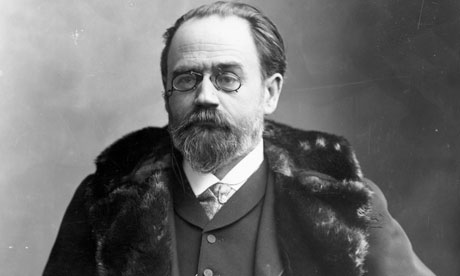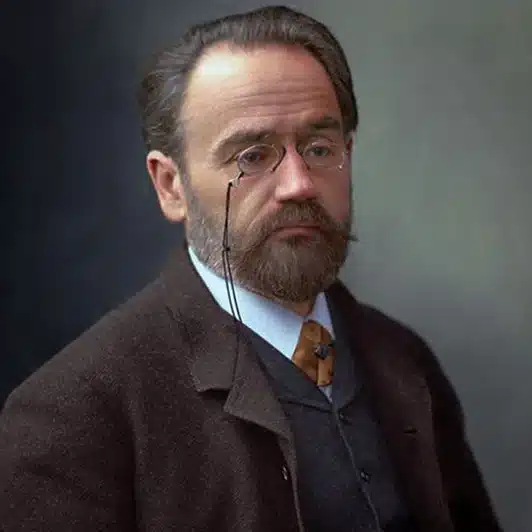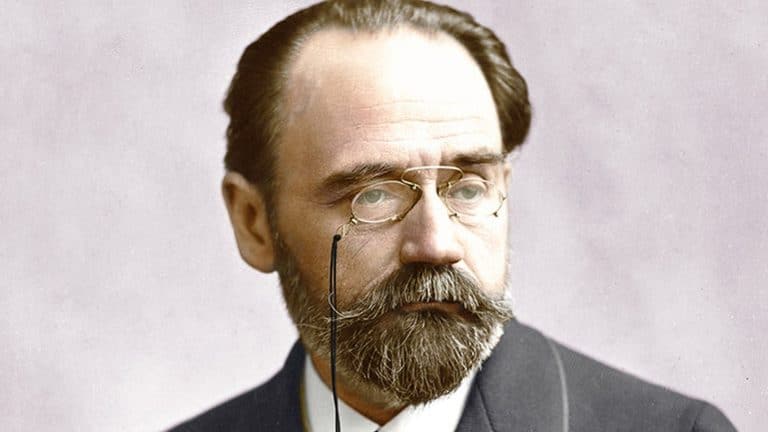
For Zola, exile in England disrupted daily life but did not end his creative work. During 1898–1899, he wrote Fécondité, maintained a demanding correspondence, and explored photography around London and the surrounding countryside. Michael Rosen shows how artistic routine offered Zola moments of purpose and pleasure amid political uncertainty and personal distress.
How Did Zola Keep a Writing Routine in Exile?
When Zola arrived in England in July 1898, he faced an unfamiliar environment and an uncertain future. His legal troubles, separation from France, and concern about the Dreyfus Affair created considerable emotional pressure.
Yet he continued to write. His literary work gave structure to days that might otherwise have revolved entirely around anxiety and waiting.
One of the central projects of this period was Fécondité (Fruitfulness), which appeared in 1899. The novel formed part of Zola’s projected Les Quatre Évangiles cycle, through which he explored social and moral questions concerning family, society, and the future.
Michael Rosen discusses this work in his account of Zola’s life at the Queen’s Hotel in Upper Norwood. The hotel became more than temporary accommodation: it also served as a place where Zola could resume a demanding writing routine.
His experience challenges the assumption that exile necessarily stops artistic production. Although political upheaval interrupted his ordinary life, Zola continued to work on a project that connected him to his long-term literary ambitions.
What Role Did Photography Play in Zola’s English Life?
Photography offered Zola another way to observe and record his surroundings. During his stay in England, he photographed landscapes, roads, bridges, churches, and scenes from the countryside.
His interest in photography became particularly visible during outings with Jeanne Rozerot and the children. They explored areas around Norwood, Weybridge, Walton-on-Thames, and other locations, often travelling by bicycle.
These excursions provided an alternative to the confinement of hotel rooms and correspondence. They allowed Zola to engage directly with the physical world while remaining far from his homeland.
The photographs also have historical value. They preserve aspects of the landscapes and places that shaped his temporary life, offering visual evidence alongside the letters and recollections that inform Rosen’s narrative.
However, photography did not remove the restrictions of exile. Zola could explore England, but he could not freely return to France. His creative activities existed within that continuing limitation.
How Did the English Landscape Influence Zola’s Experience?
Zola’s English surroundings provided a mixture of curiosity, discomfort, and occasional pleasure. He often complained about British food, weather, and unfamiliar customs. At the same time, he explored suburban streets, gardens, waterways, and rural landscapes.
These experiences complicate the idea that exile consisted only of isolation. Zola encountered new places and developed routines that differed from his usual life in France.
Photography made this process especially significant. Instead of simply passing through unfamiliar environments, he actively selected and recorded scenes that attracted his attention.
His photographs and walks also created opportunities for family life. The excursions offered time with Jeanne and the children, while his morning writing routine preserved space for independent intellectual work.
Nevertheless, his emotional state remained unstable. Rosen’s account makes clear that moments of enjoyment coexisted with anger, political anxiety, and a strong desire to return home.
The landscape, therefore, did not function as a cure for exile. It provided temporary relief and a means of engagement with the world.
Why Did FéconditéWhy Did Matter to Zola in Exile?
Fécondité represented continuity in Zola’s literary career. Even while he confronted a major political crisis, he continued developing the larger project that occupied his imagination.
The novel’s publication in 1899 also demonstrates that exile did not remove him entirely from the literary world. He remained a working author whose books could circulate beyond the immediate circumstances of his political conflict.
Rosen notes that writing Fécondité gave Zola a strong sense of pleasure and achievement. This detail matters because it reveals a side of exile that political histories often overlook: the ability to sustain creative purpose while living under pressure.
At the same time, readers should not romanticize the experience. Zola remained productive, but that did not mean his suffering was insignificant or that exile improved his life overall. Instead, the evidence suggests that creative work provided one source of stability within a difficult period.
What Can Zola’s Creative Routine Teach Us About Art and Adversity?
Zola’s English exile shows that artistic work can continue even when a writer loses familiar surroundings and control over major life decisions.
Writing established a daily rhythm. Photography encouraged observation. Correspondence maintained personal connections. Together, these activities helped Zola preserve parts of his identity during a period defined by uncertainty.
However, creativity did not exist separately from politics or private life. His work unfolded alongside his concern for Dreyfus, his negotiations with family members, and his struggle to decide when he could return to France.
This combination makes the case of Zola in exile particularly revealing. His creative life neither erased the crisis nor remained untouched by it. Instead, writing and photography became ways to continue living and working while the crisis persisted.
For how British readers received his novels, read Zola, censorship and Victorian England.
Key Takeaways
- Zola continued writing during his English exile.
- He worked on Fécondité, published in 1899.
- Photography became an important part of his activities in England.
- Bicycle excursions combined landscape exploration, family time, and artistic observation.
- His creative work offered purpose and pleasure without eliminating political or emotional distress.
References
- Rosen, Michael. The Disappearance of Émile Zola: Love, Literature and the Dreyfus Case. London: Faber & Faber, 2017. See Chapters 5, 8, 10, and the Postscript.
- Zola, Émile. Fécondité (1899).
- Michael Rosen’s official book description
- The Guardian’s review of Zola’s exile
Further reading: How Does Pushkin Unite History and the Individual in The Captain’s Daughter?
About the Author