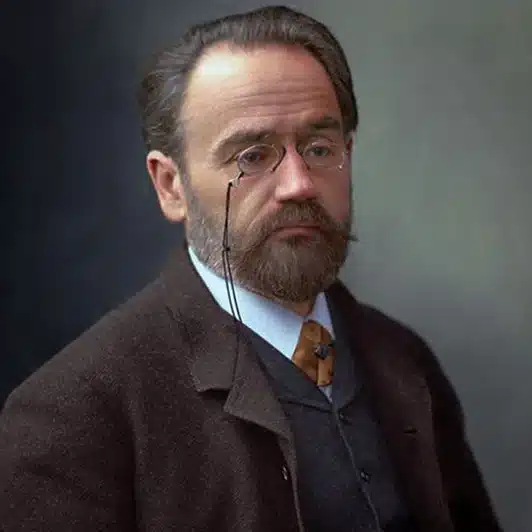
English exile exposed the private life of Émile Zola and the complex domestic arrangements behind his public identity. Separated from France, he maintained close correspondence with his wife, Alexandrine, and his partner, Jeanne Rozerot, with whom he had two children. Michael Rosen shows how love, family responsibility, secrecy, and political uncertainty shaped the everyday experience and private life of Émile Zola.
Who Were the Two Women in the Private Life of Émile Zola?
The private life of Émile Zola did not fit the conventional image of a nineteenth-century literary household. He remained married to Alexandrine Zola while maintaining a relationship with Jeanne Rozerot, who was the mother of his two children, Denise and Jacques.
Rosen examines this arrangement through correspondence and personal recollections. Rather than presenting the women as incidental figures in a famous writer’s biography, he explores their distinct relationships with Zola and the emotional pressures they experienced.
Alexandrine had shared many years of marriage with the novelist. Jeanne, meanwhile, occupied a different position in his domestic life and raised their children. Zola’s exile made the practical and emotional tensions between these relationships especially visible.
The separation from France forced him to consider who would join him in England, when they would arrive, and how he could manage the different expectations surrounding his household.
How Did Exile Change Zola’s Relationship With Alexandrine and Jeanne?
Zola began writing to both women soon after arriving in London. His letters reveal the difficulty of maintaining relationships across distance while navigating an uncertain legal situation.
He could not simply bring everyone together without considering the consequences. Travel arrangements, public attention, financial concerns, and the possibility of renewed legal trouble shaped the family’s decisions.
Rosen’s account also highlights the unusual degree of knowledge and accommodation within this domestic arrangement. Alexandrine knew about Jeanne and the children, although that knowledge did not eliminate emotional pain or tension.
Zola’s letters show that he attempted to manage the situation through reassurance, negotiation, and practical planning. Yet correspondence could not remove the fundamental difficulties of separation.
Consequently, his exile created a revealing contrast: the novelist faced a public crisis over justice and political integrity while privately negotiating relationships that demanded patience, discretion, and emotional compromise.
Why Did Zola Value His Time With Jeanne and the Children in England?
During part of his stay, Zola lived with Jeanne and the children. This arrangement allowed him to experience a degree of everyday family life that his usual circumstances did not readily permit.
He could work in the mornings and spend time with the family later in the day. The household also explored the surrounding countryside, often by bicycle, while Zola pursued his interest in photography.
These activities provided moments of pleasure amid the larger uncertainty of exile. Rosen describes the summer of 1898 as a particularly significant period in Zola’s family life.
However, the apparent tranquillity did not erase his distress about France. Zola continued to express anger over the Dreyfus Affair and anxiety about the future. The family’s quieter routines therefore existed alongside political frustration and emotional strain.
The episode also complicates any simple account of Zola as either a devoted family man or a selfish celebrity. His letters reveal affection and responsibility, but they also expose the difficulties created by his decisions and competing commitments.
How Did Zola’s Children Shape His Priorities?
Zola’s children, Denise and Jacques, occupied an important place in his correspondence and plans. He followed their development and education, arranged practical details, and thought about their future.
His letters frequently connect family concerns with the logistics of exile. He considered travel, accommodation, and the possibility of reuniting with them in England.
At the same time, Rosen’s narrative reveals differences in Zola’s expectations for his children. Zola placed particular emphasis on Jacques’s education and future achievements, while his expectations for Denise reflected more conventional gender assumptions.
This contrast offers a useful reminder that a person’s progressive political positions do not necessarily translate into equally progressive views within the family. Zola could challenge antisemitism and institutional injustice while retaining traditional expectations about women’s roles.
Therefore, his domestic life deserves attention not merely as biographical background, but as evidence of the tensions between public ideals and private assumptions.
What Does the Private Life of Émile Zola Reveal About the Cost of Political Exile?
Political exile changes more than a person’s location. It can reorganize relationships, interrupt routines, and force families to make decisions under pressure.
Zola’s circumstances illustrate these effects clearly. His absence separated him from France, complicated his relationships, and left him uncertain about when he could resume his former life.
Nevertheless, his letters and family activities also reveal his efforts to maintain continuity. He continued writing, planned visits, discussed the children’s needs, and tried to preserve relationships across distance.
Rosen’s account shows that political biography becomes more complete when it includes these private details. Zola’s courage in the Dreyfus Affair remains significant, but the personal consequences of his intervention help explain what that courage demanded.
For the wider story of his exile, see Émile Zola in England: loneliness, identity and everyday life.
Key Takeaways
- Zola remained married to Alexandrine while maintaining a relationship with Jeanne Rozerot.
- Jeanne and Zola had two children, Denise and Jacques.
- His letters reveal both affection and tension within the family.
- His time in England included periods of domestic happiness alongside political anxiety.
- The family life of Émile Zola exposes the difference between public principles and private assumptions.
References
- Rosen, Michael. The Disappearance of Émile Zola: Love, Literature and the Dreyfus Case. London: Faber & Faber, 2017. See Chapters 3–6, 11, and the Postscript.
- Michael Rosen’s official book description
- Kirkus Reviews: The Disappearance of Émile Zola
About the Author