Short Answer
Nicolaus Copernicus studied medicine at the University of Padua after receiving permission to continue his education in Italy in 1501. His medical training formed part of a broad Renaissance education that connected mathematics, natural philosophy, and practical knowledge. Copernicus later worked as a physician for his uncle, Lucas Watzenrode, Bishop of Warmia.
Why Did Copernicus Study Medicine?
Copernicus is usually remembered as an astronomer, but his education extended beyond the mathematical study of celestial movements.
In July 1501, he formally entered the Cathedral Chapter of Frombork as a canon. Soon afterwards, he obtained permission to continue his studies in Italy. This time, he enrolled in the medical faculty at the University of Padua.
The 1973 exhibition catalogue identifies Padua as the institution where he pursued medical studies. This decision reflects the breadth of Renaissance university education, in which scholars could move between different intellectual disciplines.
Medicine occupied an important position in European universities. It required students to engage with natural philosophy, the human body, inherited medical authorities, and the practical interpretation of physical symptoms.
Consequently, medical education offered a different intellectual perspective from astronomy, even though both disciplines relied on observation, reasoning, and the interpretation of natural phenomena.
How Did Padua Prepare Copernicus as a Physician?
The University of Padua belonged to a wider Italian university tradition that attracted students from different parts of Europe.
Copernicus chose to continue his studies there after his earlier academic experiences in Cracow and Bologna. The catalogue specifically connects his enrolment in Padua with the study of medicine.
We should not assume, however, that the catalogue provides a complete account of his medical curriculum. It does not list all the courses he attended or identify every teacher who influenced him.
Nevertheless, the reference establishes an important fact: Copernicus pursued formal medical education rather than merely acquiring medical knowledge through personal reading.
This distinction matters because Renaissance medicine had a structured academic tradition. University training connected practical treatment with the study of authoritative medical texts and natural philosophy.
How Did Copernicus Work as a Physician?
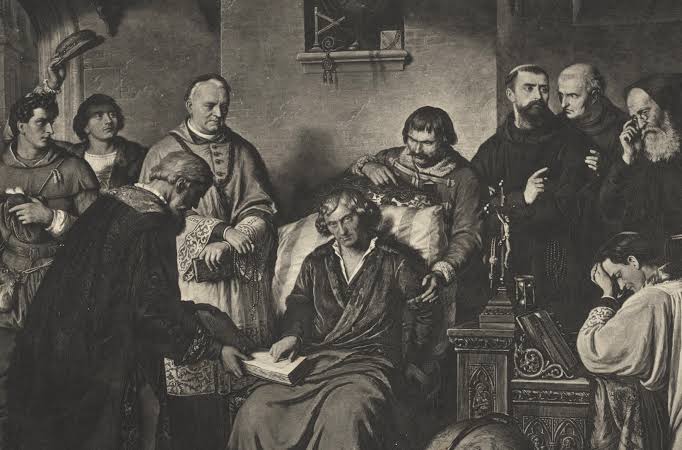
After returning to Poland in 1503, Copernicus assumed responsibilities within the Warmian Chapter. At the same time, Copernicus served as a physician and secretary to his uncle, Lucas Watzenrode, the Bishop of Warmia.
The catalogue places these responsibilities within the setting of the episcopal castle at Lidzbark.
This position illustrates how medical knowledge could function within the administrative and social structures of the period. A physician serving a bishop did not necessarily work in the same way as a modern hospital doctor. Personal medical service often formed part of a broader relationship involving trust, household responsibilities, and institutional duties.
The work of Copernicus as a physician also demonstrates that his professional identity did not depend on astronomy alone.
He participated in the religious and administrative life of Warmia while maintaining interests in mathematics and the natural world.
What Does Copernicus as a Physician Tell Us About Renaissance Knowledge?
The Renaissance did not divide intellectual life into narrowly separated professional categories in the modern sense.
A scholar might study astronomy, mathematics, medicine, theology, or law during different stages of education. These disciplines often shared a common interest in understanding nature and human society.
Copernicus’s career illustrates this intellectual breadth. His medical education did not replace his astronomical interests; rather, it formed part of a larger programme of learning.
Moreover, the later service of Copernicus as a physician shows how university knowledge could enter everyday institutional life.
It is therefore misleading to imagine Copernicus exclusively as an isolated astronomer working on celestial models. His life also involved medical responsibilities, ecclesiastical service, and practical engagement with the people around him.
Key Points
- Copernicus entered the medical faculty at the University of Padua after receiving permission to continue his studies in Italy in 1501.
- He returned permanently to Poland in 1503.
- He served as secretary and personal physician to his uncle, Lucas Watzenrode.
- Watzenrode held the office of Bishop of Warmia.
- Copernicus’s medical education formed part of a broader Renaissance intellectual tradition.
References
- Information Canada. Mikołaj Kopernik, 1473–1543. Ottawa: Information Canada, 1973, pp. 19–20.
- Henryk Bietkowski and Włodzimierz Zonn. The World of Copernicus. Warsaw: Arkady, 1973.
Related reading
- Copernicus at Olsztyn: Administration, War, and the Defence of a Renaissance Castle
- Copernicus in Rome: The Jubilee of 1500, Astronomy, and the Observation of a Lunar Eclipse
- Copernicus and Canon Law: The Legal Education Behind His Ecclesiastical Career
- The Cracow Circle: The Scholars and Intellectual Networks Surrounding Copernicus
- The Printing Revolution and Renaissance Astronomy: How Books Changed the Circulation of Scientific Knowledge
About the Author