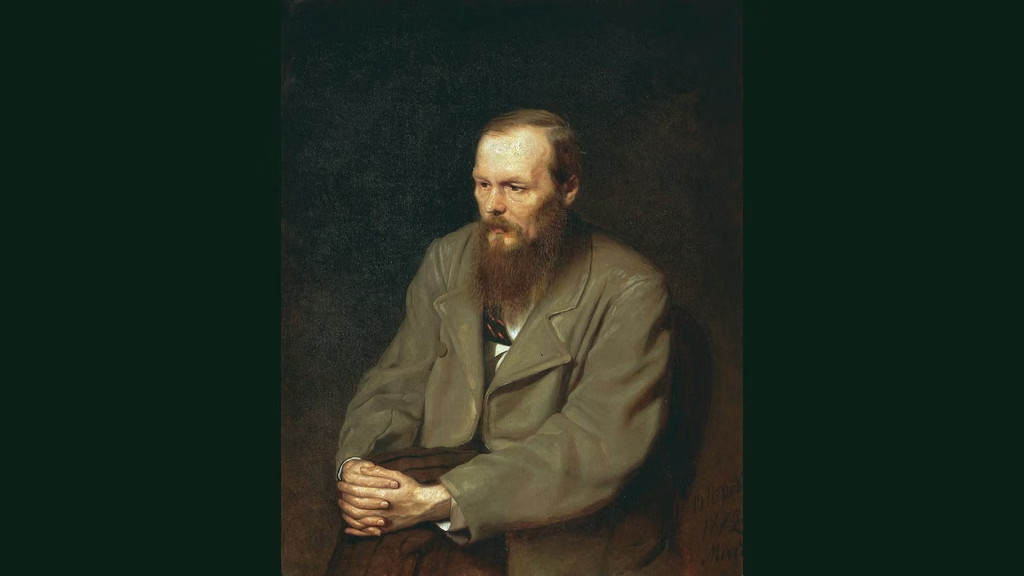
Dostoevsky’s father is one of the most important keys to understanding the writer’s inner world. Dr. Mikhail Andreyevich Dostoevsky was a stern, suspicious, and irritable man. Yet he was also a father devoted to his children. Joseph Frank argues that this contradictory figure shaped the whole of Dostoevsky’s artistic vision (Frank, 2010/2017, pp. 45–46).
Drawing on Frank’s biography, this article explores three questions: What kind of man was Dostoevsky’s father? Why did his death remain shrouded in mystery? And how did this relationship find its way into the writer’s fictional characters?
A Family on the Rise
Among the great writers of his era, Dostoevsky was the only one who did not come from a landowning aristocratic family. According to Frank, this circumstance profoundly influenced the writer’s perception of his own social position (Frank, 2010/2017, p. 29). His father had left the clerical class, studied medicine, and risen through the ranks of state service until he acquired noble status (p. 31).
Nevertheless, the family never received the respect it believed it deserved. Frank puts the matter plainly: “There was a clear contradiction between their actual position in society and the position they considered themselves entitled to occupy” (Frank, 2010/2017, p. 31). This tension would later reappear in Dostoevsky’s portraits of humiliated and socially marginalized characters.
What Kind of Man Was Dostoevsky’s Father?
Frank describes the doctor as a man with coarse facial features and a stern bearing. His defining characteristic was “severity, not warmth” (Frank, 2010/2017, p. 34). Moreover, he suffered from a nervous disorder. During periods of bad weather, he experienced headaches and fell into melancholy (p. 34).
Despite his harsh temperament, however, the doctor never beat his children. Physical punishment was widely accepted in nineteenth-century Russia, which makes his attitude particularly noteworthy. Indeed, he sent his children to a private school partly to protect them from corporal punishment (Frank, 2010/2017, p. 35). Years later, Dostoevsky would describe his parents as “extraordinary people” (as quoted in Frank, 2010/2017, p. 36).
Even so, the atmosphere at home remained oppressive. Evening walks, for instance, took place under the father’s strict supervision. According to Frank, the doctor’s impatience hung over his children “like a sword perpetually suspended above their heads” (Frank, 2010/2017, p. 39).
Hidden Emotions and the Mystery of Personality
One of Frank’s most intriguing observations concerns the concealed tensions within the family. The doctor sometimes suspected his wife of infidelity. Nevertheless, he never openly expressed these suspicions (Frank, 2010/2017, p. 36). From the outside, the household appeared orderly and peaceful.
For the young Dostoevsky, Frank suggests, this environment became a kind of education:
“For a boy who would become famous for his understanding of the complexities of human psychology, growing up in a home where the meanings of behavior remained hidden from view—and where their concealment stimulated a curiosity to sense and decipher those hidden meanings—was a first-rate education.” (Frank, 2010/2017, p. 38)
Furthermore, Frank connects Dostoevsky’s lifelong reserve to this relationship. The writer may have learned to conceal his emotions as a way of coping with his father’s severity (Frank, 2010/2017, p. 45).
The Death of Dostoevsky’s Father: Murder or Stroke?
Dr. Dostoevsky died in the summer of 1839 on his estate at Darovoe. According to family tradition, his own peasants had murdered him. Frank, however, emphasizes that “none of these questions can be answered with certainty” (Frank, 2010/2017, p. 72). Two doctors who examined the body attributed the death to a stroke. Moreover, a year-long investigation uncovered no evidence of murder (p. 72).
Nevertheless, Dostoevsky came to believe the murder story. According to Frank, this belief had “incalculable consequences” for the writer’s emotional equilibrium (Frank, 2010/2017, p. 72). The young man may also have felt guilty because he had repeatedly asked his father for money (p. 73).
Freud, Dostoevsky’s Father, and the Burden of Guilt
Sigmund Freud argued that Dostoevsky emotionally assumed the guilt of parricide—the killing of one’s father. Frank partly agrees with this interpretation (Frank, 2010/2017, p. 73). On the other hand, he rejects one of Freud’s specific claims. Freud maintained that Dostoevsky’s first epileptic seizure followed the news of his father’s death. Yet the writer’s letters first mention epilepsy in 1845 (p. 73).
Rather than explaining Dostoevsky’s guilt primarily through Oedipal rivalry, Frank offers a different interpretation. He traces the feeling to the father’s insistence that academic achievement represented a moral obligation (Frank, 2010/2017, p. 45). As a result, Dostoevsky struggled between resentment toward his father and a desire to forgive him (p. 46).
“Man Is a Mystery”
A few weeks after his father’s death, Dostoevsky wrote these famous words to his elder brother, Mikhail:
“Man is a mystery. It must be unraveled, and if you spend your entire life unraveling it, do not say that you have wasted your time; I am studying this mystery because I want to be a human being.” (Dostoevsky, quoted in Frank, 2010/2017, p. 74)
Frank emphasizes that the appearance of these words in a letter discussing his father’s death was no coincidence (Frank, 2010/2017, p. 74). In short, Dostoevsky’s father left the writer with a mystery that he would spend his life trying to solve: the complicated relationship between guilt, resentment, forgiveness, and the hidden motives that shape human behavior.
References
Frank, J. (2017). Dostoevsky: A Writer in His Time (M. Petrusewicz, Ed.; Ü. İnce, Trans.; 2nd ed.). Everest Publishing. (Original work published in 2010)
About the Author

3 thoughts on “Dostoevsky’s Father: The Roots of Guilt”