Questioning the Boundaries of the Universe
Giordano Bruno became one of the most significant figures in the history of philosophy and science through his radical ideas about the structure of the universe in the sixteenth century. Questioning the limits of traditional cosmology, he argued that the universe could be infinite and that countless other worlds might exist. Therefore, the Bruno infinite universe idea connected his thought not only to astronomy but also to humanity’s attempt to understand its place in the cosmos.
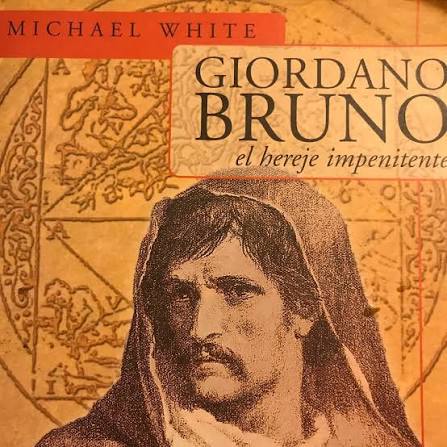
In the fourth chapter of Giordano Bruno, el hereje impenitente (Giordano Bruno, the Unrepentant Heretic), Michael White examines Bruno’s conception of the universe, its philosophical foundations, and the intellectual climate of his time.
How Did Bruno’s Infinite Universe Idea Emerge?
Bruno’s cosmology developed through a critical examination of the intellectual assumptions inherited from the Middle Ages. The traditional worldview of his time understood the universe as an ordered structure in which Earth occupied a privileged position. However, Bruno believed that this model did not necessarily represent an absolute reality.
Moreover, he did not limit himself to criticizing the prevailing conception of the universe. In his view, the universe possessed an infinite structure, and other worlds could also exist. In this way, he opened established assumptions about humanity’s cosmic position to reconsideration.
He set out these ideas most fully in the Italian dialogues he wrote in London. In De l’infinito, universo e mondi (1584), he described an infinite space filled with innumerable suns and planets. As a result, the stars stopped being fixed lights on a distant sphere. Instead, each star could be a sun with worlds of its own.
However, an important distinction must be made here: Bruno’s idea of an infinite universe was not equivalent to the observational and mathematical methods of modern astronomy. Nevertheless, his approach remains significant for its philosophical exploration of the boundaries of the universe.
From Copernicus to Bruno’s Infinite Universe
Bruno built on the heliocentric model that Nicolaus Copernicus had published in 1543. Copernicus placed the Sun at the center, yet he still kept a finite universe enclosed by the sphere of fixed stars. Bruno, by contrast, removed that outer boundary altogether. In other words, he turned a reform of astronomy into a new philosophy of nature.
In addition, the Bruno infinite universe carried theological consequences. If space had no center and no edge, Earth lost its unique status. Many contemporaries saw this as a challenge to religious authority. His cosmology was only one of the issues raised during his long trial before the Roman Inquisition. Even so, it became a central part of his legacy after his execution in Rome in 1600.
Why Is Bruno’s Thought Important in the History of Science?
Bruno’s approach reflects an effort to move beyond explanations grounded in authority in the pursuit of understanding nature. Furthermore, he drew on different philosophical traditions in an attempt to develop a comprehensive vision of the universe.
On the other hand, describing him as a direct founder of modern science would be an excessive interpretation from a historical perspective. His contribution lay primarily in expanding the boundaries of cosmological thought and developing an alternative view of the structure of the universe.
Ultimately, while questioning the vastness of the universe, Bruno also challenged the limits of human thought. For this reason, his cosmology remains important for examining the relationship between the history of science and the history of philosophy. For a scholarly overview, see the Stanford Encyclopedia of Philosophy entry on Giordano Bruno. Likewise, readers interested in how later philosophers built systematic pictures of reality can continue with our article on Hegel’s dialectic and the thesis–antithesis–synthesis formula.
References
- White, Michael. Giordano Bruno, el hereje impenitente. 2001. Particularly Chapter 4: “Prisca Sapienta.”
- Bruno, Giordano. De l’infinito, universo e mondi (On the Infinite Universe and Worlds). 1584.
About the Author