Rembrandt’s The Anatomy Lesson of Dr. Nicolaes Tulp: Art, Medicine, and Knowledge in Seventeenth-Century Amsterdam
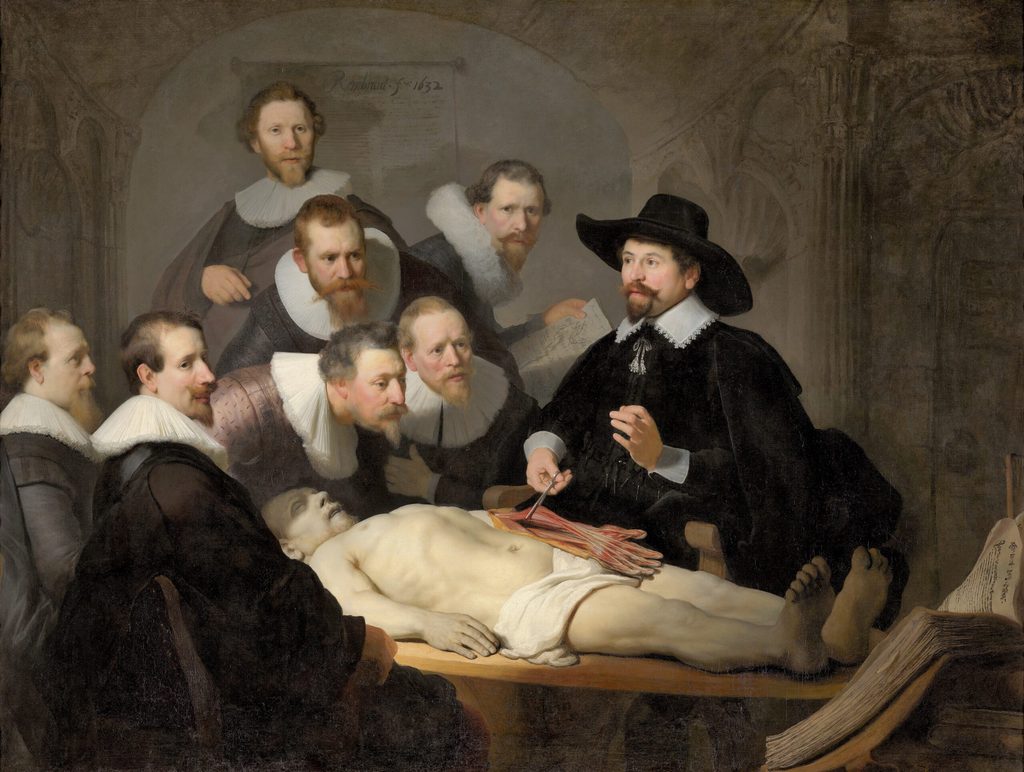
Rembrandt van Rijn completed The Anatomy Lesson of Dr. Nicolaes Tulp in 1632. The painting shows Dr. Nicolaes Tulp demonstrating the anatomy of the human forearm to members of Amsterdam’s Surgeons’ Guild. However, the work moves far beyond a simple medical scene. Through carefully arranged figures, expressive gestures, and strong contrasts of light and shadow, Rembrandt turns an anatomical demonstration into a reflection on knowledge, human vulnerability, and mortality.
The painting also offers valuable insight into the history of medical education. As the Mauritshuis collection catalogue explains, Rembrandt created a distinctive group portrait that emphasizes the interaction between the lecturer and his audience. Consequently, the work allows scholars to examine how artistic representation can illuminate the development of scientific knowledge.
Historical Context: Anatomy in Seventeenth-Century Amsterdam
Public anatomical demonstrations held an important place in the medical culture of seventeenth-century Amsterdam. The Surgeons’ Guild organized these events to promote professional education and to show the practical value of anatomical knowledge. Furthermore, such gatherings strengthened the social status of medical practitioners and reinforced the guild’s professional identity.
Nicolaes Tulp served as the guild’s lecturer in anatomy and conducted the demonstration depicted in the painting in January 1632. The body belonged to Adriaen Adriaensz, also known as Aris Kindt, a convicted criminal who had received a death sentence. Thus, the painting connects medical education with the criminal justice system and the social institutions of the Dutch Republic.
During this period, direct observation and anatomical dissection increasingly contributed to medical investigation. Although classical medical authorities continued to influence physicians, practical examination offered opportunities to investigate the human body more directly. For a detailed examination of the historical and anatomical context, see the peer-reviewed study by IJpma and colleagues, “The Anatomy Lesson of Dr. Nicolaes Tulp by Rembrandt (1632),” published in The Journal of Hand Surgery in 2006.
Composition and the Representation of Knowledge
One of the most remarkable features of the painting is its dynamic composition. Rather than arranging the physicians in a rigid row, Rembrandt positions them around the corpse and distributes their attention throughout the scene. Some examine the exposed arm, while others observe Tulp or follow the demonstration with concentrated expressions.
This arrangement encourages the viewer to move visually between the lecturer, the observers, and the deceased man. Moreover, the different gestures and facial expressions suggest that the participants engage with the demonstration in distinct ways. As the Mauritshuis analysis of the painting explains, the physicians look in different directions and thereby create a sense of movement unusual in conventional group portraits of the period.
The composition also establishes a relationship between individual authority and collective learning. Tulp occupies a prominent position, yet the surrounding physicians remain essential to the scene. Their presence suggests that scientific knowledge develops through observation, explanation, and the exchange of ideas. In this respect, the painting represents not merely a medical procedure but also the social process through which knowledge acquires authority.
Light and Shadow as Instruments of Meaning
Rembrandt’s use of light and shadow gives the painting much of its dramatic power. The pale body contrasts sharply with the dark clothing and background, while the physicians’ faces emerge from the surrounding darkness. This technique, commonly associated with chiaroscuro, directs attention toward the anatomical demonstration and establishes a clear visual hierarchy.
However, light serves a purpose beyond visual emphasis. The illuminated corpse becomes the focal point of an investigation conducted by living observers. Consequently, the contrast between brightness and darkness reinforces the distinction between life and death.
Rembrandt also uses subtle variations in illumination to connect the figures. The hands, faces, and anatomical details create visual links between Tulp and his audience. Furthermore, these connections guide the viewer through the scene without relying on a strictly symmetrical arrangement. Light therefore functions as both a compositional device and a means of communicating the intellectual and emotional significance of the event.
Anatomical Accuracy and Scientific Observation
The painting has attracted considerable interest from historians of medicine because of its depiction of the human forearm. Tulp demonstrates the relationship between muscles and movement and presents the body as an object of systematic investigation. Accordingly, the scene reflects the importance of direct observation in medical education.
In a peer-reviewed study published in The Journal of Hand Surgery, Frank F. A. IJpma and his colleagues compared the painted forearm with an actual anatomical dissection. Their 2006 research examined the anatomical details and investigated a disputed structure depicted in the painting. The researchers considered whether the unusual white cord near the wrist might represent an anatomical variation rather than an artistic error. Readers can access the full study through PubMed or the Journal of Hand Surgery abstract.
Nevertheless, the painting does not function as a modern anatomical textbook. Rembrandt organized the scene according to artistic and commemorative purposes and emphasized the participants’ expressions and the visual relationship between the figures. Therefore, its scientific significance lies not only in its anatomical details but also in its representation of medical practice and professional learning.
The Human Body, Death, and Philosophical Reflection
Beyond its historical and scientific dimensions, the painting raises fundamental questions about human existence. The physicians investigate a body that no longer possesses consciousness or movement. Yet the corpse provides essential information about the living organism. This contrast establishes a tension between the pursuit of knowledge and the finality of death.
Scientific inquiry seeks to explain the structures and processes of life. However, anatomical knowledge cannot eliminate human mortality. The physicians may examine muscles, identify structures, and communicate their findings, but the dead body remains an undeniable reminder of the limits of their expertise.
Moreover, the deceased man occupies a paradoxical position within the composition. His body makes the demonstration possible, while the living physicians receive recognition for their professional knowledge. This contrast invites questions about the relationship between individual suffering, institutional authority, and scientific progress.
Rembrandt does not offer an explicit philosophical answer. Instead, he places the viewer before a scene in which knowledge and mortality coexist. As a result, the painting encourages reflection on the possibilities of scientific investigation without suggesting that knowledge can overcome every limitation of human existence.
Professional Authority and the Social Function of Art
The painting also reflects the ambitions of Amsterdam’s Surgeons’ Guild. Group portraits allowed professional associations to commemorate important events and to present their members as distinguished participants in civic life. In this context, Rembrandt’s commission served both artistic and institutional purposes.
The Mauritshuis collection essay notes that Rembrandt was only 25 when he received this prestigious commission. The work helped establish his reputation as a portraitist in Amsterdam. Consequently, the painting documents not only medical culture but also the relationship between artistic achievement and professional patronage.
Yet the artist moves beyond a straightforward celebration of professional status. Rather than presenting the physicians as isolated individuals, he portrays them as participants in a shared intellectual activity. Tulp explains, the others observe, and the corpse provides the material focus of their investigation.
Furthermore, the composition links professional authority with collective participation. Although Tulp occupies the most prominent position, the surrounding physicians contribute to the scene’s meaning through their gestures and attention. Thus, Rembrandt presents medical knowledge as a combination of individual expertise, practical observation, and professional cooperation.
References
- IJpma, F. F. A., van de Graaf, R. C., Nicolai, J.-P. A., & Meek, M. F. (2006). The Anatomy Lesson of Dr. Nicolaes Tulp by Rembrandt (1632): A comparison of the painting with a dissected left forearm of a Dutch male cadaver. The Journal of Hand Surgery, 31(6), 882–891. https://pubmed.ncbi.nlm.nih.gov/16843145/
- IJpma, F. F. A., & van Gulik, T. M. (2016). The Anatomy Lesson of Nicolaes Tulp, painted by Rembrandt in 1632. British Journal of Surgery, 103(11), 1408. https://academic.oup.com/bjs/article-abstract/103/11/1408/6136753
- Mauritshuis. (n.d.). The Anatomy Lesson of Dr Nicolaes Tulp — Collection catalogue. https://www.mauritshuis.nl/en/our-collection/artworks/146-the-anatomy-lesson-of-dr-nicolaes-tulp
- Wikipedia contributors. (n.d.). The Anatomy Lesson of Dr. Nicolaes Tulp. Wikipedia. https://en.wikipedia.org/wiki/The_Anatomy_Lesson_of_Dr._Nicolaes_Tulp
About the Author