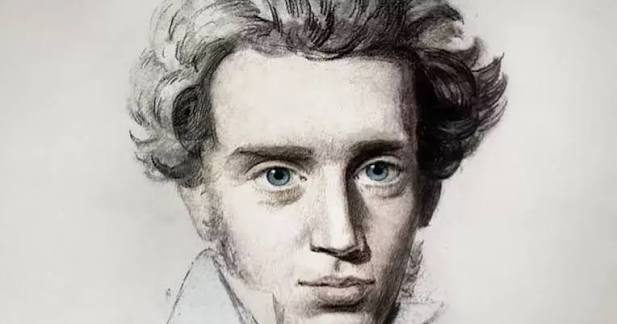
Most people treat anxiety as a problem to eliminate. Søren Kierkegaard, the nineteenth-century Danish philosopher, offered a different reading of anxiety. In The Concept of Anxiety (1844), he argued that anxiety reveals something essential about human existence: our freedom. This article explores Kierkegaard’s account of anxiety, its key concepts, and its lasting influence on philosophy and psychology.
Who Was Søren Kierkegaard?
Søren Kierkegaard (1813–1855) lived and wrote in Copenhagen. He is often regarded as the father of existentialism. His work focused on the lived experience of the individual rather than on abstract philosophical systems. Moreover, he frequently wrote under pseudonyms, a strategy that allowed him to present different perspectives on life (Hannay, 2001).
He published The Concept of Anxiety under the pseudonym Vigilius Haufniensis, “the watchman of Copenhagen.” The book approaches anxiety through psychology, theology, and the doctrine of original sin (Kierkegaard, 1844/1980a).
Kierkegaard on Anxiety Versus Fear: A Crucial Distinction
Kierkegaard draws a sharp line between fear and anxiety. Fear always points toward a definite object, such as a dangerous animal or an illness. Anxiety, in contrast, has no concrete object. Its object is “nothing,” or more precisely, possibility itself.
Consider a person standing at the edge of a cliff. Fear concerns the danger of falling. However, anxiety arises from a stranger awareness: the person could choose to jump. Nothing forces that choice, yet the mind recognizes it as open.
For this reason, Kierkegaard describes anxiety as “the dizziness of freedom” (Kierkegaard, 1844/1980a, p. 61). The dizziness does not come from the abyss alone. Instead, it comes from looking into one’s own possibilities.
Kierkegaard: Anxiety as the Consciousness of Freedom
Freedom Before Choice
For Kierkegaard, anxiety appears when a person becomes aware of being able to choose. He illustrates this idea through the biblical story of Adam. Before the prohibition, Adam lives in innocence. Once he hears the command, however, he senses that he can act otherwise. That sense of “being able” produces anxiety.
A Sympathetic Antipathy
Kierkegaard also calls anxiety “a sympathetic antipathy and an antipathetic sympathy.” In other words, the unknown attracts and repels us at the same time. This ambivalence explains why possibility both fascinates and frightens human beings.
Spirit and the Self
Furthermore, Kierkegaard links anxiety to spirit. In his view, a human being is a synthesis of body and soul, and spirit holds that synthesis together. Animals do not feel anxiety because they lack this self-relating dimension. Thus, the capacity for anxiety signals the presence of a self capable of freedom.
Why Anxiety Is Not a Pathology for Kierkegaard
Kierkegaard does not treat anxiety as a malfunction. On the contrary, he sees it as a sign of human greatness. A being without anxiety would also lack freedom, responsibility, and the possibility of becoming a self.
Accordingly, he writes that whoever learns to be anxious “in the right way” has learned “the ultimate” (Kierkegaard, 1844/1980a, p. 155). Anxiety educates the individual. It exposes false comforts and pushes the person toward authentic decisions.
Nevertheless, Kierkegaard’s view does not dismiss clinical suffering. Modern psychiatry recognizes anxiety disorders that require professional treatment. His argument operates at the level of human existence, not medical diagnosis. Therefore, readers should not use his ideas as a reason to avoid therapy or medical care.
Kierkegaard on Anxiety and Despair
Kierkegaard returned to these themes in The Sickness unto Death (1849), which was published under the pseudonym Anti-Climacus. There he examines despair, the condition of failing to be oneself. Anxiety and despair belong together, yet they differ. While anxiety opens the field of possibility, despair describes a self that misrelates to itself (Kierkegaard, 1849/1980b).
The remedy, for Kierkegaard, lies in faith. According to him, the self must rest “transparently” in the power that established it. Although this solution has a religious basis, many secular thinkers have adapted its structure.
Kierkegaard’s Influence on Philosophy and Psychology
Kierkegaard’s analysis shaped twentieth-century thought. Martin Heidegger, for example, developed the concept of Angst in Being and Time, where anxiety discloses the individual’s being-in-the-world (Heidegger, 1927/1962). Similarly, Jean-Paul Sartre described anguish in Being and Nothingness as the reflective awareness of radical freedom (Sartre, 1943/1956).
Theology also absorbed his insights. Paul Tillich (1952) argued in The Courage to Be that courage means affirming oneself in spite of existential anxiety.
In addition, psychology adopted many of his ideas. Rollo May (1950/1977) drew directly on Kierkegaard when he distinguished normal anxiety from neurotic anxiety. Later, Irvin Yalom (1980) built existential psychotherapy around four ultimate concerns: freedom, death, isolation, and meaninglessness. Likewise, Alfred Adler, working in a different tradition, linked inner tension to growth through his idea of the inferiority complex and his future-oriented psychology.
Kierkegaard and Anxiety Today: What He Teaches Us
Today, many people live with constant uncertainty about careers, relationships, and the future. Kierkegaard offers a useful reframing. Anxiety can point toward real choices that deserve attention.
Consequently, the central question changes. Instead of asking only “How can I eliminate anxiety?”, one can also ask “What possibility is my anxiety revealing?” This shift does not replace treatment, but it can deepen self-understanding.
Finally, Kierkegaard reminds us that freedom carries weight. Every genuine decision involves risk, and anxiety marks the place where that risk becomes visible.
Frequently Asked Questions
What did Kierkegaard say about anxiety?
Kierkegaard argued that anxiety is “the dizziness of freedom.” It arises when a person becomes aware of their own possibilities and their capacity to choose.
What is the difference between fear and anxiety in Kierkegaard’s philosophy?
Fear has a specific object, such as a threat or danger. Anxiety has no concrete object; its object is possibility, or “nothing.”
Which book contains Kierkegaard’s theory of anxiety?
The Concept of Anxiety (1844), which Kierkegaard wrote under the pseudonym Vigilius Haufniensis.
Did Kierkegaard think anxiety was a mental illness?
No. He viewed anxiety as a fundamental feature of human existence and a sign of freedom. His philosophical view, however, does not replace clinical diagnosis or treatment.
References
Hannay, A. (2001). Kierkegaard: A biography. Cambridge University Press.
Heidegger, M. (1962). Being and time (J. Macquarrie & E. Robinson, Trans.). Harper & Row. (Original work published 1927)
Kierkegaard, S. (1980a). The concept of anxiety: A simple psychologically orienting deliberation on the dogmatic issue of hereditary sin (R. Thomte & A. B. Anderson, Trans.). Princeton University Press. (Original work published 1844)
Kierkegaard, S. (1980b). The sickness unto death: A Christian psychological exposition for upbuilding and awakening (H. V. Hong & E. H. Hong, Trans.). Princeton University Press. (Original work published 1849)
May, R. (1977). The meaning of anxiety (Rev. ed.). W. W. Norton. (Original work published 1950)
Sartre, J.-P. (1956). Being and nothingness (H. E. Barnes, Trans.). Philosophical Library. (Original work published 1943)
Tillich, P. (1952). The courage to be. Yale University Press.
Yalom, I. D. (1980). Existential psychotherapy. Basic Books.
About the Author