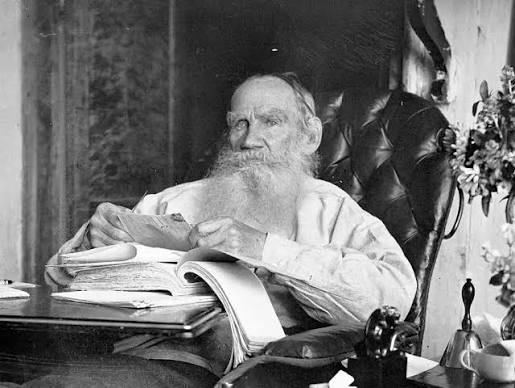
The Tolstoy excommunication of 1901 was the result of an irreconcilable conflict. On one side stood the author’s evolving understanding of Christianity; on the other, the doctrines of the institutional Russian Orthodox Church. This conflict developed over many years and finally culminated in an official decision.
1. The Background to the Tolstoy Excommunication and the Philosophical Rift
From the 1880s onward, Tolstoy harshly criticized the institutional structure of Christianity. Church rituals and dogmas based on miracles were also among his targets. Above all, he regarded the doctrine of the Trinity, established through the tradition of the Council of Nicaea, the virgin birth, and miracles as forms of “mental delusion” and “hypnosis.” For Tolstoy, these ideas undermined rational thought and conscience.
In his view, the Church instilled these beliefs in people from childhood, preventing them from understanding authentic religion and genuine moral development.
2. The Holy Synod’s Decision to Excommunicate Tolstoy (February 1901)
In February 1901, the Holy Synod, the highest governing body of the Russian Orthodox Church, issued an official declaration concerning Tolstoy. Chief Procurator K. P. Pobedonostsev had initiated the move. The declaration cited Tolstoy’s heretical views and his public rejection of church doctrine as grounds for the decision.
3. Public Reactions to the Tolstoy Excommunication
Contrary to expectations, the Tolstoy excommunication did not isolate the writer from society. Instead, it generated an enormous wave of support. In his diaries, Tolstoy recorded numerous congratulatory messages, expressions of sympathy, addresses, and letters. These arrived from across Russia and around the world following the announcement.
4. Tolstoy’s Response: A Reply to the Holy Synod’s Edict (April 1901)
In response to the Church’s decision, Tolstoy wrote a historic text entitled A Reply to the Holy Synod’s Edict, which he completed in April. His central arguments during this period, as reflected in his diaries, included the following:
– “A Magical Antidote to Fear”: Tolstoy characterized Orthodox belief as a “magical antidote” developed to counter the fear of death and existence, as well as a refuge dependent on miracles.
– The Coleridge Reference: In his letter, he quoted the following statement attributed to the poet Samuel Taylor Coleridge: “He who loves Christianity more than Truth will proceed to love his own sect or church more than Christianity, and will ultimately love himself more than anything else.”
– The Definition of True Religion: Tolstoy once again declared that faith consisted not of rituals and dogmas but of individual conscience, love for God, and service to humanity.
5. The Finality of the Decision and His Wishes Concerning His Death
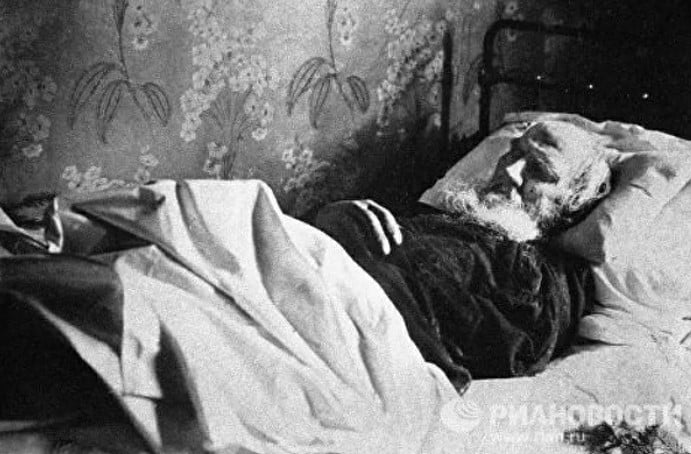
Until the end of his life, Tolstoy categorically rejected reconciliation with the Church. In his diary entry dated 22 January 1909, he recorded his response to the appeals of the Bishop of Tula, who had visited him and urged him to return to the faith:
“For me, to return to the Church or receive Communion before my death would be as impossible as blasphemy. Any claim that I repented on my deathbed would be nothing but a lie.”
Finally, Tolstoy also stipulated his wishes concerning his burial. He asked to be laid to rest without ceremonies, a priest, or prayers, in the cheapest peasant grave available.
6. Why the Tolstoy Excommunication Still Matters
The Tolstoy excommunication was more than a dispute between one writer and one Church. It became a symbol of the clash between individual conscience and institutional authority. Moreover, the episode amplified Tolstoy’s moral voice instead of silencing it. His ideas on nonviolence and conscience later reached readers far beyond Russia, including the young Mahatma Gandhi, with whom he corresponded in his final years. Tolstoy’s critique of established authority was not limited to religion, either. He applied the same uncompromising standard to art, as seen in his criticism of Wagner and Beethoven.
References (Cited Diary Entries)
- R. F. Christian (ed.), Tolstoy’s Diaries, Volume 2: 1895–1910, Faber & Faber.
- Diary Entry, 16 February 1895: Tolstoy’s wishes to be buried without ceremonies or a priest.
- Diary Entry, 22 September 1895: Rejection of the Council of Nicaea, the Trinity, and church dogmas.
- Diary Entries, 1 January and 9 October 1900: The harmful effects of religious education for children and the concept of ecclesiastical hypnosis.
- Diary Entries, 8 February–8 April 1901: The excommunication process, public support, the Coleridge quotation, and the completion of A Reply to the Synod.
- Notes from the 1901 Period (Note 10): Details concerning the Holy Synod and Pobedonostsev’s declaration of excommunication.
- Diary Entry, 22 January 1909: The Bishop of Tula’s visit, Tolstoy’s rejection of religious rites on his deathbed, and the reaffirmation of his burial wishes.
Related reading
- Leo Tolstoy’s Final Escape: His Diaries, Spiritual Crisis, and Death at Astapovo in 1910
- Tolstoy’s Response to His Excommunication by the Church
- Death and Immortality in Tolstoy’s Late Diaries (1895–1910): Spiritual Consciousness, Love, and the Illusion of Time
- Leo Tolstoy’s Literary Criticism of Anton Chekhov and Maxim Gorky: Diaries, Conversations, and Literary Aesthetics in Yasnaya Polyana and Crimea
- Leo Tolstoy and Mahatma Gandhi: Nonviolence, Pacifism, and the Ethics of Resistance (1909–1910)
About the Author