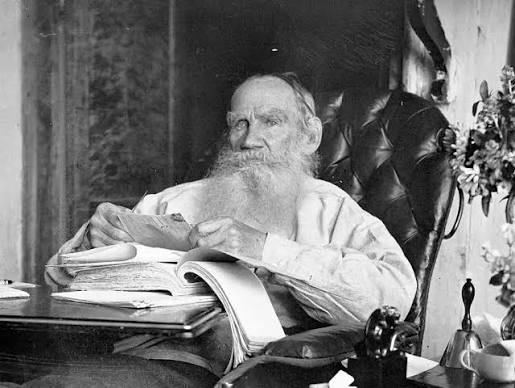
Following his excommunication in February 1901 by the Holy Synod, the highest governing body of the Russian Orthodox Church, Leo N. Tolstoy wrote A Reply to the Holy Synod’s Edict (Otvet Sinodu). In this text, Tolstoy turned his reply to the Holy Synod into one of the clearest and boldest declarations of his religious philosophy.
In this historic response, Tolstoy challenged the authority of the Church. Moreover, he defended authentic faith, reason, and conscience against the ecclesiastical establishment that accused him of unbelief. His diaries from 1900–1901 show how this reply took shape, entry by entry.
Background: Why Tolstoy Wrote His Reply to the Holy Synod
By the late 1890s, Tolstoy had openly rejected the sacraments and much of Orthodox dogma. His novel Resurrection (1899) also included a satirical portrayal of an Orthodox church service, which deeply offended the clergy. Consequently, Chief Procurator Konstantin Pobedonostsev and the Holy Synod decided to act. In February 1901, the Synod declared that the Church no longer considered Tolstoy one of its members until he repented. The decree appeared in the official church press and quickly became a national sensation. (For the full story, see How Did Tolstoy’s Excommunication by the Church Unfold?)
1. The Distinction Between Truth and Church Doctrine: The Coleridge Quotation
In his response, Tolstoy emphasized that he did not reject God or the essence of Christianity. Instead, he rejected the man-made dogmas that the Church had built upon the Gospel over the centuries.
– The Principle Attributed to S. T. Coleridge: Tolstoy opened his reply with a significant quotation. It came from the English poet and philosopher Samuel Taylor Coleridge:
“He who loves Christianity more than Truth will proceed to love his own sect or church more than Christianity, and will ultimately love himself more than anything else.”
– Truth Against Bureaucracy: Through this quotation, Tolstoy targeted church officials, particularly Chief Procurator Pobedonostsev. In his view, they placed the religious institution and their own political power above the Gospel’s universal principles of love and truth.
2. “A Magical Antidote to Fear”: Criticism of Miracles and Religious Rituals
In his diaries, Tolstoy described the Church’s conception of Christianity as a mechanism of control. In particular, it exploited human psychological vulnerability in the face of death and existential uncertainty.
– The Exploitation of Fear: He saw the rituals, icons, veneration of saints, and dogmatic prayers of the Orthodox Church as a “magical antidote to the fear of death.” In other words, these practices offered comfort instead of moral guidance.
– Rejection of Belief in Miracles: Tolstoy argued that basing religion on miracles made the human mind passive and subservient. Authentic religion, by contrast, meant living according to reason, conscience, and love for humanity. Such a faith, he believed, had no need for miracles.
3. The Dignity of Reason and Childhood Education
In challenging the grounds for his excommunication, Tolstoy drew attention to a deeper harm. Above all, he pointed to the damage that dogmatic education inflicted on children and society.
– The Mutilation of the Mind: He believed that teaching children irrational doctrines, such as the Trinity and miracles, impaired their capacity for reason and faith for life. Indeed, he compared this process to forcing a child to accept that two plus two equals five (2 + 2 = 5).
– Authentic Religious Education: According to Tolstoy, the Church “hypnotized” people and legitimized state oppression. Authentic religion, however, was a universal law of life. It directed individuals toward moral self-improvement.
4. The Social Impact of Excommunication and the Public Response
The Holy Synod’s efforts to discredit Tolstoy in the eyes of society produced the opposite result.
– Public Support: Immediately after the excommunication, messages of support, letters, and congratulatory addresses poured in. They came from across Russia, particularly from St. Petersburg and Moscow, as well as from abroad.
– A Courageous Stand: By completing and publishing his reply to the Holy Synod, Tolstoy strengthened his moral influence among the public. As a result, he fundamentally challenged the legitimacy of the Church hierarchy in the eyes of ordinary people.
Why Tolstoy’s Reply to the Holy Synod Still Matters
Today, the reply Tolstoy addressed to the Holy Synod remains a striking case of conscience confronting institutional power. The Russian Orthodox Church never formally revoked the decree, and Tolstoy died in 1910 without reconciling with it. Nevertheless, his reply continues to shape debates about faith, freedom of thought, and religious authority. Furthermore, the episode shows how consistently Tolstoy applied the same moral test to every sphere of life. He judged art by that standard as well, as his critique in Why Does Tolstoy Criticize Wagner and Beethoven? reveals. For readers today, therefore, his reply is not only a historical document but also an invitation to think independently.
References (Cited Diary Passages)
- R. F. Christian (ed. and trans.), Tolstoy’s Diaries, Volume 2: 1895–1910, introductory overview (the Tula famine, the 1901 excommunication, and A Reply to the Holy Synod’s Edict).
- Diary Entry, 1 January 1900: The teaching of dogmas such as \(2 + 2 = 5\) to children and the resulting damage to the mind.
- Diary Entry, 9 October 1900: The Church’s indoctrination of children and Tolstoy’s criticism of dogmatism.
- Diary Entry, 6 February 1901: The need to teach religion as universal morality without coercion.
- Diary Entry, 19 March 1901: The excommunication decree, the flood of public support, and the address to the Tsar.
- Diary Entry, 19 March 1901: The historic quotation attributed to Coleridge concerning loving Christianity more than Truth.
- Diary Entry, 28 March 1901: Orthodox Christianity as a “magical antidote to fear” and its dependence on miracles.
- Diary Entries, 31 March and 8 April 1901: The completion of A Reply to the Synod and its public impact.
- Notes from the 1901 Period (Note 10): Chief Procurator Pobedonostsev and the Holy Synod’s decree.
- Notes from the 1901 Period (Note 12): The use of the Coleridge quotation as an epigraph in A Reply to the Synod.
- Book Title: Tolstoy’s Diaries, Volume 2: 1895–1910
- Author: Leo Tolstoy (Lev Nikolayevich Tolstoy)
- Compiled, Edited, and Translated by: R. F. Christian (Reginald Frank Christian)
- Introduction by: Rosamund Bartlett
- Publisher: Faber & Faber (Faber Finds)
- Publication Language: English (selected entries translated from the original Russian)
- Copyright / Publication Year: 1985 (translation and selection copyright: R. F. Christian, 1985; introduction: 2010/2015)
Related reading
- How Did Tolstoy’s Excommunication by the Church Unfold?
- Leo Tolstoy’s Literary Criticism of Anton Chekhov and Maxim Gorky: Diaries, Conversations, and Literary Aesthetics in Yasnaya Polyana and Crimea
- Leo Tolstoy’s Final Escape: His Diaries, Spiritual Crisis, and Death at Astapovo in 1910
- Death and Immortality in Tolstoy’s Late Diaries (1895–1910): Spiritual Consciousness, Love, and the Illusion of Time
- Leo Tolstoy and Mahatma Gandhi: Nonviolence, Pacifism, and the Ethics of Resistance (1909–1910)
About the Author