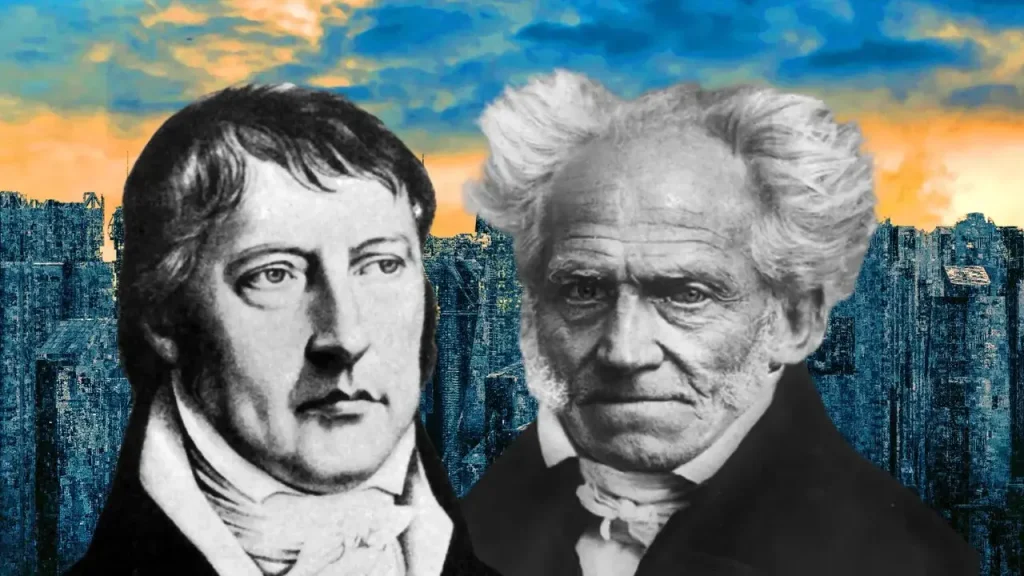
The rivalry between Arthur Schopenhauer and Georg Wilhelm Friedrich Hegel represents one of the most striking intellectual rivalries in nineteenth-century German philosophy. Their conflict involved more than philosophical disagreement. It also developed within the competitive academic environment of the University of Berlin.
In 1820, Schopenhauer began teaching at Berlin as a Privatdozent, an unsalaried university lecturer. At that moment, Hegel already occupied one of the university’s most prestigious philosophical positions. Moreover, Hegel had attracted a large audience through his lectures.
Schopenhauer responded in a remarkably confrontational way. He deliberately scheduled his lectures at the same time as Hegel’s main lectures. However, the strategy produced the opposite of the result he presumably wanted: students overwhelmingly attended Hegel. (Stanford Encyclopedia of Philosophy)
Berlin and the Rise of Hegel
Berlin had become one of the most important centers of German Idealism. Hegel arrived at the University of Berlin in 1818 and assumed the prestigious chair previously associated with Johann Gottlieb Fichte.
Schopenhauer, meanwhile, sought to establish his own academic career in the same intellectual environment. Therefore, Berlin offered him both an opportunity and a formidable challenge.
The two philosophers occupied very different positions within the university. Hegel had institutional authority, an established academic network, and a growing group of students. Schopenhauer entered the university as a relatively isolated philosopher who had already developed a sharp opposition to the dominant currents of German Idealism. (Cambridge University Press)
Schopenhauer Deliberately Challenged Hegel
Schopenhauer received his habilitation in March 1820 after presenting his trial lecture, “On the Four Different Kinds of Causes.” He subsequently began teaching as a Privatdozent at Berlin.
Yet he did not simply choose an available teaching schedule. According to the German Deutsche Biographie, Schopenhauer deliberately arranged his lectures at the same time as Hegel’s heavily attended lectures. The source describes this decision explicitly as a form of “bewußte Konkurrenz”, or conscious competition. (Deutsche Biographie)
The Stanford Encyclopedia of Philosophy provides a similar account. It explains that in March 1820 Schopenhauer scheduled his class simultaneously with Hegel’s popular lectures, but only a few students chose Schopenhauer’s course. (Stanford Encyclopedia of Philosophy)
Thus, Schopenhauer transformed the university timetable into an arena of philosophical competition.
Hegel Had the Larger Audience
The result was decisive. Hegel attracted a substantial student audience, whereas Schopenhauer struggled to attract listeners.
This outcome had an important biographical consequence. Schopenhauer did not merely lose a competition for students; he also failed to establish the academic career that he wanted.
Furthermore, his failure occurred at precisely the institution where Hegel’s influence continued to expand. Cambridge University’s recent study of Schopenhauer’s polemics emphasizes this broader context: Hegel developed an increasingly successful academic career in Berlin while Schopenhauer remained on the margins of university life. (Cambridge University Press)
The contrast became increasingly difficult for Schopenhauer to ignore.
Why Did Students Choose Hegel?
We should avoid reducing the situation to a simple question of which philosopher was “better.” Academic reputation, institutional position, intellectual networks, and student expectations all influenced the outcome.
Hegel already held a prestigious professorship when Schopenhauer began his Berlin teaching career. Moreover, Hegel had developed an influential philosophical system that attracted students throughout the German academic world.
Schopenhauer, by contrast, promoted a highly unconventional philosophy centered on the concept of the will. His The World as Will and Representation had appeared in 1818, but it had not yet achieved the recognition that Schopenhauer expected.
Consequently, the young lecturer faced an established philosophical school rather than an empty intellectual field. After all, philosophy has always depended on its audience, a point already visible in how Socrates turned public spaces into a classroom.
How Schopenhauer Criticized Hegel
The rivalry also had a profound philosophical dimension.
Schopenhauer rejected Hegel’s systematic idealism. He considered Hegel’s philosophy obscure and objected particularly to its treatment of reason, history, consciousness, and the state.
Instead, Schopenhauer placed the will at the center of his philosophical system. He argued that the world does not ultimately reveal itself as a rational structure governed by the kind of dialectical development that Hegel described.
Therefore, the disagreement involved two fundamentally different interpretations of reality.
Hegel emphasized the historical and rational development of Spirit. Schopenhauer emphasized the irrational, striving character of the will. Their disagreement consequently extended far beyond academic competition.
The 1820 Trial Lecture
An especially interesting detail comes from the historical record of Schopenhauer’s habilitation.
On 23 March 1820, Schopenhauer delivered his trial lecture before the philosophical faculty at Berlin. Hegel himself belonged to this faculty.
The episode therefore placed the two philosophers in direct institutional proximity. Schopenhauer was attempting to establish himself within the very academic environment in which Hegel already exercised considerable authority.
Moreover, Schopenhauer’s trial lecture demonstrates that the rivalry did not begin simply as a later personal resentment. Their philosophical confrontation already existed within the academic setting of 1820.
A Failed Academic Strategy
Schopenhauer’s decision to compete directly with Hegel produced a remarkable paradox.
If he wanted to build an academic career, he needed students. However, he selected a timetable that placed him directly against the university’s most successful lecturer.
As a result, his strategy undermined his own professional ambitions.
The Deutsche Biographie reports that Schopenhauer taught for only one semester during this initial period. He later left Berlin in 1822. His subsequent attempts to establish an academic position also failed. (Deutsche Biographie)
In other words, the problem involved more than one unsuccessful semester. It formed part of a longer failure to secure a stable university career.
Hegel’s Success and Schopenhauer’s Isolation
The contrast between the two philosophers became increasingly striking during the 1820s.
Hegel built a substantial intellectual network around his philosophy. Students and younger academics developed his ideas, defended them, and eventually contributed to the formation of different Hegelian schools.
Schopenhauer experienced the opposite trajectory. He remained intellectually isolated and increasingly criticized the academic establishment.
Cambridge’s recent scholarship stresses this asymmetry. Hegel’s Berlin career advanced while Schopenhauer’s academic ambitions repeatedly failed. Consequently, Schopenhauer’s later attacks on Hegel developed against the background of a genuine difference in academic status and influence. (Cambridge University Press)
Did Schopenhauer Oppose Hegel Only for Personal Reasons?
This question requires caution.
It would be too simplistic to claim that Schopenhauer hated Hegel merely because Hegel attracted more students. Their philosophical disagreement had deeper roots.
Schopenhauer opposed central elements of Hegelian philosophy. Furthermore, he believed that Hegel’s growing institutional influence marginalized alternative approaches to post-Kantian philosophy.
At the same time, however, Schopenhauer’s personal academic disappointment clearly formed part of the historical context.
Thus, we should distinguish philosophical opposition from personal resentment while recognizing that the two interacted throughout his career.
The Irony of the Schopenhauer and Hegel Rivalry
The Berlin episode contains a remarkable historical irony.
Schopenhauer tried to challenge Hegel at the very moment when Hegelian philosophy enjoyed extraordinary institutional success. Instead of creating a competing audience, Schopenhauer’s decision exposed the enormous difference between their academic positions.
Nevertheless, the story did not end there.
During the later nineteenth century, Schopenhauer gained a reputation that he had failed to achieve during his Berlin years. His philosophy eventually influenced thinkers and artists such as Friedrich Nietzsche, Richard Wagner, and numerous writers and psychologists.
Therefore, the lecturer who once struggled to fill a classroom eventually became one of the most influential critics of nineteenth-century European thought.
Bibliography
- Stanford Encyclopedia of Philosophy, “Arthur Schopenhauer.”
Stanford Encyclopedia of Philosophy – Arthur Schopenhauer - Deutsche Biographie, “Schopenhauer, Arthur.”
Deutsche Biographie – Arthur Schopenhauer - Cambridge University Press, Schopenhauer’s Politics, Chapter 5: “Schopenhauer’s Polemics.”
Cambridge University Press – Schopenhauer’s Polemics - Internet Encyclopedia of Philosophy, “Arthur Schopenhauer.”
Internet Encyclopedia of Philosophy – Arthur Schopenhauer - Deutsche Biographie, “Henning, Leopold von.”
Deutsche Biographie – Leopold von Henning
About the Author