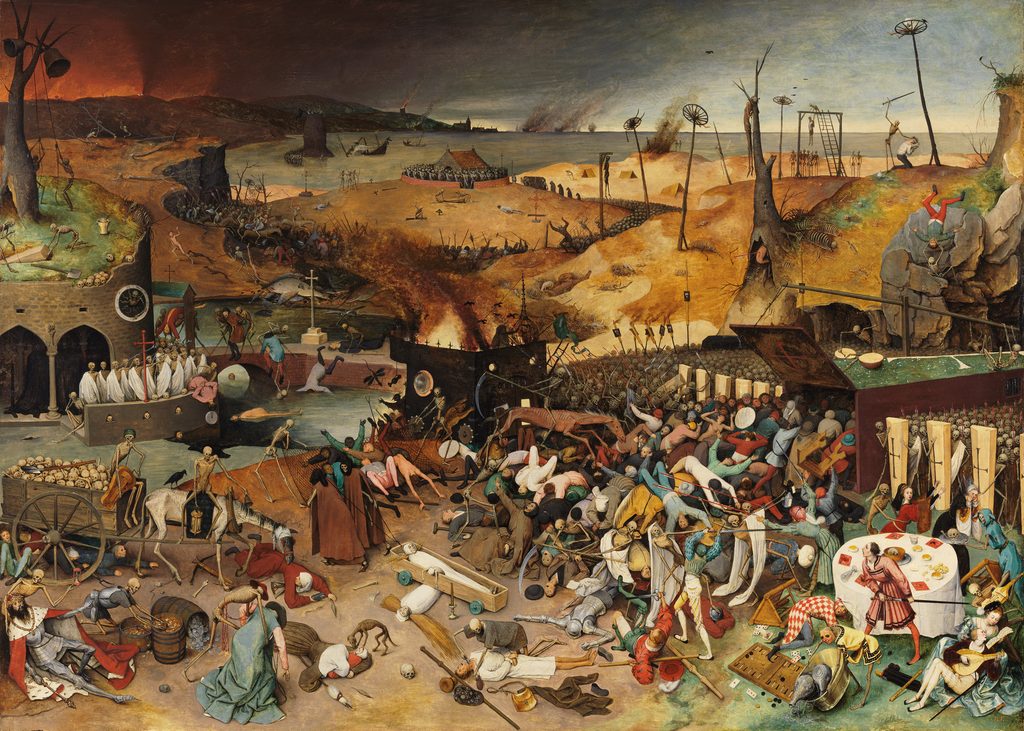
Pieter Bruegel the Elder’s The Triumph of Death stands among the most powerful and disturbing paintings of sixteenth-century European art. Bruegel created the work around 1562–1563, using oil on panel. The painting measures approximately 117 × 162 cm, and the Museo Nacional del Prado in Madrid houses it today. (Museo del Prado)
The Triumph of Death presents an enormous army of skeletons that attacks the world of the living. Therefore, Bruegel transforms death from an individual experience into a universal social force. Kings, soldiers, peasants, lovers, musicians, merchants, and religious figures all encounter the same fate.
Moreover, Bruegel does not present death as a distant or abstract idea. He fills the landscape with violence, destruction, corpses, executions, burning cities, and terrified people. Consequently, the viewer encounters death as an active power that controls the entire visual field.
Historical Context of The Triumph of Death
Bruegel worked during a period of profound political, religious, and social tension in the Low Countries. His art frequently combined detailed observation of everyday life with moral and philosophical questions.
The Prado dates The Triumph of Death to 1562–1563 and identifies it as a moral work about Death’s victory over worldly existence. (Museo del Prado)
However, the painting does not simply repeat a medieval religious formula. Bruegel combines medieval traditions with the visual language of the Renaissance. In fact, his composition brings together landscape, social observation, allegory, satire, and grotesque imagery.
Art historians also connect the work with the sixteenth-century Flemish tradition, Hieronymus Bosch, the medieval Dance of Death, and contemporary social conditions.
The Army of Skeletons in The Triumph of Death
The most striking element of The Triumph of Death consists of the enormous army of skeletons.
Death leads the army from the center of the composition while riding a reddish horse. Skeletons surround the living and force them toward a gigantic coffin. The Prado describes this army as the central symbol of Death’s victory over worldly things. (Museo del Prado)
Furthermore, Bruegel gives the skeletons an organized military structure. They do not wander randomly through the landscape. Instead, they advance as a disciplined force.
This arrangement creates an important contrast between human society and Death. Human beings normally create armies to defend political power, territory, and social institutions. Bruegel reverses this structure: Death itself commands the strongest army in the painting.
Death as a Universal Power
In this way, Bruegel destroys social distinctions through death.
For instance, kings possess crowns, soldiers carry weapons, merchants possess wealth, and ordinary people perform everyday activities. Nevertheless, none of these differences can protect anyone from Death.
The Prado explicitly notes that the composition includes different social institutions and that neither worldly power nor religious devotion can save the figures from their fate. (Museo del Prado)
Thus, the painting presents death as the ultimate equalizer.
In the end, a king and a peasant ultimately share the same destiny. A wealthy merchant cannot purchase another life. A soldier cannot defeat the skeleton army. For this reason, Bruegel turns mortality into a powerful critique of human pride.
The Medieval Dance of Death
The painting draws strongly on the medieval tradition known as the Dance of Death (Danse Macabre).
In particular, this tradition often showed Death approaching people from different social classes. Its central message emphasized the temporary nature of worldly status.
Similarly, Bruegel develops the same principle on a much larger scale. Instead of showing Death merely dancing with individuals, he creates an entire landscape controlled by death.
The Prado explains that the painting belongs to a tradition of medieval representations of the Dance of Death, while also emphasizing Bruegel’s distinctive treatment of the theme. (Museo del Prado)
Nevertheless, Bruegel does not simply imitate medieval examples. He introduces complex spatial organization, detailed landscapes, contemporary objects, and numerous individual episodes.
Hieronymus Bosch and Bruegel
At the same time, Bruegel’s grotesque imagery also reveals the influence of Hieronymus Bosch.
For example, Bosch frequently filled his paintings with demons, monsters, strange creatures, punishments, and morally charged scenes. Bruegel adopts a similar visual density in The Triumph of Death.
However, Bruegel replaces many of Bosch’s fantastic creatures with skeletons and recognizable human figures.
The Prado describes Bosch’s influence through the large number of scenes and the moralizing character of Bruegel’s composition. (Museo del Prado)
In addition, Bruegel uses the landscape itself as an instrument of psychological pressure. Burning cities, dead trees, wrecked ships, gallows, wheels, and scattered bodies create an environment in which destruction seems endless.
A Landscape of Destruction in The Triumph of Death
Furthermore, the background extends the theme far beyond the foreground.
Smoke rises above burning cities. Ships lie damaged near the sea. Gallows and execution wheels appear throughout the landscape. The barren environment reinforces the impression that Death has conquered civilization itself.
The scene unfolds as a panoramic landscape of death and destruction, with burning cities, shipwrecks, gallows, execution wheels, and a large army of skeletons.
As a result, Bruegel does not limit death to individual bodies. He imagines the destruction of an entire civilization.
This feature gives the painting an almost apocalyptic character.
The Coffin and the Loss of Hope
One of the painting’s central symbols consists of the enormous coffin that receives the living.
Death’s army pushes people toward this structure. The coffin therefore functions as more than an object associated with burial. It represents the final destination that awaits every person.
Indeed, Bruegel places a cross on the coffin, creating a direct relationship between death, religion, and salvation.
Yet the composition offers no easy consolation. The overwhelming scale of the skeleton army creates an atmosphere of extreme pessimism.
The Prado describes the figures as moving toward an enormous coffin and emphasizes the inability of worldly power to provide escape. (Museo del Prado)
The Isolated Cross
A small cross occupies an important position near the center of the painting.
Its relatively small scale contrasts sharply with the enormous army of skeletons surrounding it. Therefore, Bruegel creates a striking visual tension between religious symbolism and the overwhelming presence of death.
The cross can represent Christian salvation, but the painting does not give it visual dominance.
On the other hand, the skeleton army dominates almost every part of the composition. This contrast encourages different interpretations of Bruegel’s religious outlook.
Rather than offering one simple theological answer, the artist creates a disturbing question about humanity, mortality, and faith.
The King and the Limits of Power
Bruegel also places a crowned ruler among the victims.
A skeleton stands behind the king and holds an hourglass. The image connects political authority with the passage of time.
In other words, the king possesses power, but time ultimately controls him.
The crowned figure represents power and authority, while the hourglass points to mortality.
The message remains simple but powerful: political power cannot negotiate with time.
Wealth Cannot Defeat Death
Bruegel also attacks the illusion of material security.
One skeleton reaches toward barrels filled with money. The scene associates wealth with the futile attempt to preserve worldly possessions.
Similarly, other figures continue to carry out activities associated with ordinary life even while the skeleton army surrounds them.
The painting therefore questions the value of possessions when mortality ultimately destroys every material distinction.
Consequently, The Triumph of Death functions not only as a meditation on mortality but also as a critique of greed and attachment to worldly wealth.
The Lovers in the Lower Right Corner
The lower-right corner contains one of the painting’s most memorable scenes: a couple of lovers.
While the world around them collapses, the lovers remain absorbed in their own private moment.
An accompanying skeleton imitates the male lover and appears to play a musical instrument. (Museo del Prado)
Ironically, the lovers seem unaware of the catastrophe around them.
Their scene introduces an unusual mixture of eroticism, humor, and mortality. Bruegel therefore refuses to create a uniformly solemn composition.
Instead, he uses irony to remind viewers that human beings often ignore death while they pursue pleasure.
The Musician and Everyday Life
Music appears repeatedly in Bruegel’s world.
A musician attempts to hide beneath a table near the lovers. Elsewhere, people continue ordinary activities even as Death approaches.
Thus, Bruegel places everyday pleasures alongside catastrophe.
The contrast makes the painting psychologically complex. People do not respond to death in a single way. Some fight, some flee, some hide, and others continue their activities.
In fact, this variety gives the painting much of its human realism.
The Destruction of Social Hierarchy in The Triumph of Death
Bruegel includes people from different social groups.
Farmers, soldiers, nobles, merchants, rulers, and ordinary citizens all face the skeleton army.
For this reason, the painting functions as a visual statement about social equality in death.
The artist does not allow aristocratic status to create a privileged space within the composition. Everyone becomes part of the same catastrophe.
Ultimately, death removes the distinctions that human society constructs.
Everyday Objects and Historical Evidence
The painting also provides valuable information about sixteenth-century European life.
Bruegel depicts clothing, weapons, musical instruments, gaming activities, furniture, methods of execution, and other objects associated with contemporary society.
Especially, the representation of the execution wheel provides insight into forms of punishment that existed during the period.
Consequently, the painting operates on two levels. It functions as an allegory of mortality, but it also records aspects of sixteenth-century material culture.
War, Disease, and Political Anxiety
Scholars and commentators have proposed several historical interpretations of The Triumph of Death.
Some interpretations connect its atmosphere with the political tensions that preceded the Eighty Years’ War. Others associate the imagery with the memory of the Black Death or with broader social transformations in medieval and early modern Europe.
Nevertheless, we should distinguish historical interpretation from established fact. Bruegel completed the painting around 1562–1563, several years before the conventional beginning of the Eighty Years’ War in 1568.
Therefore, the painting cannot simply function as a literal depiction of that later conflict.
Instead, its atmosphere can reflect broader anxieties about violence, instability, disease, political power, and social transformation.
Color and Atmosphere in The Triumph of Death
In The Triumph of Death, Bruegel uses predominantly dark and earthy tones.
The reddish-brown atmosphere contributes to the painting’s infernal character. The Prado also highlights this reddish-brown tonal structure and connects it with the disturbing subject of the work. (Museo del Prado)
Moreover, the limited palette prevents the landscape from becoming visually comforting.
The colors reinforce the emotional message of the composition. Fire, smoke, dead earth, skeletons, and human bodies merge into a world that seems to have lost its vitality.
The Triumph of Death as a Moral Allegory
At its deepest level, The Triumph of Death presents a moral argument.
Human beings pursue wealth, power, pleasure, love, military glory, and social status. Yet, death eventually interrupts every one of these pursuits.
Bruegel does not place death outside human civilization. Instead, he places Death directly inside it.
Therefore, the painting asks viewers to reconsider the value of worldly ambitions.
The work does not simply say that everyone dies. It asks a more difficult question:
What remains meaningful when death makes every worldly distinction temporary?
Cultural Influence of The Triumph of Death
Over the centuries, Bruegel’s The Triumph of Death continued to influence literature and popular culture.
The Triumph of Death appears in discussions of works by Don DeLillo, Arturo Pérez-Reverte, Anne Rice, and Sylvia Plath. It even appears in a Monty Python sketch.
Furthermore, the Prado notes that the painting inspired later works and that Pieter Brueghel the Younger produced literal copies of the composition. (Museo del Prado)
This continuing influence demonstrates the extraordinary durability of Bruegel’s imagery.
Bruegel returned to questions of pride, sin, and human limits in several other works. For example, our analysis of The Tower of Babel explores ambition and hubris. Similarly, our essay on Anger from The Seven Deadly Sins examines how he visualized wrath.
References
- Museo Nacional del Prado. The Triumph of Death, Pieter Bruegel the Elder, 1562–1563. Museo del Prado, Madrid. Museo del Prado – The Triumph of Death (Museo del Prado)
- Museo Nacional del Prado. El triunfo de la Muerte – Pieter Bruegel el Viejo. Prado Encyclopedia. Museo del Prado – Encyclopedia (Museo del Prado)
- Museo Nacional del Prado. The Triumph of Death: Pieter Bruegel the Elder. Commentary by Alejandro Vergara, Chief Curator of Flemish and Northern School Painting. Museo del Prado – Commentary Video (Museo del Prado)
- Museo Nacional del Prado. The Triumph of Death. Pieter Bruegel the Elder – Easy-to-read Artwork. Museo del Prado – Easy-to-read Artwork (Museo del Prado)
- Cirlot, L., ed. Museo del Prado I. Colección “Museos del Mundo,” Vol. 6. Espasa, 2007, pp. 180–181.
- Monreal, L. Grandes Museos, Vol. 1. Planeta, 1975.
- Olivar, M. Cien obras maestras de la pintura. Biblioteca Básica Salvat, 1971.
About the Author