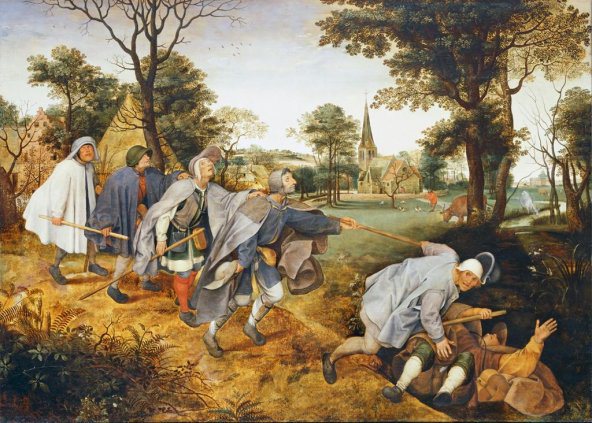
Pieter Bruegel the Elder’s The Blind Leading the Blind stands among the most remarkable paintings of the Northern Renaissance. Bruegel completed the work in 1568, near the end of his life. The painting measures approximately 86 × 154 cm, and the Museo di Capodimonte in Naples houses the original. (Wikipedia)
The painting draws its subject from a passage in the Gospel of Matthew 15:14, in which Jesus describes the Pharisees as “blind guides of the blind.” Bruegel transforms this brief biblical metaphor into a complex visual narrative about human vulnerability, misguided leadership, and the consequences of following others without understanding. (Wikipedia)
Moreover, the painting demonstrates Bruegel’s extraordinary interest in observing ordinary people. Rather than presenting blindness through a generalized symbol, he gives each figure distinctive physical characteristics and movements.
The Biblical Source of The Blind Leading the Blind
The painting takes its central idea from Matthew 15:14. In this passage, Jesus criticizes religious leaders and compares them to blind guides who lead other blind people. The biblical metaphor therefore connects physical blindness with spiritual and intellectual blindness. (Wikipedia)
Bruegel expands this metaphor through a sequence of six blind men. The group moves diagonally across the landscape, and the movement eventually ends in disaster.
Consequently, the painting turns an abstract moral warning into a visible chain of cause and effect.
Six Blind Men and a Carefully Constructed Movement
One of the most remarkable features of Pieter Bruegel’s The Blind Leading the Blind lies in the arrangement of the six figures.
The men move from the upper-left area toward the lower-right corner. The first figures have already begun to lose their balance, while the others continue to follow them. Bruegel therefore creates a visual sequence that resembles a chain reaction. (Wikipedia)
Furthermore, the artist does not show the group as a static collection of figures. Instead, he represents different stages of movement: walking, stumbling, falling, and collapse.
The fifth figure from the left looks directly toward the viewer while falling. This unusual position creates a particularly strong connection between the painted world and the observer. (Wikipedia)
A Painting That Captures Movement
Bruegel achieves something extraordinary through the bodies of the six men in The Blind Leading the Blind. Each figure occupies a different stage of the same physical event.
The first man has already fallen into the ditch. The following figures lose their balance one after another. Meanwhile, the men at the rear continue forward because they cannot see the danger ahead.
Thus, the composition functions almost like a sequence of frames from a moving image.
Art historian Lorne Campbell has similarly emphasized the extraordinary representation of movement in the work, describing the progression from tentative movement to complete collapse. (Wellcome Collection)
Bruegel’s Attention to Detail in The Blind Leading the Blind
Bruegel approaches blindness with an unusually observational eye. Instead of simply painting six men with closed eyes, he gives the figures different physical conditions.
The painting includes details associated with conditions affecting the eyes, including corneal damage, ocular atrophy, and the absence of the eyes. These details demonstrate Bruegel’s interest in the physical realities of blindness. (Wikipedia)
Therefore, the painting combines religious symbolism with empirical observation.
This combination distinguishes Bruegel from many earlier Renaissance representations of blind figures. He observes the human body closely and incorporates that observation into a theological narrative.
Blindness in Sixteenth-Century Europe
Bruegel lived in a society where blindness had many possible causes. Some people experienced congenital blindness, while disease, poor hygiene, accidents, and other conditions could also damage vision.
Moreover, blind people often depended on charity for their survival. Bruegel reflects this social reality through the appearance and clothing of his figures. (Wikipedia)
The painting therefore does more than illustrate a biblical quotation. It also reflects the social environment of sixteenth-century Europe.
Consequently, Bruegel brings together biblical metaphor and contemporary human experience.
The Limited Color Palette
The color scheme contributes significantly to the atmosphere of the painting.
Unlike some of Bruegel’s more colorful scenes of dances and weddings, The Blind Leading the Blind uses a relatively restricted palette dominated by brown, gray, and blue tones. (Wikipedia)
This restrained palette reinforces the serious character of the subject.
Furthermore, the subdued colors prevent the viewer from interpreting the scene as a festive rural landscape. Instead, they emphasize vulnerability, uncertainty, and approaching disaster.
The Ditch as a Symbol
The ditch provides the painting’s decisive moment.
The men cannot see the obstacle ahead, and the first figures have already begun to fall. The physical ditch therefore becomes a metaphor for the consequences of following incompetent or misguided leadership.
The Rijksmuseum similarly connects the subject with the proverb that describes what happens when one incapable person advises another incapable person. (Rijksmuseum.nl)
Thus, the ditch operates simultaneously as a literal physical danger and a moral symbol.
The Church in the Background
A church occupies an important position in the upper-right part of the composition. Its precise meaning remains open to interpretation.
Some scholars regard the church as a relatively conventional background element. Others connect it directly with the painting’s biblical and religious subject. A third interpretation gives the church a moral function because it stands between the figures who have already fallen and those who still remain upright. (Wikipedia)
Therefore, Bruegel leaves room for multiple interpretations rather than providing a single explicit explanation.
The Lily and the Question of Salvation
Near the ditch, Bruegel includes a lily. Traditional Christian symbolism often associates the lily with purity and salvation.
However, the painting does not clearly establish whether Bruegel intended the flower to suggest salvation for the blind men. (Wikipedia)
Nevertheless, its proximity to the falling figure invites interpretation. The flower introduces a subtle contrast between physical danger and the possibility of spiritual hope.
A Critique of Blind Leadership
The central message of The Blind Leading the Blind extends beyond physical blindness.
Bruegel uses the biblical metaphor to examine the dangers of following leaders who lack knowledge, judgment, or moral insight. The men follow one another without the ability to assess their direction independently.
In this sense, the painting addresses a universal human problem.
Moreover, the composition suggests that one person’s error can rapidly affect others. The first man’s fall creates a chain reaction because the remaining figures depend on the same unreliable path.
The Painting and Renaissance Human Observation
The Blind Leading the Blind also demonstrates an important characteristic of Renaissance art: the close observation of the human body.
Bruegel combines anatomical observation with religious meaning. He examines how blindness affects posture, movement, balance, and facial appearance.
Consequently, the painting occupies an interesting position between religious art, social observation, and visual naturalism.
Why The Blind Leading the Blind Still Matters
The relevance of The Blind Leading the Blind extends far beyond its biblical source.
Modern viewers can interpret the work through questions about misinformation, leadership, conformity, and collective decision-making. A group can move confidently in one direction even when nobody within the group possesses reliable knowledge.
However, Bruegel does not reduce the painting to a simple political or social allegory. The biblical framework remains fundamental to the work.
For this reason, the painting continues to invite different interpretations while retaining a clear moral structure.
Copies and the Influence of The Blind Leading the Blind
Bruegel’s composition attracted considerable attention after his death. Numerous copies and adaptations circulated, including a large painting in the Louvre that derives from the Bruegel composition. (Wikipedia)
The Wellcome Collection also identifies a painting as probably a seventeenth-century copy of the 1568 work now held in Naples. The collection notes that Bruegel’s compositions often circulated through copies by his son Pieter Brueghel the Younger and other artists. (Wellcome Collection)
Thus, the history of The Blind Leading the Blind also demonstrates the broader influence of Bruegel’s visual language. Similarly, his The Tower of Babel and Anger from the Seven Deadly Sins series reveal the same sharp eye for human folly.
References
- Wikipedia. “Körün Kıssası / The Blind Leading the Blind.” Turkish Wikipedia. Wikipedia – Körün Kıssası
- Rijksmuseum. “The Blind Leading the Blind.” Collection database and interpretation of the biblical proverb. Rijksmuseum – The Blind Leading the Blind
- Wellcome Collection. “The blind leading the blind.” Discussion of a probable seventeenth-century copy of Bruegel’s 1568 composition. Wellcome Collection – The Blind Leading the Blind
- Hagen, Rose-Marie and Rainer. Meisterwerke im Detail, Vol. 2. Taschen, 2003.
- Sudhoff, Heinke. Ikonographische Untersuchungen zur Blindenheilung und zum Blindensturz: Ein Beitrag zu Pieter Bruegels Neapler Gemälde von 1568. Bonn, 1981.
About the Author