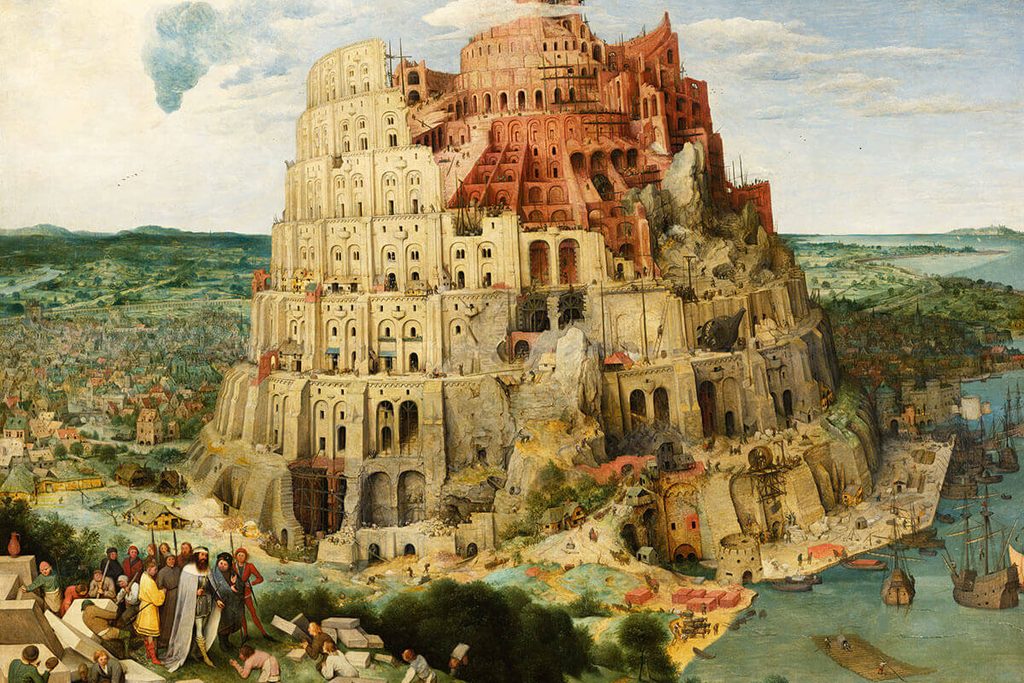
Pieter Bruegel the Elder’s The Tower of Babel stands among the most remarkable paintings of the Northern Renaissance. Bruegel completed the famous Vienna version in 1563, using oil on an oak panel measuring approximately 114 × 155 cm. Today, the painting belongs to the Kunsthistorisches Museum in Vienna. (khm.at)
The painting depicts the biblical story of the Tower of Babel from Genesis 11:1–9. However, Bruegel does not simply illustrate a biblical narrative. Instead, he transforms the story into a complex meditation on human ambition, technological achievement, political power, architectural grandeur, and hubris.
Moreover, the extraordinary amount of detail turns the painting into something resembling a visual encyclopedia of sixteenth-century construction and urban life.
The Biblical Story Behind the Painting
According to the Book of Genesis, humanity once shared a single language. The people of Shinar decided to build a city and an enormous tower that would reach toward heaven. Their project expressed their desire to establish a lasting name and prevent their dispersion across the earth.
However, God disrupted their unity by confusing their language. Consequently, the builders could no longer communicate effectively, and the construction project collapsed. The biblical story therefore connects linguistic diversity with the limits of human ambition. (Museum Boijmans Van Beuningen)
Bruegel focuses primarily on the construction itself. Rather than depicting the moment of linguistic confusion, he presents an enormous architectural project in full operation. Thus, the viewer encounters the biblical story through an image of collective labor.
An Enormous Tower Dominates the Landscape
The tower occupies the visual center of Bruegel’s composition. Its circular structure rises through several levels, while countless workers, machines, ramps, scaffolding systems, and construction activities surround it.
The enormous scale creates an immediate contrast between human beings and their architectural creation. In fact, the people appear almost microscopic beside the tower.
Nevertheless, Bruegel fills the scene with individual activities. Workers carry materials, construct walls, transport objects, and perform specialized tasks. Therefore, the painting simultaneously celebrates human ingenuity and questions its ultimate purpose.
Bruegel and the Colosseum
One of the most fascinating aspects of the painting concerns its architecture. Bruegel drew inspiration from the Colosseum in Rome, which he had encountered during his Italian journey. The tower combines Roman architectural characteristics with elements that recall Gothic architecture. (Museum Boijmans Van Beuningen)
This combination creates an imaginary architectural structure rather than an archaeological reconstruction of ancient Babylon.
Furthermore, the Colosseum reference gives the tower an additional cultural dimension. Bruegel transforms a Roman monument into the architectural model for a biblical structure. As a result, ancient Rome, biblical Babylon, and sixteenth-century Europe coexist within the same pictorial space.
Why Does the Tower Look Like a Medieval European Building?
Bruegel does not attempt to reconstruct what an actual ancient Babylonian tower might have looked like. Instead, he presents Babel through the architectural vocabulary familiar to his European audience.
The tower contains massive arches, ramps, masonry, cranes, and other construction elements. At higher levels, some architectural forms resemble Gothic structures. Therefore, the painting reflects Bruegel’s own historical environment as much as it depicts an ancient biblical setting. (Museum Boijmans Van Beuningen)
This decision creates an important interpretive effect. The story no longer belongs exclusively to the distant biblical past; rather, it becomes a warning that applies to Bruegel’s own society.
The Tower as a Symbol of Human Hubris
The central theme of the painting concerns hubris, or excessive pride.
The builders attempt to construct something that reaches toward heaven. Their enormous project demonstrates extraordinary organizational and technological capabilities. Nevertheless, their ambition exceeds human limitations.
Therefore, the tower can represent the paradox of civilization itself: human beings possess remarkable abilities, yet those abilities can encourage excessive confidence.
Bruegel does not portray the workers simply as foolish individuals. On the contrary, he shows them as highly organized and technically capable. Their failure becomes more significant precisely because their abilities are so impressive.
King Nimrod and the Question of Power
A small group of figures appears in the foreground of the Vienna painting. Scholars have traditionally interpreted this group as King Nimrod and his entourage, although the biblical text itself does not identify Nimrod as the builder of Babel. The association derives from later traditions, particularly the writings of Flavius Josephus. (Google Sanat ve Kültür)
This detail adds a political dimension to the painting.
If the foreground figure represents Nimrod, Bruegel connects monumental architecture with political authority. The tower then becomes more than an engineering project; it also becomes a demonstration of centralized power.
Consequently, the painting can be interpreted as a reflection on the relationship between political authority, collective labor, and monumental construction.
Antwerp in the Background
Another fascinating feature concerns the city surrounding the tower. Bruegel worked primarily in Antwerp, one of the major commercial and cultural centers of sixteenth-century Europe. Antwerp attracted merchants, travelers, and ships from many regions, so multiple languages could be heard throughout the city. (Museum Boijmans Van Beuningen)
For this reason, the biblical theme of the “confusion of tongues” would have carried particular resonance for Bruegel’s contemporaries.
The city in the painting therefore does not function merely as decorative scenery. It connects the ancient biblical story with the social and commercial world of sixteenth-century Europe.
Three Versions of the Tower of Babel
Bruegel produced three versions of the Tower of Babel theme. One early miniature, painted on ivory during his time in Rome, has been lost. Two larger oil paintings survive: the famous Vienna version and the smaller Rotterdam version in the Museum Boijmans Van Beuningen. (bruegel.at)
The Vienna painting dates to 1563 and measures approximately 114 × 155 cm. The Rotterdam painting measures approximately 59.9 × 74.6 cm, and the museum currently dates it broadly to around 1568, while noting that the work itself carries no date. (khm.at)
Interestingly, the two surviving paintings do not simply reproduce one another. Bruegel changes the viewpoint, scale, figures, and details of the construction.
The Vienna and Rotterdam Paintings
The differences between the two versions offer valuable insight into Bruegel’s artistic method.
In the Vienna painting, viewers can see more of the upper portion of the tower. The composition also includes the group of figures traditionally identified as Nimrod and his entourage.
By contrast, the Rotterdam version presents the tower from a lower viewpoint. The tower consequently appears even more imposing, while the Nimrod group disappears from the foreground. (bruegel.at)
Thus, Bruegel did not merely repeat the same composition. Instead, he explored different ways of representing scale, power, and human insignificance.
A Visual Encyclopedia of Construction
One of the painting’s most extraordinary qualities lies in its technical detail. Bruegel depicts an astonishing variety of construction activities, tools, workers, architectural structures, and transportation systems.
The Kunsthistorisches Museum emphasizes Bruegel’s meticulous representation of construction and craftsmanship, noting how the artist combines ancient and Romanesque architectural elements within the tower. (khm.at)
Moreover, the viewer can spend considerable time examining individual sections of the painting. Consequently, The Tower of Babel operates simultaneously as a religious image, an architectural fantasy, a social panorama, and a study of human labor.
The Paradox of Human Achievement
The painting presents a fascinating paradox.
On one level, the tower demonstrates what coordinated human labor can accomplish. Thousands of workers participate in a project that appears almost impossible. Their organization, technical knowledge, and persistence reveal the extraordinary potential of human civilization.
On another level, however, the same achievement exposes the dangers of excessive ambition.
Therefore, Bruegel does not simply condemn human intelligence or technological skill. Instead, he raises a more complicated question: What happens when human achievement becomes an expression of unlimited ambition?
References
- Kunsthistorisches Museum Vienna. The Tower of Babel – Pieter Bruegel the Elder, 1563. (khm.at)
- Museum Boijmans Van Beuningen. Bruegel’s Tower of Babel. (Museum Boijmans Van Beuningen)
- Google Arts & Culture / Kunsthistorisches Museum Wien. The Tower of Babel, Pieter Bruegel the Elder, 1563. (Google Sanat ve Kültür)
- Bruegel.at. The Tower of Babel – Pieter Bruegel the Elder. (bruegel.at)
- Genesis 11:1–9. The biblical account of the Tower of Babel.
- Bruegel, Pieter the Elder. The Tower of Babel. 1563. Oil on oak panel, Kunsthistorisches Museum, Vienna. (khm.at)
About the Author