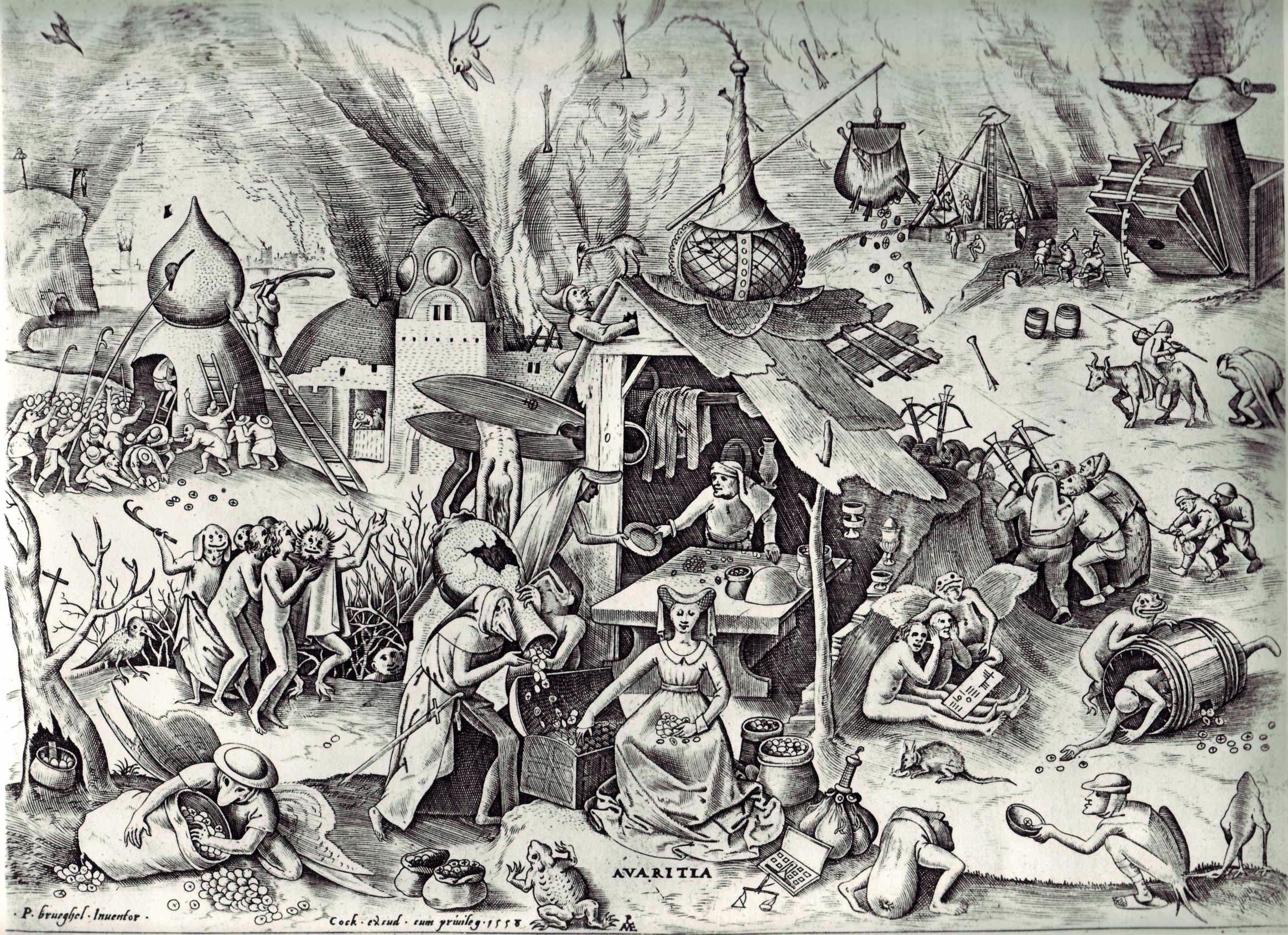
Pieter Bruegel the Elder’s Anger (Ira) belongs to his celebrated series The Seven Deadly Sins, which he designed during the 1550s. The engraver Pieter van der Heyden translated Bruegel’s design into print, while the Antwerp publisher Hieronymus Cock issued the engraving in 1558. Major museum collections, including the Metropolitan Museum of Art and the National Gallery of Art, identify Bruegel as the designer and van der Heyden as the engraver. (The Metropolitan Museum of Art)
The work presents wrath as a destructive moral force. Rather than showing anger through a simple human figure, Bruegel constructs an extraordinary landscape filled with demons, monsters, violence, disorder, and grotesque actions. Consequently, the engraving transforms an abstract moral concept into a complex visual world.
The Seven Deadly Sins in Bruegel’s Art
Bruegel created designs for seven engravings representing the traditional Seven Deadly Sins: wrath, sloth, pride, avarice, envy, gluttony, and lust. The series emerged between 1556 and 1558, and Pieter van der Heyden engraved the designs for publication by Hieronymus Cock. (British Museum) The same concern with human folly also drives his painting The Tower of Babel, where ambition rather than rage becomes the subject.
The series belongs to a long European tradition of representing virtues and vices through allegorical imagery. However, Bruegel expanded that tradition through his distinctive combination of fantasy, satire, moral instruction, and detailed landscape.
Moreover, he drew inspiration from the grotesque visual vocabulary associated with Hieronymus Bosch. Yet Bruegel adapted that tradition to his own concerns and created compositions that connected moral behavior with the social world of his own time. (British Museum)
Bruegel Designed the Image, but Another Artist Engraved It
An important distinction concerns artistic authorship.
Bruegel designed the composition, but Pieter van der Heyden engraved the final print. Hieronymus Cock then published the work in Antwerp in 1558. The Metropolitan Museum explicitly catalogues the print as “Pieter van der Heyden” after Pieter Bruegel the Elder, with Cock as publisher. (The Metropolitan Museum of Art)
This distinction matters because a sixteenth-century print often involved several stages of production. The designer developed the composition, the engraver translated it into lines on the printing plate, and the publisher organized its production and distribution.
Therefore, Anger represents not only Bruegel’s artistic imagination but also the collaborative nature of the sixteenth-century print industry.
What Does Bruegel Depict in Anger?
Bruegel presents Ira, the Latin term for wrath or anger, as a chaotic visual environment.
The scene contains violent figures, fantastic creatures, demons, weapons, and bizarre activities. Instead of concentrating on one dramatic protagonist, Bruegel distributes signs of anger throughout the composition.
As a result, the entire landscape appears infected by the vice.
This strategy creates an important visual effect: anger does not remain an individual emotion; it becomes a social and environmental disorder.
How Bruegel Shows Anger as a Destructive Force
The inscription at the bottom of the engraving directly reinforces its moral message. The Latin text describes the physical effects of anger, while the Dutch inscription similarly connects wrath with emotional disturbance and the corruption of the blood. The National Gallery of Art records both inscriptions in its catalogue. (National Gallery of Art)
Thus, Bruegel links psychological emotion with physical transformation.
Anger changes the face, disturbs the mind, and damages the body. In this sense, the engraving reflects a Renaissance understanding of the passions as forces that can disrupt both reason and bodily equilibrium.
The Grotesque as a Moral Language
One of the most striking characteristics of Anger involves its grotesque creatures.
Bruegel fills the composition with hybrid beings, monsters, demons, and strange combinations of human and animal forms. These creatures do not simply entertain the viewer. Instead, they give visual form to the irrationality associated with uncontrolled passion.
Furthermore, the grotesque allows Bruegel to make an abstract vice visible. A viewer cannot literally see “anger” itself; however, the artist can represent its consequences through violence, distortion, chaos, and monstrous behavior.
Consequently, grotesque imagery becomes a moral vocabulary.
The Influence of Hieronymus Bosch
Bruegel’s Seven Deadly Sins series clearly engages with the tradition established by Hieronymus Bosch.
Bosch had developed an influential visual language of demons, monsters, hybrid creatures, and hellish landscapes. Bruegel adopted aspects of this vocabulary but redirected them toward his own allegorical and moral concerns. The British Museum specifically notes Bruegel’s use of Bosch’s monsters, hybrids, and devils in his allegorical print designs. (British Museum)
Nevertheless, Bruegel did not simply imitate Bosch.
Instead, he combined Boschian fantasy with detailed observation of human behavior and an increasingly sophisticated understanding of landscape.
Why Did Bruegel Fill Anger with Such a Crowded Composition?
The crowded composition encourages the viewer to examine the image slowly.
At first glance, the viewer encounters a chaotic scene. After closer examination, however, numerous independent episodes emerge.
Therefore, the engraving functions almost like a visual puzzle. Each figure contributes another example of disorder, excess, violence, or irrationality.
This approach also reflects the culture of sixteenth-century prints, which often rewarded close observation and encouraged viewers to decode symbols and inscriptions.
Bruegel on Anger, Reason, and Moral Choice
The moral dimension of the engraving becomes particularly important when we consider the relationship between anger and reason.
Renaissance moral philosophy often treated uncontrolled passions as threats to rational judgment. The inscription beneath Bruegel’s image reinforces this concept by describing the physical and psychological consequences of wrath. (National Gallery of Art)
Accordingly, Bruegel’s Anger does not merely say that anger is unpleasant. It suggests that uncontrolled anger can distort perception, disrupt rational judgment, and ultimately produce destructive behavior.
In this respect, the engraving functions as a moral warning.
The Print and the Urban Audience
Hieronymus Cock operated an important print publishing business in Antwerp, and his workshop helped distribute Bruegel’s designs to a wider audience.
The British Museum notes that Bruegel’s allegorical designs adapted Bosch’s visual language for an urban audience. (British Museum)
This point helps explain why the series matters beyond religious history.
The Seven Deadly Sins transformed moral instruction into sophisticated printed imagery. Consequently, viewers could encounter theological and ethical ideas through an accessible visual medium.
Why Bruegel’s Anger Matters in Art History
Anger demonstrates how sixteenth-century Northern European artists could combine religious morality, popular imagery, fantasy, satire, and technical printmaking.
Moreover, the work illustrates Bruegel’s transition from simply depicting fantastic creatures toward developing complex compositions that investigate human behavior.
The engraving also reveals the importance of collaboration in Renaissance print culture. Bruegel supplied the intellectual and visual design, van der Heyden translated that design into engraving, and Cock brought the image into the commercial print market. (The Metropolitan Museum of Art)
References
- Metropolitan Museum of Art. Anger (Ira), from the series The Seven Deadly Sins, 1558. (The Metropolitan Museum of Art)
- National Gallery of Art. Anger, Pieter van der Heyden after Pieter Bruegel the Elder, 1558. (National Gallery of Art)
- British Museum. Early Netherlandish Drawings – Pieter Bruegel the Elder. (British Museum)
- British Museum. Gula – The Seven Deadly Sins, 1558. (British Museum)
- Orenstein, Nadine M. (ed.). Pieter Bruegel the Elder: Drawings and Prints. Metropolitan Museum of Art, 2001.
- BRUEGEL: The Complete Graphic Works. Belgian Science Policy Office / Royal Library of Belgium. (belspo.be)
About the Author