Rembrandt van Rijn completed The Night Watch in 1642. Today, the painting is regarded as one of the most recognisable masterpieces of the Dutch Golden Age. Yet its familiar title, its present appearance, and its dramatic history conceal a number of remarkable details.
Since the day Rembrandt completed it, the painting has undergone significant physical changes. It has been moved, deliberately attacked, evacuated during wartime, and subjected to extensive conservation. In this sense, The Night Watch tells two stories at once: one about Rembrandt’s artistic innovations, and another about the centuries-long struggle to preserve a work of art. [1]
1. The Night Watch Was Not Originally Called The Night Watch
The painting’s familiar title can be misleading. Rembrandt did not intend to depict a patrol taking place at night.
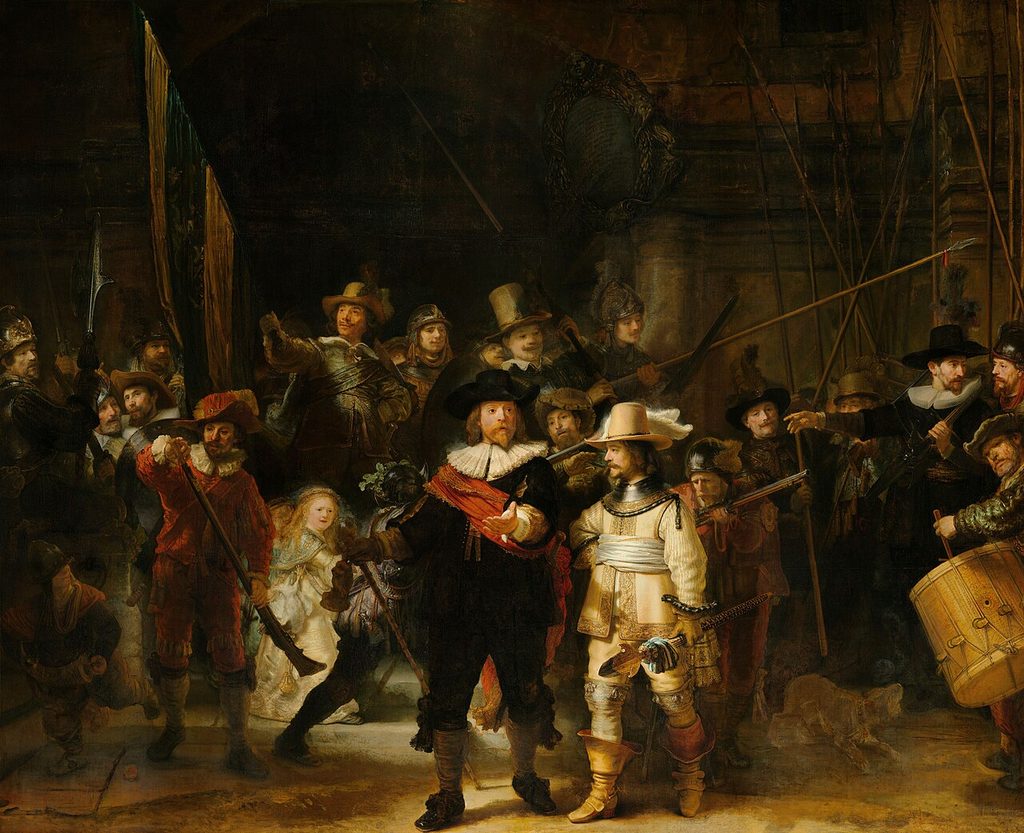
The Rijksmuseum gives the painting’s formal title as Militia Company of District II under the Command of Captain Frans Banninck Cocq. The civic guard commissioned the work for the Kloveniersdoelen, its headquarters, and Rembrandt completed it in 1642. [1]
The name The Night Watch appeared much later. According to the Rijksmuseum, the earliest known use of the title dates from a document of 1797. The name therefore reflects a later interpretation of the painting rather than Rembrandt’s original conception. [1]
The Painting Does Not Actually Depict a Night Scene
The painting’s dark appearance has long encouraged viewers to associate it with nighttime. Yet the Rijksmuseum offers a different explanation: the surface of the painting darkened over time.
Over the centuries, layers of varnish became increasingly dark and yellowed. As a result, viewers gradually came to perceive the scene as a nocturnal one. Modern conservation research, however, has allowed specialists to examine the painting in far greater detail and to reconsider what its original appearance may have been. [1]
2. Rembrandt Transformed the Traditional Group Portrait into a Scene of Action
Seventeenth-century portraits of civic guards often presented members of a company in relatively orderly arrangements. Rembrandt took a radically different approach, creating a composition filled with movement and interaction.
Captain Frans Banninck Cocq and Lieutenant Willem van Ruytenburch occupy the centre of the composition, while the other members of the company appear to move around them. A drummer stands out in the background. A musketeer handles his firearm, while a dog moves among the figures.
The result is far more than a conventional portrait of men posing for the viewer. Instead, the painting creates the impression of an event unfolding before our eyes. [1]
The original composition was also larger than the painting we see today. In 2021, the Rijksmuseum used a seventeenth-century copy by Gerrit Lundens to digitally reconstruct the missing portions. This allowed researchers to study the original composition in greater detail and to gain a clearer understanding of the way Rembrandt organised movement and space. [2]
3. Workers Cut Away Parts of the Painting’s Four Sides
One of the most surprising chapters in the physical history of The Night Watch concerns its dimensions.
In 1715, the painting was moved from the Kloveniersdoelen to Amsterdam’s Town Hall, the building that is now the Royal Palace on Dam Square. The painting was too large for its new location, so workers cut sections from all four sides in order to make it fit.
The largest section was removed from the left-hand side. [1]
None of the cut-off pieces has ever been recovered. As a result, the painting on display today does not contain the complete composition that Rembrandt originally created. [1]
How Did the Museum Reconstruct the Missing Sections?
This loss created an intriguing opportunity for modern art historians and conservators. The Rijksmuseum set out to reconstruct the missing portions using the seventeenth-century copy of The Night Watch by Gerrit Lundens.
Researchers combined historical documentation, digital imaging, and artificial intelligence to create a visual reconstruction of the missing sections. The result makes it possible to see the three figures that originally appeared on the left side of the composition but are no longer present on Rembrandt’s canvas. [2]
Importantly, the museum did not permanently add these reconstructed sections to the original painting. Instead, the reconstruction serves as a research tool, allowing specialists and visitors to better understand the composition as Rembrandt originally conceived it. [2]
4. The Night Watch Has Been Attacked Three Times
The painting has been the target of several deliberate attacks during the twentieth century.
In 1911, a man attacked the canvas with a knife. Later, on 14 September 1975, another attacker slashed the painting with a bread knife, leaving twelve cuts in the canvas. Conservation specialists subsequently repaired the damage. [3]
The most recent attack took place in 1990, when a man sprayed acid onto the painting. Fortunately, a security guard intervened quickly. The acid damaged only the varnish layer and did not penetrate the painted surface. [1]
Interestingly, conservation had already become an important issue before the 1975 attack. Research at the Rijksmuseum shows that specialists had been discussing the removal of deteriorating varnish as early as 1972–1973. The knife attack, however, made a much more extensive intervention unavoidable. [3]
5. The Museum Hid the Painting in a Cave During the Second World War
The wartime history of The Night Watch is equally remarkable.
When the Second World War began in 1939, the Rijksmuseum moved the painting, together with approximately 30,000 other works of art, to safer locations. The works were initially stored in shelters along the Dutch coast.
In 1942, The Night Watch was taken to the caves of St. Pietersberg in Maastricht. [1]
To protect the enormous canvas, the museum rolled it up. Museum officials continued to relocate important works to different secure locations as the war progressed.
After the war, the painting returned to Amsterdam. Rembrandt’s most famous work had thus survived not only centuries of environmental change and repeated physical interventions, but also the extraordinary dangers posed by a twentieth-century war. [1]
The Night Watch: More Than a Work of Art
The history of The Night Watch demonstrates that a masterpiece does not remain physically unchanged over time. Paintings acquire new historical layers through relocation, restoration, damage, and conservation.
In 2019, the Rijksmuseum launched Operation Night Watch, an extensive research and conservation project devoted to the painting. Scientists and conservators have worked together, employing advanced imaging techniques, microscopy, and technical analysis to investigate the work in unprecedented detail. [4]
As a result, The Night Watch is not merely a celebrated example of seventeenth-century Dutch art. It is also a subject of scientific investigation, a witness to wartime history, and a historical document that has been interpreted and reinterpreted for almost four centuries.
Its story is therefore inseparable from the story of its preservation. The painting we see today is not quite the painting Rembrandt completed in 1642—but a masterpiece carrying the visible and invisible traces of nearly four centuries of history.
References
- Rijksmuseum — “10 Things About Rembrandt’s Night Watch”
- Rijksmuseum — “For the First Time in 300 Years, The Night Watch Is Complete Again”
- Rijksmuseum — “How The Night Watch Survived a Knife Attack”
- Rijksmuseum — “Operation Night Watch”
Related reading
- Rembrandt’s The Anatomy Lesson of Dr. Nicolaes Tulp: Art, Science, and Human Mortality
- Picasso, African and Oceanian Art: Les Demoiselles d’Avignon in the Context of Colonialism
- Peter Paul Rubens and Classical Antiquity: Mythology, History, and Iconography
- Francisco Goya: From Court Painter to Chronicler of War and Violence
About the Author