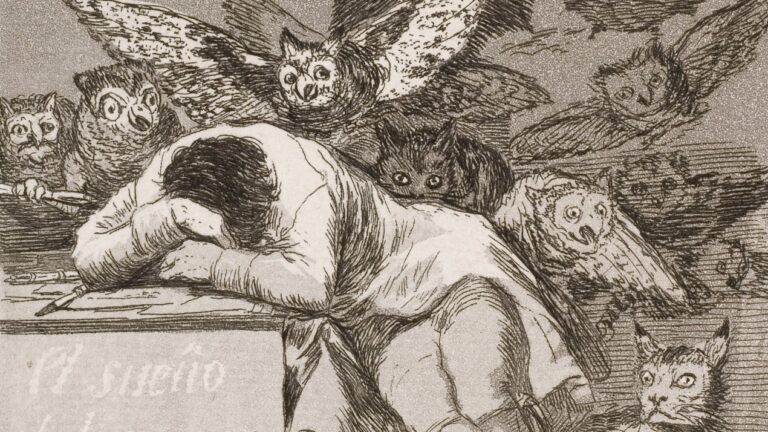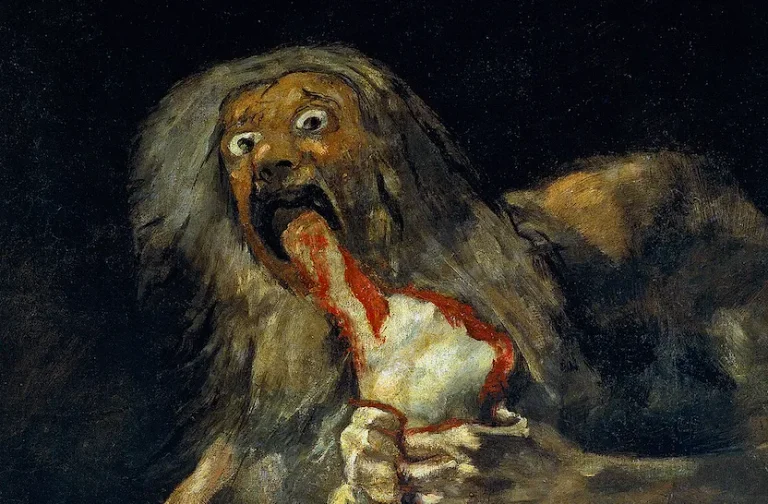
Francisco Goya (1746–1828) occupies a unique position in European art history. Today, audiences often associate him with disturbing images, violent scenes, grotesque figures, and the dark atmosphere of his later works. However, Goya did not begin his career with this visual language.
Instead, he developed his reputation within the Spanish royal court. He produced tapestry designs, portraits, and other works for aristocratic and royal patrons. Consequently, his artistic career connects two seemingly different worlds: the elegance of aristocratic culture and the brutal reality of war and violence.
This transformation makes Goya particularly important for understanding the transition from eighteenth-century court painting to modern approaches to social and political reality.
Goya’s Early Career in the Royal Environment
Goya established his career in Madrid through his work for the Royal Tapestry Factory. From 1775 onward, he created designs for tapestries intended for royal residences. These works often presented scenes of everyday life, leisure, festivals, games, and rural activities. (Ulusal Galeri)
Moreover, these early compositions reveal a very different Goya from the artist associated with the later Black Paintings. He used lighter colors, lively compositions, and subjects drawn from contemporary Spanish life.
Therefore, his early art demonstrates that Goya possessed a sophisticated understanding of decorative painting long before he developed his darker artistic language.
From Royal Painter to Court Painter
Goya’s position at court developed gradually. In 1786, he received an appointment as painter to King Charles III. After Charles III died in December 1788, Charles IV succeeded him. On April 25, 1789, Goya became a court painter under the new monarch. (Ulusal Galeri)
This distinction matters because Goya did not suddenly become a royal artist in 1789. Instead, he had already spent years developing relationships with the royal household and aristocratic patrons.
Furthermore, the Prado records that Goya received the position of Chamber Painter on April 30, 1789. His responsibilities included producing portraits of the new monarchs, Charles IV and María Luisa of Parma. (Prado Müzesi)
Goya and the Portrait of Charles IV
Goya’s 1789 portrait of Charles IV provides a clear example of his courtly responsibilities.
The painting presents the king in formal royal clothing. He wears the Order of the Golden Fleece and other insignia, while the royal crown rests beside him on a table. (Prado Müzesi)
These objects communicate royal authority through a carefully constructed visual vocabulary. Thus, Goya understood that a royal portrait needed to communicate not only the appearance of the monarch but also his institutional position.
At the same time, Goya retained an interest in individual physical appearance. This combination of official symbolism and observational realism became an important feature of his mature portraiture.
Aristocratic Patronage and Artistic Development
Goya’s relationship with the aristocracy extended beyond the royal family. The Prado notes that he developed important connections with aristocratic households during the 1780s and increasingly painted for leading members of Spanish society. (Prado Müzesi)
Consequently, portraiture became an important component of his artistic practice.
His aristocratic portraits did not merely record clothing and facial features. Instead, Goya used posture, expression, costume, gesture, and surrounding objects to communicate social identity.
For this reason, his portraits occupy an important position between traditional court representation and the more psychologically attentive portraiture of the nineteenth century.
The Elegance of Goya’s Early Court Art
Goya’s tapestry designs demonstrate another side of his relationship with aristocratic culture.
He frequently depicted fashionable people enjoying outdoor activities, dancing, playing games, eating, and socializing. These scenes presented an attractive vision of contemporary Spanish life. (Ulusal Galeri)
However, Goya did not simply reproduce an idealized aristocratic world. He also incorporated observations of ordinary people and popular culture.
In fact, this interest in everyday experience later became significant when Goya addressed social disorder, violence, and human suffering.
From Courtly Culture to a Darker Vision
The contrast between Goya’s early and later works should not lead us to imagine a complete break in his artistic development.
Instead, several concerns remained constant. Goya continued to observe human behavior, social relationships, power, and the tensions within Spanish society.
However, his historical circumstances changed dramatically. The French Revolution, political conflict, the Peninsular War, and the violence associated with the Napoleonic period transformed the environment in which he worked.
As a result, Goya increasingly abandoned the reassuring visual language of courtly decoration and explored fear, violence, irrationality, and suffering.
War Changed Goya’s Artistic Language
The Peninsular War (1808–1814) created a particularly important turning point.
Goya’s later works confront violence without presenting war simply as heroic military action. Instead, he focused on the experiences of victims, civilians, and individuals caught within violent political events.
His The Disasters of War series demonstrates this transformation particularly clearly. The images expose executions, hunger, mutilation, and brutality.
Thus, the artist who had once created elegant designs for royal residences became an acute observer of the destructive consequences of political and military conflict.
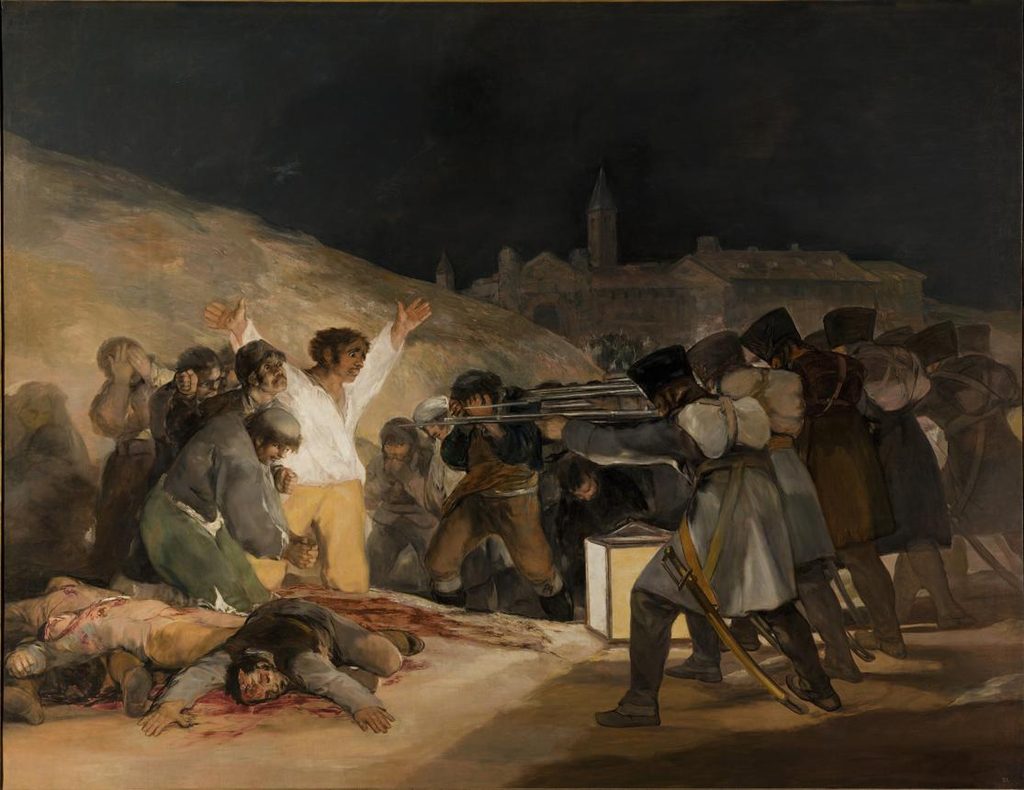
The Third of May 1808
Goya’s The Third of May 1808 represents perhaps the clearest expression of this transformation.
Instead of glorifying military victory, Goya presents an execution.
The French soldiers form a rigid firing squad, while the victims face them with fear and desperation. The central figure raises his arms, creating an emotionally powerful focal point.
Moreover, Goya removes individuality from the soldiers by showing their backs rather than their faces. Consequently, they appear less like individual heroes and more like components of an impersonal mechanism of violence.
The Meaning of Goya’s Transformation
Goya’s career demonstrates that artistic transformation can emerge from historical experience rather than from a simple rejection of earlier styles.
His early court paintings reveal technical sophistication, decorative elegance, and close observation. His later works employ many of those same skills for very different purposes.
Therefore, Goya did not abandon his earlier artistic abilities. Instead, he redirected them toward increasingly critical and psychologically complex subjects.
This development helps explain why Goya occupies such an important position between Old Master painting and modern art.
From Aristocratic Elegance to Human Reality
Goya’s artistic journey ultimately creates a remarkable contrast.
On one side, we find royal portraits, elegant clothing, aristocratic patrons, decorative tapestry designs, and scenes of leisure. On the other side, we encounter executions, war, irrationality, suffering, and the disturbing imagery of his later years.
Nevertheless, these two sides belong to the same artist.
Goya consistently examined the relationship between individuals and their social environment. First, he observed courtly society from within. Later, he confronted the consequences of political power and violence.
In this sense, his career reflects a broader transformation in European art: the movement from representing power toward questioning the human consequences of power.
Bibliography
- Museo Nacional del Prado. Francisco de Goya y Lucientes: Artist Biography and Works. Museo del Prado — Francisco de Goya (Prado Müzesi)
- National Gallery, London. Francisco de Goya (1746–1828). National Gallery — Francisco de Goya (Ulusal Galeri)
- Museo Nacional del Prado. Charles IV, Francisco de Goya y Lucientes, 1789. Museo del Prado — Charles IV(Prado Müzesi)
- The Metropolitan Museum of Art. Francisco de Goya (1746–1828) and the Spanish Enlightenment. The Metropolitan Museum of Art — Goya and the Spanish Enlightenment (The Metropolitan Museum of Art)
- National Gallery, London. Goya: The Portraits. National Gallery — Goya: The Portraits (Ulusal Galeri)
About the Author