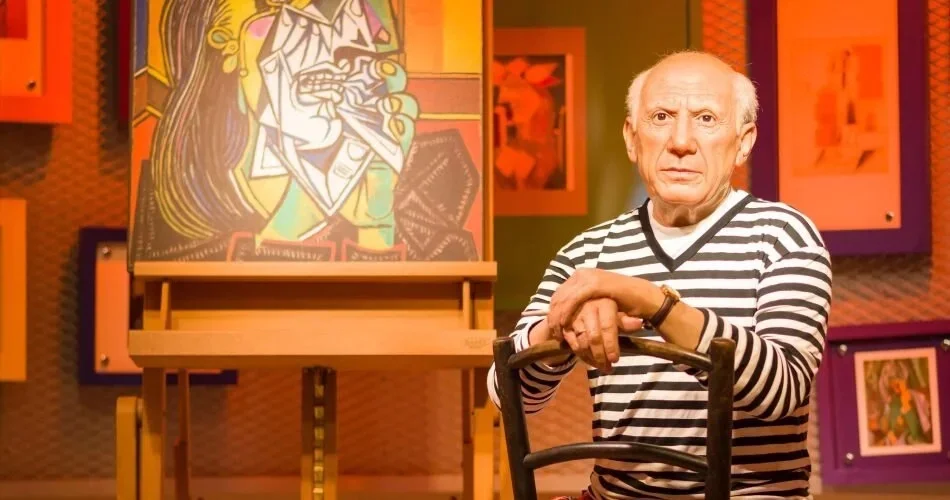
Pablo Picasso stands among the most influential figures in the history of modern art. Painted in 1907, Les Demoiselles d’Avignon represents one of the most radical turning points in Western painting. Yet Picasso did not work exclusively within the European artistic tradition. As he developed the painting, he drew upon a range of visual sources, including African and Oceanian art, Iberian sculpture, and other artistic traditions.
MoMA – Les Demoiselles d’Avignon
The influence of African and Oceanian art is particularly apparent in the two figures on the right-hand side of the composition. Their highly geometric faces resemble masks more than conventional human portraits. For decades, scholars have regarded these figures as an important indication of Picasso’s engagement with artistic traditions beyond Europe.
At the same time, Picasso’s relationship with African art must be understood within a complex historical context. European colonialism brought numerous objects from Africa and Oceania into Europe, where they entered French museums and private collections through colonial networks. Picasso’s artistic sources are therefore significant not only from an aesthetic perspective but also in relation to questions of cultural power, collecting, and appropriation.
Picasso and the Radical Transformation of Form
Picasso began working on Les Demoiselles d’Avignon during the winter of 1906–1907. Before arriving at the final composition, he produced hundreds of drawings and studies. These preparatory works make it clear that the painting did not emerge as a sudden artistic rupture. Rather, it was the outcome of an extended process of experimentation and investigation.
MoMA – Study for Les Demoiselles d’Avignon
The finished painting presents five female figures within a compressed and fragmented space. Picasso abandoned conventional perspective and replaced naturalistic anatomy with angular forms and intersecting planes. The figures consequently appear at once human and geometric, while their faces acquire an unmistakably mask-like quality.
MoMA – Les Demoiselles d’Avignon
This transformation marked a crucial stage in Picasso’s development. The radical restructuring of form would become one of the foundations for the Cubist visual language he later developed with Georges Braque. At the same time, the painting cannot be traced to a single artistic tradition; it brings together a remarkably diverse range of sources.
MoMA – Historical Significance
African Art and the Two Figures on the Right
The two figures on the right provide the most conspicuous link between Les Demoiselles d’Avignon and African art. Their eyes, noses, mouths, and facial structures depart sharply from conventional European modes of representation. The crouching figure in the lower right is particularly striking. Her asymmetrical eyes and sharply angular nose create a distinctly mask-like appearance.
MoMA – Les Demoiselles d’Avignon
MoMA identifies African and Oceanian sculpture among the artistic sources Picasso encountered while developing the painting. The museum also connects the stylised faces of the two figures on the right with nineteenth-century African and Oceanian masks.
Technical examination of the painting, moreover, reveals just how extensively Picasso reworked these figures. X-ray analysis has uncovered earlier versions beneath the final surface. The evidence suggests that Picasso did not simply reproduce a particular mask. Instead, he transformed visual characteristics through a prolonged process of experimentation.
MoMA – Technical Analysis
Oceanian Art and Picasso’s Visual Language
African art was not Picasso’s only non-European source during this period. Oceanian sculpture also contributed to the visual vocabulary he was exploring. Like African works, Oceanian objects offered forms that differed significantly from the conventions of European naturalism.
To understand the significance of Oceanian art, it is important to consider Picasso’s search for alternatives to conventional representation. Rather than simply reproducing the visible appearance of the human body, he became increasingly interested in abstraction, simplification, and deformation. In this context, Oceanian works provided important points of comparison as he searched for a new pictorial language.
MoMA – Les Demoiselles d’Avignon
At the same time, it would be misleading to describe these complex artistic traditions simply as “primitive art.” Such terminology reflects historical European classifications rather than the extraordinary diversity of African and Oceanian cultures themselves.
The Musée du Trocadéro and Picasso’s Encounter with Non-European Art
Picasso’s relationship with African and Oceanian art is also connected to the history of Parisian museums. MoMA notes that Picasso and his contemporaries encountered African and Oceanian objects in Parisian museums as well as in artists’ studios and other settings.
MoMA – Les Demoiselles d’Avignon
The Musée d’Ethnographie du Trocadéro was particularly significant in this context. Picasso visited the museum during the period in which he was developing Les Demoiselles d’Avignon. Later interpretations associated this encounter with the mask-like faces on the right-hand side of the painting.
Yet the precise chronology and extent of this influence remain matters of scholarly debate. Picasso himself gave contradictory accounts in later years concerning when he encountered African sculpture. Earlier scholarship therefore cannot provide a definitive answer. Nor is it possible to establish that a single museum visit determined the final appearance of the painting.
MoMA – Historical Significance
Colonialism and the Arrival of African Art in Europe
The history of Picasso’s artistic sources is complicated in part because of the way African objects entered French collections. European colonial expansion created networks through which objects from Africa and Oceania reached museums, galleries, dealers, and private collectors.
MoMA’s discussion of the sculptures associated with Les Demoiselles d’Avignon makes clear that African, Iberian, and Oceanian works entered French collections through colonial channels.
MoMA – Les Demoiselles d’Avignon
The story, therefore, is not simply one of Picasso discovering unfamiliar visual forms. European artists encountered these works within a system shaped by profound political and economic inequalities. In other words, the artistic encounter took place within the broader structure of European imperialism.
This historical context does not diminish the formal significance of African and Oceanian art in Picasso’s development. Rather, it allows historians to examine both dimensions of the relationship at once. On one side was the enormous impact these artistic traditions had on European modernism; on the other were the unequal historical circumstances under which European artists encountered them.
Artistic Influence or Cultural Appropriation?
Picasso’s relationship with African art raises a broader question: should his use of African forms be understood as artistic influence, cultural appropriation, or perhaps as both?
The answer depends in part on the theoretical framework being applied. From a formalist perspective, Picasso transformed facial structures and geometric forms, thereby challenging the conventions of European naturalism. A postcolonial approach, by contrast, draws attention to the power relations through which African objects circulated and were interpreted in Europe.
MoMA likewise approaches Les Demoiselles d’Avignon through questions of cultural difference and appropriation. The museum examines how Picasso drew upon both Western and non-Western sources and considers how contemporary viewers might interpret these forms of artistic borrowing today.
MoMA – Les Demoiselles d’Avignon
The painting consequently occupies an important place in the history of modernism. It demonstrates how European avant-garde artists transformed visual forms from outside Europe, while also revealing that these artists worked within a cultural system shaped by colonialism.
Picasso Did Not Simply Copy African Masks
It would be misleading to describe Les Demoiselles d’Avignon simply as a direct copy of African masks. Picasso drew upon a wide range of sources, including European painting, Iberian sculpture, African art, and Oceanian sculpture.
MoMA – Les Demoiselles d’Avignon
Moreover, the painting changed considerably during its development. Picasso altered the composition, removed some figures, reshaped faces, and experimented with different visual structures. X-ray examination has confirmed several stages of this transformation.
MoMA – Technical Analysis
African and Oceanian art was therefore part of a much broader network of visual references. Picasso did not simply reproduce these sources; he transformed them in accordance with his own artistic aims.
Why Does This Context Matter for Modern Art?
The significance of Les Demoiselles d’Avignon extends beyond its place in the history of Cubism. The painting reveals how modern European art developed through encounters with artistic traditions from different parts of the world.
It also challenges the notion that modern European art evolved in isolation. African and Oceanian objects entered Europe at a time when European colonial expansion was intensifying. These works subsequently became part of artistic debates and entered galleries, museums, and private collections.
Ultimately, Picasso’s relationship with African and Oceanian art reveals one of the central paradoxes of modernism. European artists turned to forms from outside Europe in order to challenge established conventions within European art. Yet they did so within systems of power created by European imperialism.
For this reason, Les Demoiselles d’Avignon is more than a revolutionary painting in the history of modern art. It also offers a window onto the complex relationship between cultural exchange, appropriation, colonialism, and modernity.
References
- Museum of Modern Art (MoMA), “Pablo Picasso. Les Demoiselles d’Avignon”, New York.
- Museum of Modern Art (MoMA), “Study for Les Demoiselles d’Avignon”, New York.
- Museum of Modern Art (MoMA), “Historical Significance: Les Demoiselles d’Avignon”.
- Museum of Modern Art (MoMA), “Technical Analysis: Les Demoiselles d’Avignon”.
- Musée Picasso Paris, “Picasso Biography and Chronology”.
About the Author