Francisco de Goya occupies a crucial position in the transition from eighteenth-century European painting to modern art. Although audiences first knew him for court portraits, religious commissions, and refined decorative works, his later career moved toward darker and increasingly private forms of artistic expression. Among these works, the Black Paintings (Pinturas negras) stand out for their disturbing imagery, restricted original setting, and uncertain meanings.
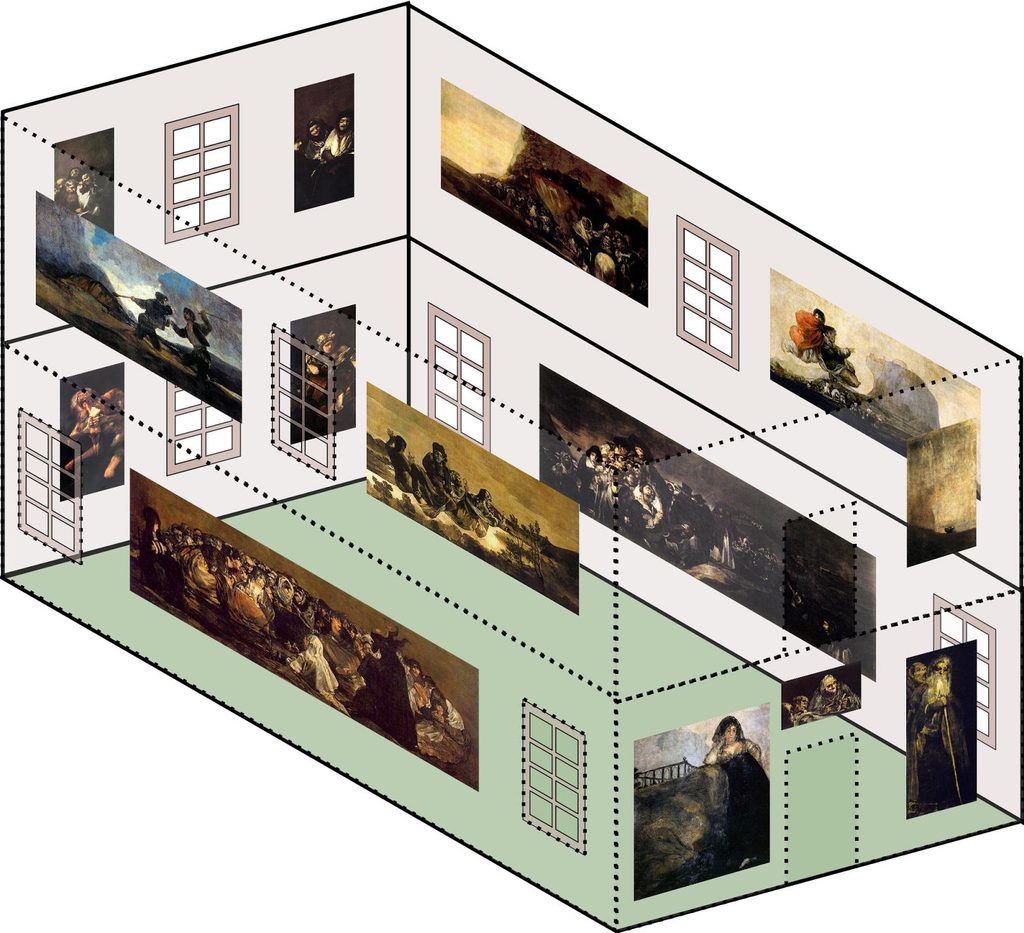
Goya created these paintings between approximately 1820 and 1823, during the final years of his residence in Spain. He painted them directly onto the walls of his country house near Madrid, known as the Quinta del Sordo, or “House of the Deaf Man.” The Metropolitan Museum of Art describes these works as a highly private group of frescoes with sinister and often horrifying scenes. (The Metropolitan Museum of Art)
What Were Goya’s Black Paintings?
The term Black Paintings refers to fourteen paintings that Goya created on the walls of the Quinta del Sordo.
The group includes some of his most disturbing images, such as Saturn Devouring His Son, Witches’ Sabbath, The Dog, Judith and Holofernes, and Fight with Cudgels. However, the name “Black Paintings” did not originate with Goya himself. Later scholars and art historians applied the term to the group.
Moreover, the paintings differ considerably in subject. Some depict mythological figures, while others show witches, violence, isolated individuals, or mysterious landscapes. Consequently, no single interpretation can fully explain the entire series.
The Quinta del Sordo: A Private Artistic Space
The location of the paintings provides one of their most fascinating characteristics.
Goya lived in the Quinta del Sordo, a country house outside Madrid. Between 1820 and 1823, he created a series of highly private frescoes there. The Metropolitan Museum specifically describes the works as “very private” and places their creation within Goya’s retreat from Madrid’s political and intellectual life. (The Metropolitan Museum of Art)
Therefore, Goya did not design the Black Paintings as a conventional public exhibition.
This distinction matters. A commissioned altarpiece or royal portrait addresses a public audience and usually follows recognizable conventions. By contrast, the Quinta del Sordo paintings occupied the walls of Goya’s own domestic environment.
As a result, the paintings invite a different kind of interpretation. They may reveal aspects of Goya’s personal concerns, fears, imagination, or reflections on human behavior.
Why Did Goya Paint Such Disturbing Images?
Historians cannot identify one definitive reason for Goya’s decision to create the Black Paintings.
Nevertheless, the historical context provides important clues. Goya created the works during a period of political instability and personal isolation. Spain had experienced the French invasion, the Peninsular War, political repression, and intense social conflict.
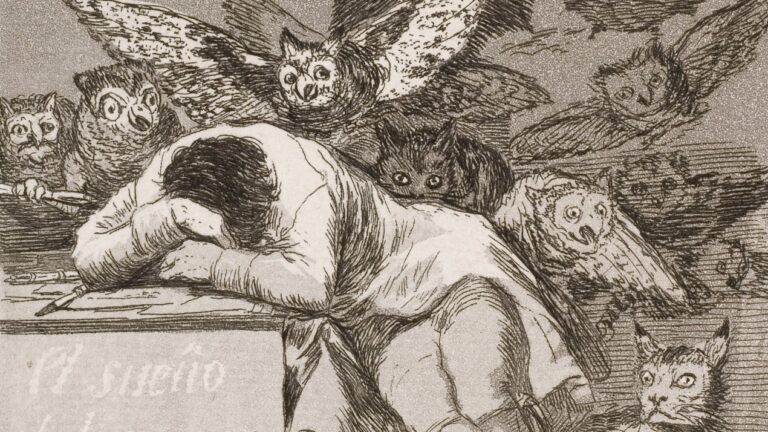
Furthermore, Goya had already explored irrationality, violence, superstition, and human cruelty in earlier works such as Los Caprichos and The Disasters of War.
The Black Paintings therefore did not appear suddenly. Instead, they extended concerns that Goya had explored throughout his mature career.
Goya’s Illness and Deafness
Goya’s personal history also provides an important context.
A severe illness in 1792–93 left him permanently deaf. The Metropolitan Museum notes that this illness led to his deafness and later influenced his social and artistic circumstances. (The Metropolitan Museum of Art)
However, we should avoid a simplistic explanation that connects deafness directly to the dark character of the Black Paintings.
Goya had already produced satirical, grotesque, and disturbing imagery before the Black Paintings. Therefore, deafness represents one element of his biography rather than a complete explanation for his later artistic transformation.
The Horror of Saturn Devouring His Son
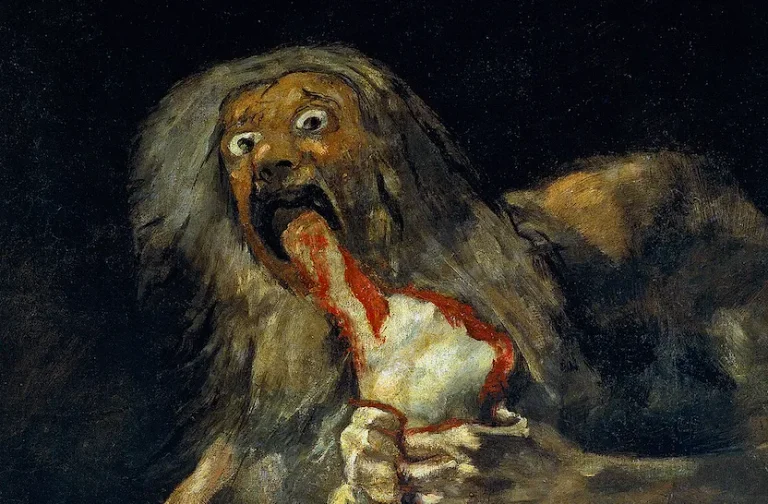
Among the fourteen paintings, Saturn Devouring His Son has become perhaps the most famous.
The painting depicts the mythological Saturn consuming one of his children. Goya presents the myth without the elegance and idealized beauty that characterized much earlier European treatments of classical mythology.
Instead, he emphasizes violence, fear, distorted anatomy, and psychological horror.
Consequently, the ancient myth becomes something much more immediate and disturbing.
Mythology Becomes Psychological Horror
The story of Saturn derives from classical mythology. According to the myth, Saturn fears that one of his children will overthrow him, so he consumes them.
Goya transforms this narrative into a terrifying image of uncontrolled violence.
The figure’s enormous eyes and open mouth intensify the sense of panic. Meanwhile, the dark background eliminates much of the surrounding narrative context.
Thus, Goya does not invite viewers to admire an ancient mythological scene. Instead, he confronts them with an image of fear and destruction.
Witches’ Sabbath and the Irrational
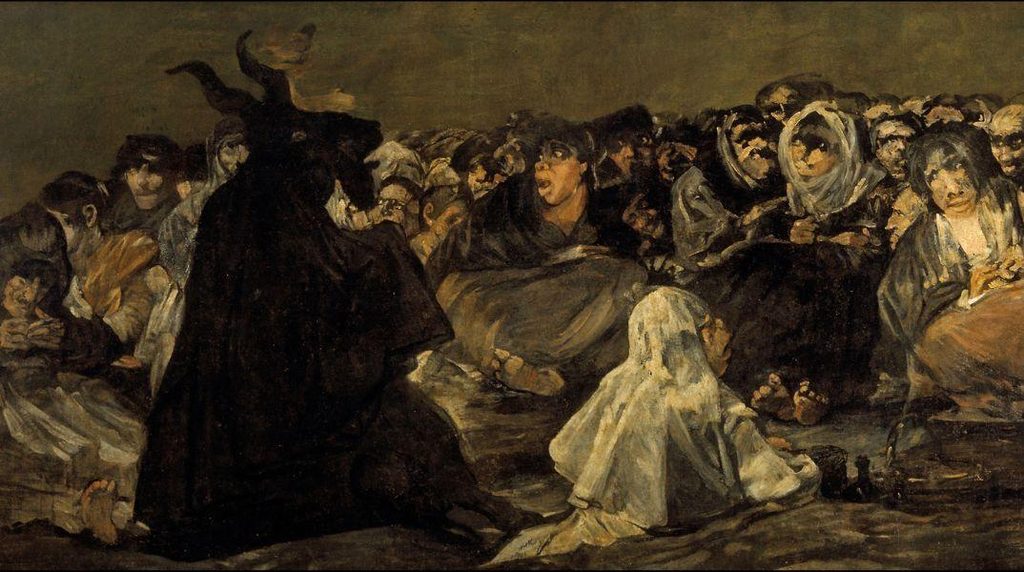
Another major Black Painting, Witches’ Sabbath, presents a gathering around a large goat-like figure.
The work connects with Goya’s earlier interest in superstition and irrational behavior. His graphic works repeatedly examined social beliefs and practices that he regarded critically.
However, the precise meaning of Witches’ Sabbath remains uncertain.
Rather than assigning a single definitive message, scholars can examine the painting through several related themes: superstition, collective fear, manipulation, irrationality, and social conformity.
In this sense, the image extends Goya’s broader interest in the darker dimensions of human behavior.
The Black Paintings and Political Anxiety
The political context also matters.
Goya created the Black Paintings during the Trienio Liberal, a period of political upheaval in Spain. The Metropolitan Museum connects the works with Goya’s isolation from political and intellectual life in Madrid and notes his dissatisfaction with political developments. (The Metropolitan Museum of Art)
Nevertheless, we should distinguish historical context from direct intention.
No surviving document definitively explains that Goya created each painting as a specific political allegory. Therefore, interpretations that connect particular figures to political events remain interpretations rather than established facts.
The Dog: An Image of Isolation
The Dog provides a striking contrast to the more violent images in the series.
The painting shows a dog’s head emerging from an apparently empty and expansive background.
The simplicity of the composition creates an unusual psychological effect. The animal seems small, vulnerable, and isolated within an enormous field of ochre and darkness.
Therefore, the painting does not require a dramatic narrative to produce unease.
Indeed, its ambiguity forms one of its most powerful qualities. Viewers cannot easily determine what lies beneath the dog or what situation surrounds it.
Why the Black Paintings Remain Difficult to Interpret
One reason for the continuing scholarly interest in the Black Paintings involves their lack of clear explanations.
Goya left no comprehensive written commentary explaining the fourteen works. Consequently, later scholars have developed different interpretations.
Some emphasize political conditions. Others focus on aging, mortality, illness, superstition, violence, or personal anxiety.
However, the paintings may not require a single interpretive key.
Their ambiguity allows several levels of meaning to coexist. In fact, that ambiguity may contribute significantly to their continuing power.
From Wall Paintings to Museum Objects
The Black Paintings did not remain permanently on the walls of the Quinta del Sordo.
After Goya’s death, the house changed ownership. In the nineteenth century, the paintings attracted increasing attention, and specialists eventually transferred the frescoes from the walls onto canvas.
The Prado Museum in Madrid now houses the fourteen works.
This transformation fundamentally changed their context. Originally, viewers encountered them as parts of a domestic environment. Today, museum visitors encounter them as individual works of art.
Therefore, the modern viewer experiences Goya’s paintings differently from the people who might have encountered them in the Quinta del Sordo.
The Black Paintings and Modern Art
Goya’s Black Paintings exerted a profound influence on later European art.
Their distorted figures, unusual compositions, violent imagery, and psychological intensity anticipated important developments in Romanticism, Symbolism, Expressionism, and modern art.
Furthermore, Goya demonstrated that painting could explore fear, irrationality, alienation, and psychological disturbance without following traditional standards of beauty.
His influence therefore extends beyond Spanish art.
The Black Paintings helped establish a conception of the artist as someone who could investigate the darker dimensions of human consciousness.
Were the Black Paintings Really “Private”?
The private nature of the paintings remains one of their most intriguing characteristics.
Goya created them in his own house rather than for a royal palace, church, or public institution. The Metropolitan Museum explicitly characterizes them as private works created at the Quinta del Sordo. (The Metropolitan Museum of Art)
However, “private” does not necessarily mean purely autobiographical.
Goya lived through enormous political and social changes. His earlier works demonstrate his sustained interest in superstition, violence, social hypocrisy, and irrational behavior.
Thus, the Black Paintings can simultaneously function as personal, social, psychological, and historical images.
Bibliography
- Metropolitan Museum of Art. “Francisco de Goya (1746–1828) and the Spanish Enlightenment.” The Metropolitan Museum of Art. Read the Met essay
- Metropolitan Museum of Art. Goya in The Metropolitan Museum of Art. New York: The Metropolitan Museum of Art. Read the Met publication
- Metropolitan Museum of Art. “Seated Giant.” The Metropolitan Museum of Art Collection. View the artwork record
- Wilson-Bareau, Juliet. Goya: Truth and Fantasy. London: Hayward Gallery, 1994.
- Hughes, Robert. Goya. New York: Alfred A. Knopf, 2003.
About the Author