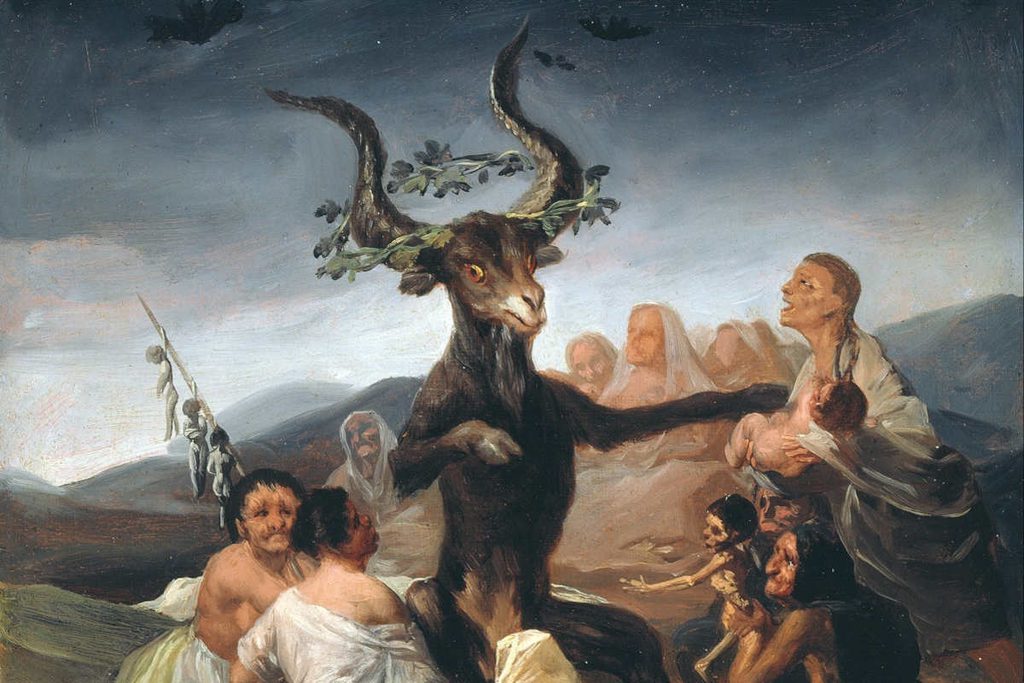
Francisco Goya’s Witches’ Sabbath, or The Great He-Goat (El Aquelarre / El Gran Cabrón) ranks among the most disturbing works of his late career. Goya created the painting between 1820 and 1823, when he lived in the house known as the Quinta del Sordo. The work belongs to the group that later became known as the Black Paintings. (Prado Müzesi)
At first glance, the painting presents a supernatural gathering. A large goat-like figure dominates one side of the composition, while a group of men and women gathers around him. However, Goya’s subject extends beyond witches, demons, and occult rituals.
Instead, the painting raises questions about superstition, collective behavior, fear, manipulation, and human irrationality. Therefore, Witches’ Sabbath deserves attention not merely as a frightening image but as a complex study of human behavior.
The Great He-Goat and the Black Paintings
Goya painted Witches’ Sabbath directly onto a wall of the Quinta del Sordo. The Prado Museum identifies the work as an oil mural transferred to canvas and dates it to 1820–1823. Later, Émile d’Erlanger acquired the house and commissioned the transfer of the murals to canvas in 1873. (Prado Müzesi)
The Black Paintings received their modern designation because Goya used extensive dark pigments and because the subjects often convey somber or disturbing themes. Moreover, the private setting of the house gave Goya unusual freedom to explore subjects that differed sharply from his earlier court commissions. (Prado Müzesi)
Consequently, Witches’ Sabbath represents an important stage in the transformation of Goya’s artistic language.
The Goat as a Supernatural Authority
The enormous goat occupies a dominant position within the scene. Goya gives the animal a powerful silhouette and places it before a tightly gathered group of figures.
The Prado identifies the goat as a representation of the devil and describes the surrounding figures as witches and warlocks participating in their Sabbath. (Prado Müzesi)
However, the goat does not function merely as a conventional monster. Its commanding position establishes a visual hierarchy. The surrounding figures look toward the central creature, creating a relationship between authority and submission.
Thus, the supernatural setting can also function as a metaphor for collective obedience.
A Crowd Governed by Fear
The human figures form a compact group around the goat. Their faces appear distorted, aged, and expressive, while their attention remains directed toward the central figure.
Furthermore, Goya does not individualize the crowd in the same way that he might portray a formal portrait sitter. Instead, he creates a psychologically charged collective.
This distinction matters. The painting does not simply ask who these people are. Rather, it encourages viewers to consider why individuals surrender their judgment to a collective belief system.
For this reason, the witches can represent more than practitioners of magic. They can also embody the vulnerability of people who accept irrational beliefs without critical examination.
Superstition and the Enlightenment
Goya lived during a period when Enlightenment ideas challenged superstition, ignorance, and unquestioned authority. His interest in irrational beliefs appeared throughout his career, particularly in works dealing with witches and supernatural creatures.
Indeed, Goya had already explored these subjects in earlier works. Around 1797–1798, for example, he created a series of paintings on witchcraft for the Duke and Duchess of Osuna. Scholars have interpreted these works in different ways, including as critiques of superstition and aspects of Spanish society. (FLVC Journals)
Therefore, the supernatural imagery in Goya’s art does not necessarily express a simple belief in the supernatural. Instead, it often creates a visual environment in which society’s fears and irrational tendencies become visible.
Irrationality as a Social Problem
The painting becomes especially significant when we examine its relationship to human behavior.
Goya presents a group that accepts an extraordinary figure as an object of collective attention. The participants do not appear to question the authority before them.
Consequently, the scene can suggest how fear and superstition influence groups. A community can create its own systems of belief, reinforce them through collective participation, and marginalize critical thought.
In this sense, Goya transforms the supernatural into a language for discussing human irrationality.
The Young Woman and the Problem of Interpretation
The right side of the original composition contained a young woman who appears different from the surrounding group. The Prado notes that she may represent a woman awaiting initiation into the witches’ rites. (Prado Müzesi)
This figure creates an important interpretive contrast.
The older figures already belong to the group, whereas the young woman appears to stand at the threshold of participation. Therefore, the scene may suggest a process through which individuals enter a collective system of belief.
However, we should avoid treating this interpretation as definitive. The painting has generated numerous interpretations, and the Prado itself emphasizes its continuing mystery and ambiguity. (Prado Müzesi)
Why Did Goya Choose a Goat?
The goat has attracted considerable scholarly attention.
Art historian Avigdor W. G. Posèq examined earlier interpretations of the goat and proposed a possible visual source in Athanasius Kircher’s Oedipus Aegyptiacus. His study also connects the image with broader themes of moral corruption within the Black Paintings. (bha-test.inist.fr)
Nevertheless, the precise meaning of the goat remains uncertain.
This uncertainty forms part of the painting’s power. Goya gives viewers a recognizable symbolic figure while withholding a single, definitive explanation.
Goya and the Grotesque
Another important feature of Witches’ Sabbath involves the treatment of the human face.
Goya exaggerates facial characteristics rather than presenting idealized beauty. The figures appear distorted, aged, and psychologically unsettling.
Moreover, this grotesque treatment connects the painting with other works from the Black Paintings. Goya repeatedly used distorted bodies and faces to explore fear, irrationality, violence, and human vulnerability.
Thus, the grotesque does not merely make the painting frightening. It transforms physical appearance into a visual expression of psychological disturbance.
The Painting Is Not Simply a Horror Scene
It would therefore be misleading to classify Witches’ Sabbath simply as a horror painting.
Goya does use frightening imagery. However, the painting also explores deeper questions:
- How does superstition influence human behavior?
- Why do people submit to collective authority?
- How does fear reinforce irrational beliefs?
- Can a crowd lose its individual judgment?
- How does society create and maintain systems of belief?
In fact, these questions help explain why the painting continues to attract scholars.
The Mystery of Goya’s Intention
One of the most important methodological points concerns Goya’s intentions.
We cannot confidently claim that the painting possesses one definitive meaning. The Prado describes the Black Paintings as mysterious and enigmatic despite the numerous explanations that art historians have proposed. (Prado Müzesi)
Therefore, interpretations should remain distinguishable from documented facts.
We know when Goya painted the work, where he painted it, and what appears in the composition. However, we cannot reconstruct his private intention with complete certainty.
This distinction allows a more rigorous art-historical reading.
From Supernatural Imagery to Modern Art
Witches’ Sabbath also occupies an important position in the history of modern art.
The Prado notes that the Black Paintings strongly influenced later artistic movements, including German Expressionism and Surrealism. (Prado Müzesi)
Furthermore, Goya’s willingness to abandon conventional beauty, stable composition, and heroic subject matter anticipated important developments in nineteenth- and twentieth-century art.
Consequently, the painting represents more than a late example of Spanish supernatural imagery. It also demonstrates how an artist could use distorted forms and psychological tension to investigate the darker dimensions of human experience.
Bibliography
- Museo Nacional del Prado. “Witches’ Sabbath, or the Great He-Goat.” Collection catalogue. Museo del Prado — Witches’ Sabbath
- Posèq, Avigdor W. G. “The Goat in Goya’s ‘Witches’ Sabbaths.’” Source: Notes in the History of Art, vol. 18, no. 4, 1999, pp. 30–39. University of Chicago Press — The Goat in Goya’s Witches’ Sabbaths
- Fernández-Salvador, Carmen. “The Witches of Goya.” Athanor. The article examines Goya’s recurring interest in witchcraft, superstition, and the social meanings of his witch paintings. (FLVC Journals)
- Heckes, Frank Irving. Supernatural Themes in the Art of Francisco de Goya. University of Michigan, 1985. The study examines the role of witches, demons, monsters, and other supernatural figures throughout Goya’s work. (openpublishing.psu.edu)
About the Author