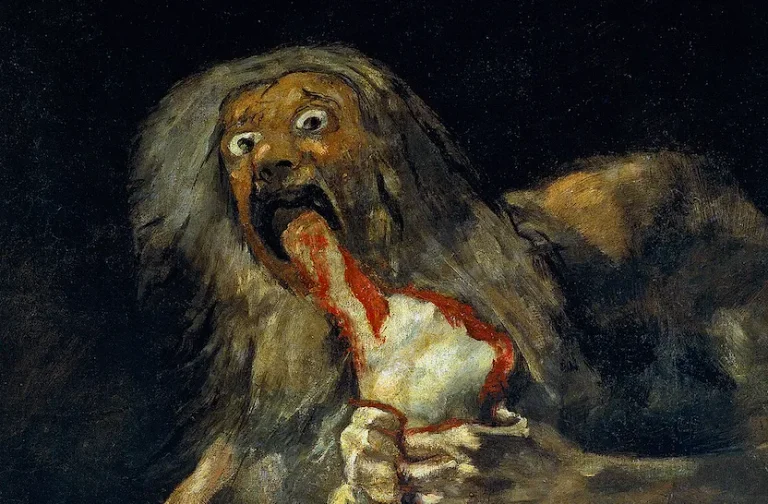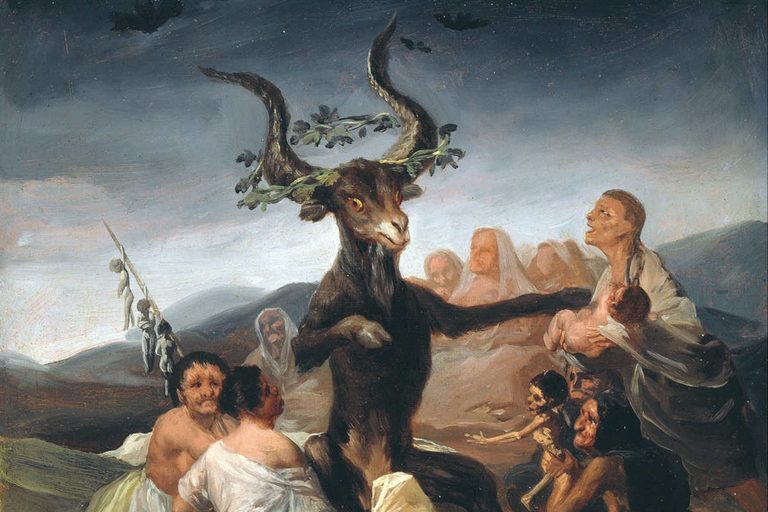
Francisco de Goya (1746–1828) occupies a crucial position in the history of European art because he transformed the way artists represented war. Although later generations often associate him with battlefield imagery, Goya did not simply celebrate military victories or heroic commanders. Instead, he examined violence, suffering, fear, hunger, displacement, and the destruction of ordinary life.
His print series The Disasters of War (Los desastres de la guerra) provides the clearest example of this approach. Goya created the series during and after the Peninsular War, which devastated Spain between 1808 and 1814. Rather than presenting war as an arena of glory, he directed attention toward its human consequences. (Prado Müzesi)
Goya and the Peninsular War
Goya remained in Madrid during the conflict between Spain and Napoleonic France. He also traveled to Zaragoza in 1808, where José de Palafox invited him to record the aftermath of the city’s first siege. Therefore, Goya encountered the consequences of war directly rather than treating the subject as distant historical material. (Prado Müzesi)
However, his position remained complicated. Goya continued to work as a court painter under Joseph Bonaparte and portrayed figures connected with the French-backed government. At the same time, he developed an increasingly critical artistic response to the violence and dehumanization that accompanied the conflict. (Prado Müzesi)
This contradiction makes his war imagery particularly significant. Goya did not simply adopt the propaganda of one political side. Instead, he concentrated on the consequences of violence for human beings.
What Are The Disasters of War?
Goya created The Disasters of War as a series of prints using techniques such as etching, drypoint, aquatint, and engraving. The individual plates depict executions, mutilated bodies, famine, sexual violence, displacement, and other consequences of war. (The Metropolitan Museum of Art)
The series contains 80 prints. Nevertheless, Goya did not publish the complete series during his lifetime. The first edition appeared in 1863, approximately 35 years after his death. (Metropolitan Museum of Art Resources)
This delayed publication matters because the series did not function as a conventional contemporary propaganda campaign. Instead, it became a sustained artistic investigation of violence.
Goya Rejected the Traditional Language of Heroism
Traditional history painting often presented warfare through generals, victorious armies, heroic gestures, and dramatic victories. Goya approached the subject differently.
Instead, he frequently placed anonymous victims at the center of his compositions. Consequently, the viewer encounters individuals rather than triumphant armies.
The Prado Museum describes Goya’s war imagery as a critical reflection on the causes, manifestations, and consequences of war. The museum also distinguishes his approach from contemporary patriotic representations that sought to glorify national struggle. (Prado Müzesi)
Thus, Goya shifted the focus from military glory to human suffering.
The Victims of War
Goya’s series repeatedly emphasizes civilians.
The Prado notes that many early prints in The Disasters of War portray civilians as innocent victims of soldiers’ violence, including scenes involving violence against women. (Prado Müzesi)
For example, several prints depict women confronting soldiers, while others show the consequences of sexual violence and physical brutality.
Moreover, Goya does not present these victims merely as symbols. He often gives them individual gestures, expressions, and physical forms. In this way, the viewer confronts the human cost of war at close range.
“And There Is No Help”
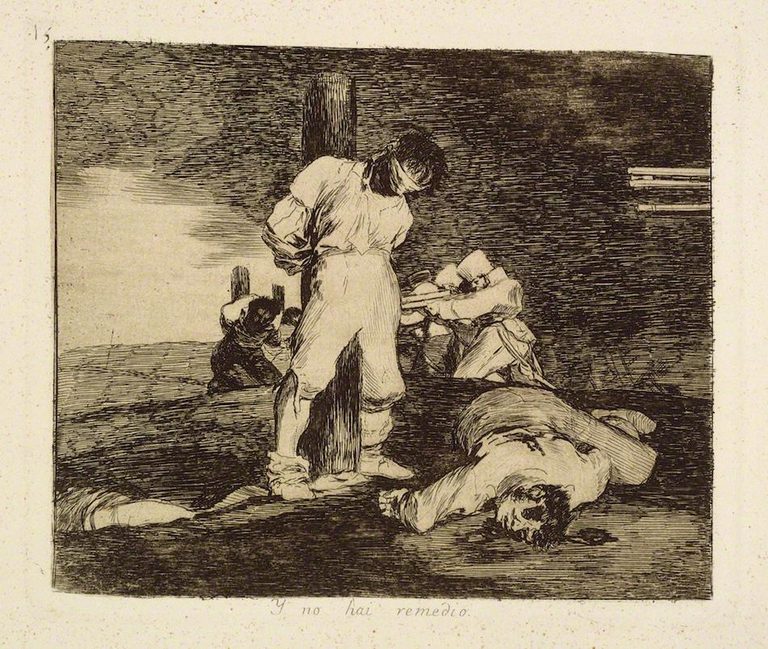
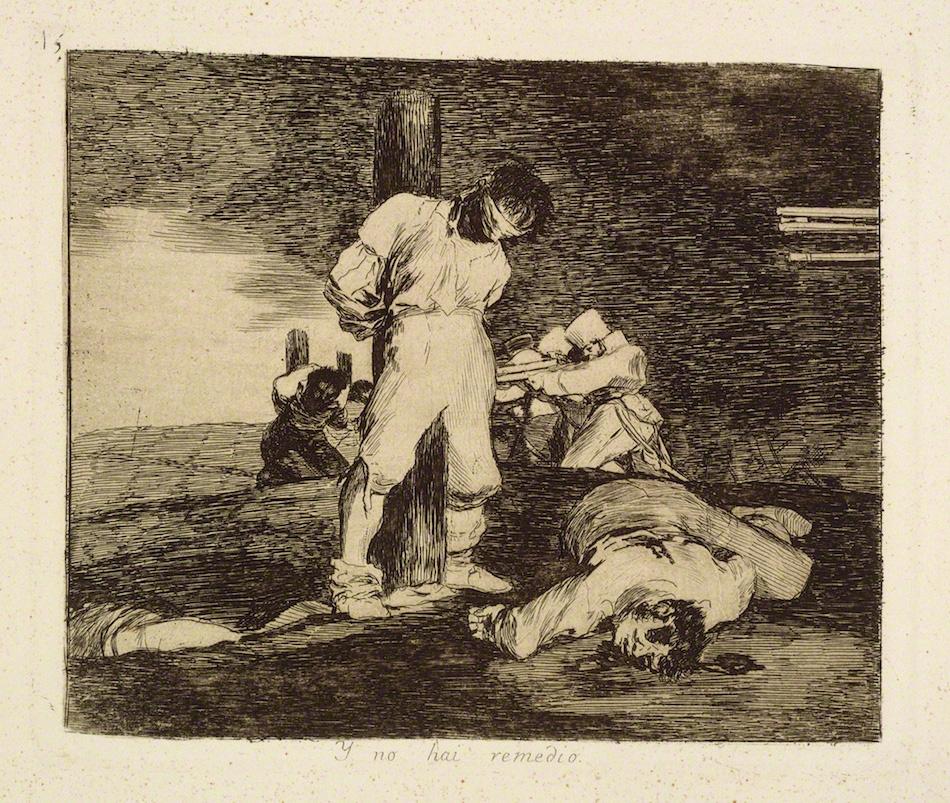
One of the most disturbing prints, “And there is no help” (Y no hai remedio), depicts a Spanish prisoner tied to a stake while French soldiers prepare to execute him.
The Metropolitan Museum of Art explains that Goya compresses several moments of the execution into a single image. The viewer sees the condemned man, the firing squad, and bodies lying in the foreground. (The Metropolitan Museum of Art)
Therefore, the composition does more than document an execution. It creates a visual experience of imminent death.
The rifles also contribute to the effect. Their repeated horizontal forms direct the viewer toward the prisoner and create an oppressive visual barrier.
“I Saw It”: Witnessing Violence
Another important print carries the title “I saw it” (Yo lo vi).
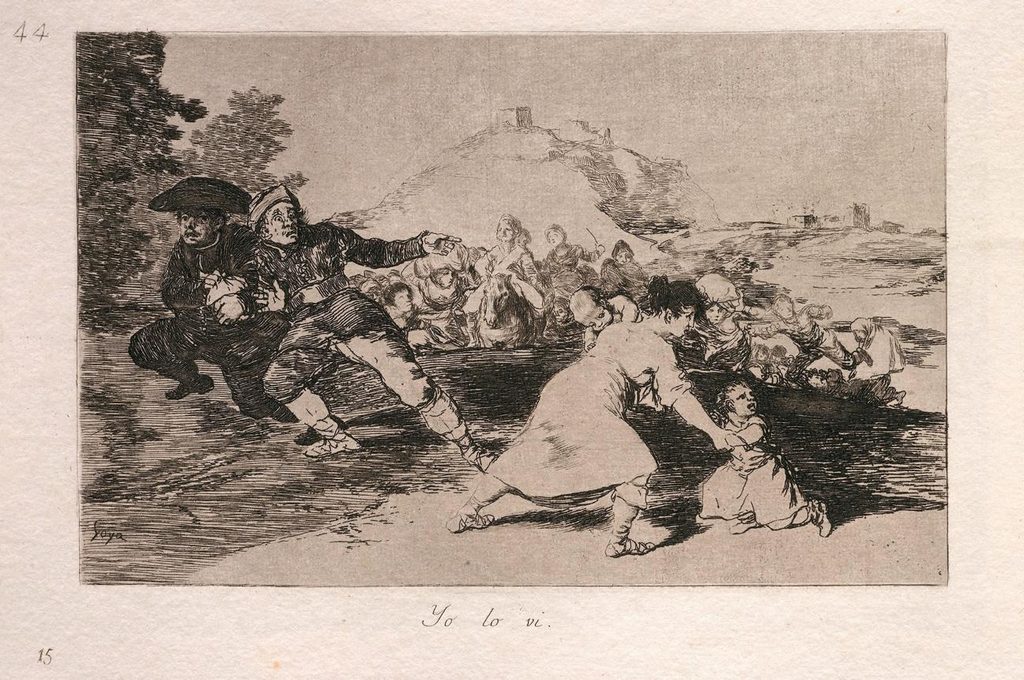
The Metropolitan Museum explains that the phrase “I saw it” may function as an assertion of authenticity. The print depicts people fleeing their town, an experience that many civilians faced during the French occupation. (The Metropolitan Museum of Art)
However, the phrase creates an important question about artistic truth. Did Goya literally witness every event that he depicted?
Probably not. Nevertheless, the statement establishes the position of the artist as a witness to historical violence, whether through direct observation, reports, or visual imagination.
War Also Produces Hunger
Goya did not limit the series to direct physical violence.
Several prints address the famine that struck Madrid during 1811–1812. The Metropolitan Museum identifies failed crops, abandoned fields, and disrupted food supplies as major factors in the crisis and notes that an estimated 15 percent of Madrid’s population died. (The Metropolitan Museum of Art)
This aspect of the series expands Goya’s concept of war.
War does not end when soldiers leave the battlefield. Instead, it can destroy food systems, disrupt communities, and transform everyday life into a struggle for survival.
Consequently, Goya presents hunger as another weapon-like consequence of war, even when no battlefield appears in the image.
“Ravages of War” and the Destruction of Ordinary Life
Plate 30, “Ravages of War” (Estragos de la guerra), presents another dimension of Goya’s approach.
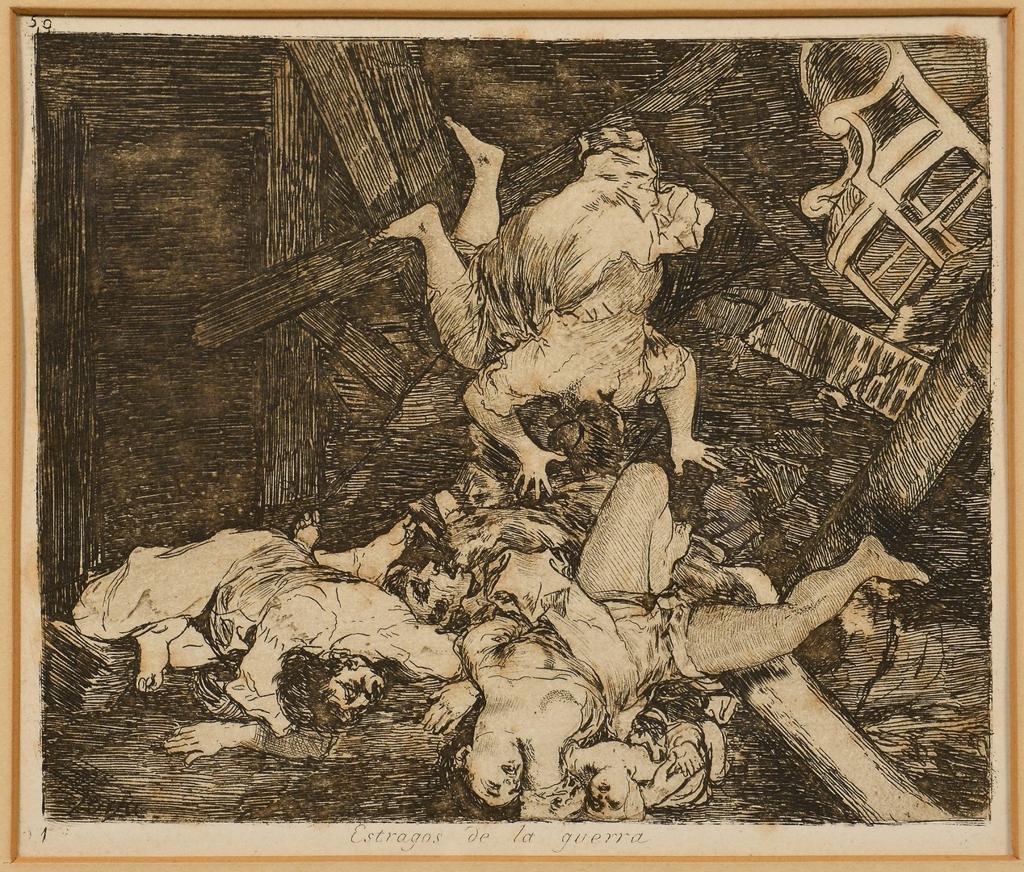
The image depicts the aftermath of an explosion inside a building. People fall through the destroyed structure, while ordinary domestic objects remain among the wreckage. (The Metropolitan Museum of Art)
The presence of furniture and everyday details makes the scene particularly powerful.
Rather than showing a distant battlefield, Goya brings destruction into the home. Thus, war becomes an intrusion into ordinary civilian existence.
Goya and the Question of Moral Responsibility
Goya’s prints repeatedly raise the question: Why do human beings inflict such violence on one another?
One print simply carries the title “Why?” (Por qué?). (The Metropolitan Museum of Art)
This brief question captures an important dimension of Goya’s art.
He does not provide a simple political explanation. Instead, he confronts the viewer with the apparent irrationality of violence.
For this reason, The Disasters of War can function as both historical testimony and moral inquiry.
Goya Was Not Simply a “War Reporter”
Art historians sometimes describe Goya as a “witness to history” or even as an early form of graphic reporter. However, the Prado cautions against reducing his historical scenes to straightforward documentary reporting. The museum emphasizes the complexity and inventive character of his representations. (Prado Müzesi)
This distinction matters.
Goya certainly drew upon contemporary events, but he also constructed compositions, selected viewpoints, manipulated light and shadow, and created titles that shape interpretation.
Therefore, The Disasters of War combines observation, memory, artistic invention, and moral reflection.
Why Goya’s War Art Became Modern
Goya’s treatment of war anticipates important developments in modern art.
First, he shifted attention from heroic individuals toward anonymous victims. Second, he represented violence without turning it into spectacle or celebration. Third, he explored psychological responses such as fear, despair, confusion, and helplessness.
Moreover, he treated civilians as central participants in the history of war.
This approach helped establish a visual tradition in which artists could examine political violence through the experiences of ordinary people.
From Historical Event to Universal Human Experience
Although The Disasters of War emerged from a specific historical conflict, its meaning extends beyond the Peninsular War.
Goya rarely identifies every victim or perpetrator by name. Instead, he often presents anonymous human figures.
As a result, the images can address a broader question: What happens to human beings when organized violence destroys ordinary moral boundaries?
In this sense, Goya transforms a particular war into a broader meditation on human cruelty.
Bibliography
- Museo Nacional del Prado. “Goya in Times of War.” Prado Museum. Prado Museum — Goya in Times of War
- Museo Nacional del Prado. “Francisco de Goya y Lucientes — Collection.” Prado Museum. Prado Museum — Goya Collection
- The Metropolitan Museum of Art. Goya: The Disasters of War. Collection and research materials. The Metropolitan Museum of Art — Goya
- The Metropolitan Museum of Art. Goya, Plate 15: “And there is no help.” The Metropolitan Museum of Art — “And there is no help”
- The Metropolitan Museum of Art. Goya, Plate 44: “I saw it.” The Metropolitan Museum of Art — “I saw it”
- The Metropolitan Museum of Art. Goya, Plate 30: “Ravages of War.” The Metropolitan Museum of Art — “Ravages of War”
- The Metropolitan Museum of Art. Goya, Plate 64: “Cartloads to the cemetery.” The Metropolitan Museum of Art — “Cartloads to the cemetery”
About the Author